Get AI Briefings, Transcripts & Alerts on Local & National Government Meetings — Forever.
Legislative Revenue Office outlines how Oregon's corporate activities tax is calculated and who it covers
Summary
Legislative Revenue Office analyst Michael Dowdy briefed the Senate Finance and Revenue Committee on the corporate activities tax (CAT): what counts as Oregon commercial activity, nexus tests, common exclusions and subtractions, the $1,000,000 filing threshold, and 2022 return patterns showing liability concentrated among large filers.
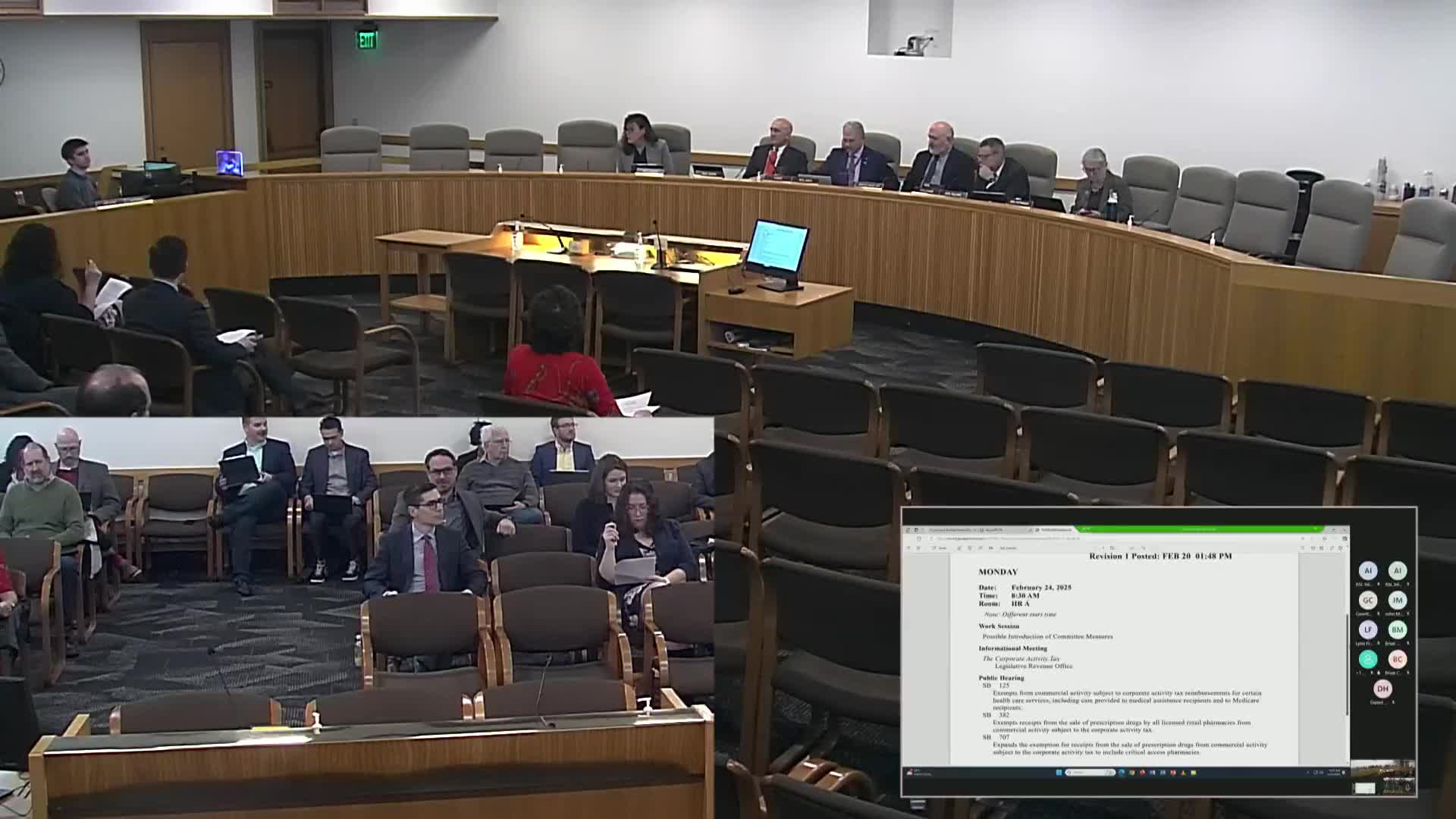
Chair Meek called the Senate Committee on Finance and Revenue's informational session on the corporate activities tax (CAT) to order and invited staff from the Legislative Revenue Office to present a policy-level overview.
Michael Dowdy, an analyst with the Legislative Revenue Office, told the committee the CAT is a tax on Oregon commercial activity and described how the tax is defined and calculated. He said commercial activity is the total amount realized from transactions and activities in the regular course of a person's trade or business "without deductions for expenses incurred by the trade or business." Dowdy emphasized that exports are excluded from Oregon commercial activity.
Dowdy summarized the statute's substantial-nexus tests that can subject nearly any business type to the CAT if they have sufficient ties to Oregon. Examples he listed that establish nexus include: owning or using capital in Oregon; a certificate from the Secretary of State authorizing the business to do business in Oregon; $50,000 in Oregon property or payroll; $750,000 in commercial activity in Oregon; 25% of property, payroll, or commercial activity in Oregon; or an Oregon headquarters. He said the statute specifically states that if a substantial nexus exists and a business is not constitutionally protected, the entity is subject to the CAT.
Dowdy said the CAT contains roughly 50 statutory exclusions that are either entity- or activity-based. Notable entity exclusions include nonprofit organizations, governmental entities, and hospitals and long-term care facilities subject to the medical provider tax. Activity exclusions he cited include motor vehicle fuel sales, wholesale and retail grocery sales, charitable contribution receipts, tax refunds, and restaurant tips passed through to employees.
He described two primary subtractions available on returns: either 35% of cost of goods sold (calculated generally as on a federal return) or 35% of labor cost (compensation excluding payroll taxes, with a $500,000 limit per employee and excluding independent contractor costs). He also noted a 15% exclusion for general contractors' subcontractor labor costs for single-family-residence construction.
Dowdy ran the committee through the CAT's calculation steps: start with Oregon commercial activity, remove statutory exclusions, subtract 35% of COGS or 35% of labor if claimed, apply the 15% subcontractor labor exclusion if applicable, exclude the first $1,000,000 of commercial activity (the filing threshold), and multiply the taxable commercial activity in excess of $1,000,000 by the 0.57% tax rate, then add $250 to compute liability. He noted an entity with $750,000 or more in Oregon commercial activity must register with the Department of Revenue and entities with more than $1,000,000 must file a return.
On returns and timing, Dowdy explained why available datasets lag: tax years vary by filer and some returns and extensions arrive many months after calendar-year filers. For tax year 2022, he said about 22% of returns arrived in April 2023 and roughly 92% had been received by December 2023; the data were not considered complete until October 2024.
Using 2022 returns, Dowdy said the dataset contained roughly 27,000 filed returns. He reported that retail trade had the most reported commercial activity and that six industries together accounted for about $886 million of liability (72% of total liability). He said the 35% cost-of-goods-sold subtraction was used on 58% of returns and represented 88% of the dollar value subtracted. Dowdy also showed that the fixed $250 component of the CAT accounted for about $5 million of liability, while amounts derived from the 0.57% rate accounted for about $1.2 billion (about 99.6% of total CAT liability). He highlighted concentration: businesses with more than $100 million in activity were only 1.7% of returns but comprised more than 50% of liability; filers with $25 million or more in activity represented about 7% of returns and roughly 75% of liability.
Dowdy concluded the overview by offering to take questions and by noting that timing of returns affects when a full-year analysis is feasible.
The presentation set context for the committee's subsequent public hearing on Senate Bill 125, which would create a targeted exclusion for certain public payer reimbursements.