Get Full Government Meeting Transcripts, Videos, & Alerts Forever!
Get email alerts on the Juvenile Justice topic
No spam. Unsubscribe anytime.
Judicial presentation flags rising juvenile delinquency, shortfalls in dependency timelines and expansion of ICWA courts
Summary
Oregon court leaders reported increasing juvenile delinquency filings, gaps between targets and actual timelines in dependency and termination cases, and expansion of state ICWA courts under a federal grant during a House Bill 5012 hearing.
Court officials told the Public Safety Subcommittee that juvenile delinquency filings have risen and that dependency and termination timelines are not meeting statutory or program targets.
The nut graf: Testimony from Nancy Kozine and program staff said juvenile delinquency has increased across felony, misdemeanor and violation categories; dependency cases have become more complex; and Oregon is expanding Indian Child Welfare Act (ICWA) courts with federal grant support.
Amy Miller and other presenters summarized juvenile metrics: dependency cases now average more hearings per case (rising from about 5.47 hearings in 2020 to over 7 in 2024), and the courts fall short of internal KPM targets for time to disposition. The department’s targets and current performance cited in testimony: jurisdictional findings within 90 days for dependency cases (target 98% — current performance 60%); delinquency cases resolved within 180 days (target 98% — current performance 81%); termination of parental rights decisions within 270 days (target 98% — current performance 79%).
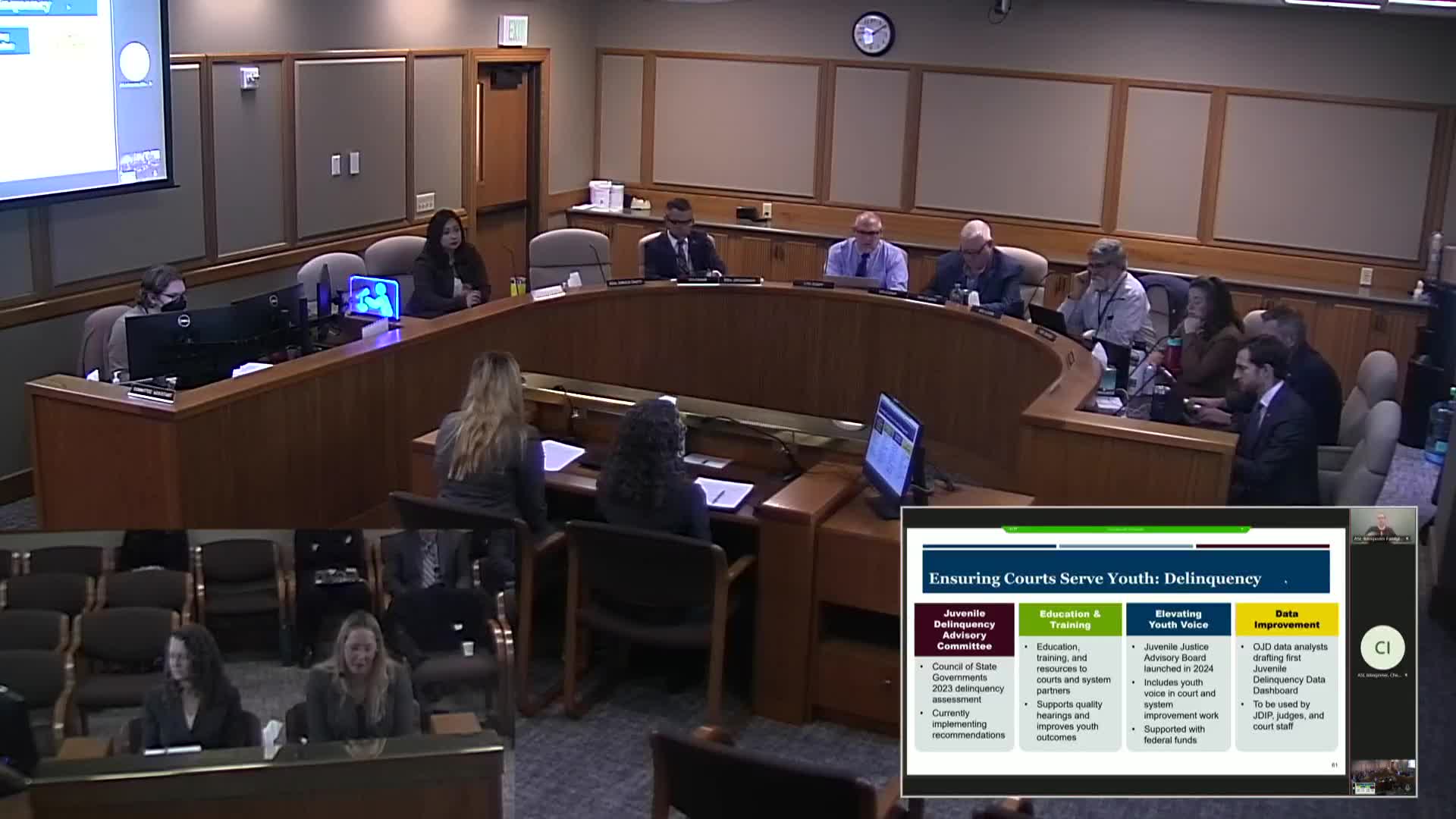
Miller described four initiatives for delinquency improvement, including a delinquency assessment with the Council of State Governments, expanded education and training, a juvenile justice advisory board (including youth voice) supported by a federal grant, and development of a juvenile delinquency data dashboard.
On tribal child welfare, presenters described expansion of ICWA‑specific courts. Miller said OJD began ICWA court work with a court in Klamath County and expects three ICWA courts soon; the presentation noted a five‑year federal grant supporting the expansion and a Marion County ICWA court celebration scheduled for March 6.
Ending: Presenters said improving juvenile outcomes will require training, data dashboards and resources; members asked whether judge training and tracked attendance are available, and staff said they can provide attendance records for many training programs and that judges are subject to Oregon State Bar continuing legal education requirements, though some trauma‑informed training is not uniformly tracked.