Get Full Government Meeting Transcripts, Videos, & Alerts Forever!
Get email alerts on the Family Law topic
No spam. Unsubscribe anytime.
Court leaders urge more facilitators, mediation and remote services to help self-represented family-law litigants
Summary
State court officials told the subcommittee that family law cases and protective order filings have risen since 2020, most family litigants are self‑represented, and expanded facilitators, mediation and remote dockets (including a child support remote docket) help access but demand outstrips capacity.
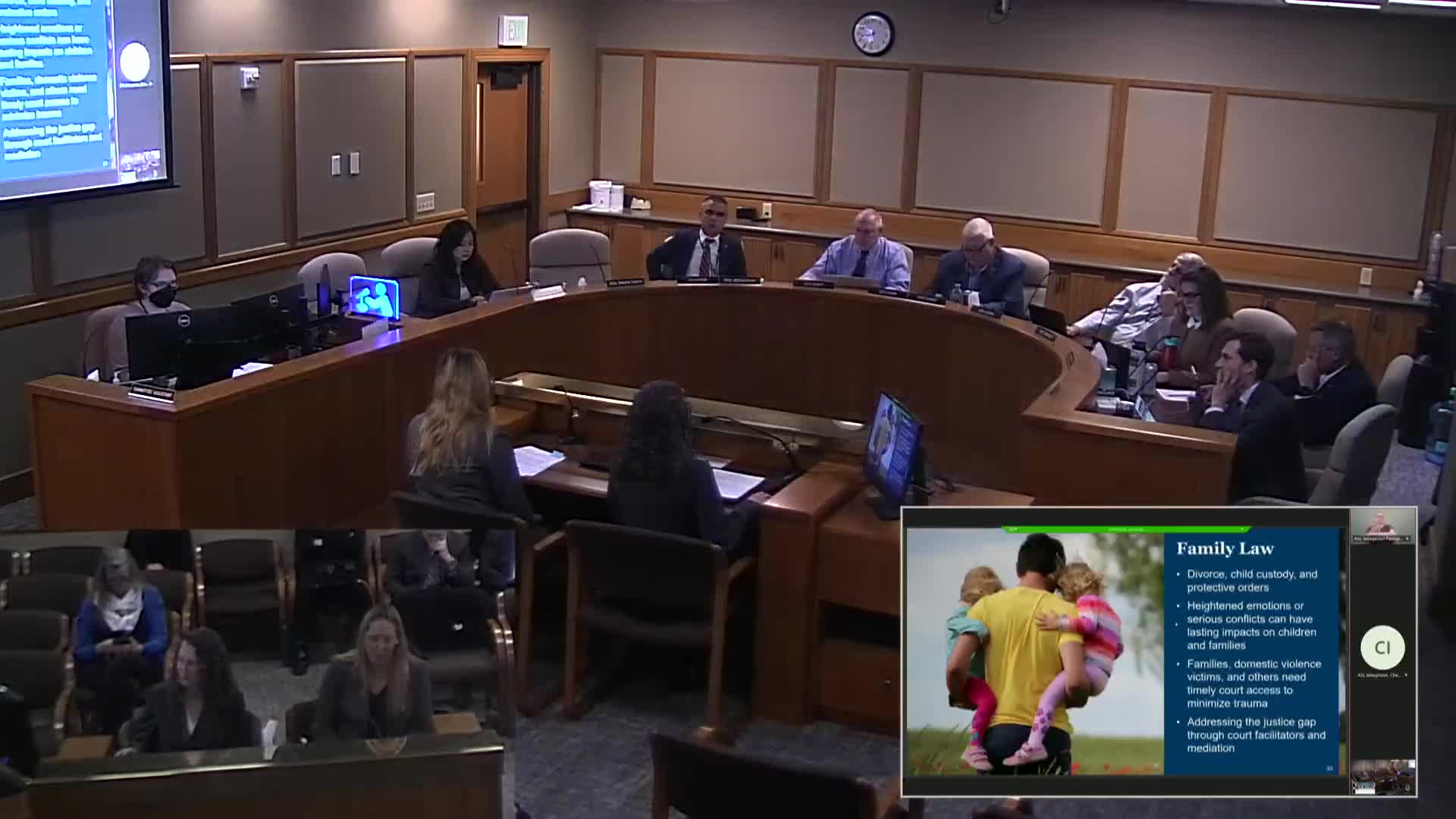
State court leaders told the Public Safety Subcommittee on Feb. 24 that most family law cases now involve at least one self‑represented litigant and that the courts lack capacity to meet demand for facilitators and mediation.
The nut graf: Nancy Kozine and Amy Miller said facilitation, mediation and a new child support remote docket demonstrably improve access and outcomes, but staffing and funding shortages leave many counties underserved.
Nancy Kozine, state court administrator, said family law filings have been "ticking up" and that "86% of family law cases involve at least 1 self represented litigant," a dynamic the courts seek to address through facilitation, translated materials and user-friendly electronic forms. Kozine described family law facilitators as non‑lawyer staff who "fill out forms" and "refer people to resources" but cannot provide legal advice.
Kozine said remote facilitation began in 2022 across 11 counties in southern and eastern Oregon and has been successful, but demand exceeds supply. She gave several county examples: Clackamas County (population approaching half a million) has only one in‑person facilitator; Union and Wallowa counties each have one facilitator who is cross‑trained to cover multiple duties. Kozine said Marion County had 1,557 people seek facilitator services in January and that the program’s capacity was insufficient to meet demand.
Amy Miller described a child support remote docket operating statewide by phone or video that aims to connect parents with employment services and leverage a federal match for services. Miller said the remote docket has a 75 percent compliance rate and higher appearance rates (about 85 percent) compared with traditional dockets (about 70 percent).
On protective orders, Miller said timeliness is sometimes "literally a matter of life and death," and that filings rose 19 percent from 2020 to 2024. She recommended additional resources for training, entry of orders into law enforcement databases and coordination with advocates and service providers.
Kozine and Miller also discussed mediation: state law requires each judicial district to provide a mediation orientation and certain custody cases require mediation where appropriate. They said mediation achieved a 52 percent resolution rate where parties attended; in judicial districts that offer landlord‑tenant mediation, settlement rates ranged from about 50 percent (Jackson County) to 90 percent (Deschutes County).
Ending: Subcommittee members asked for follow‑up data on facilitator staffing, training standards for nonjudicial consultants in custody cases and differences among types of protective orders; court staff agreed to provide additional details in subsequent briefings.