Get Full Government Meeting Transcripts, Videos, & Alerts Forever!
Get email alerts on the Judicial Budget topic
No spam. Unsubscribe anytime.
Judicial branch urges full funding in informational hearing on House Bill 5012
Summary
Chief Justice Megan Flynn and state court leaders presented the Oregon Judicial Department's structure, workload and a Chief Justice–recommended budget of $1.2 billion during an informational hearing on House Bill 5012, stressing growing caseloads, facilities needs and the human impacts of court delays.
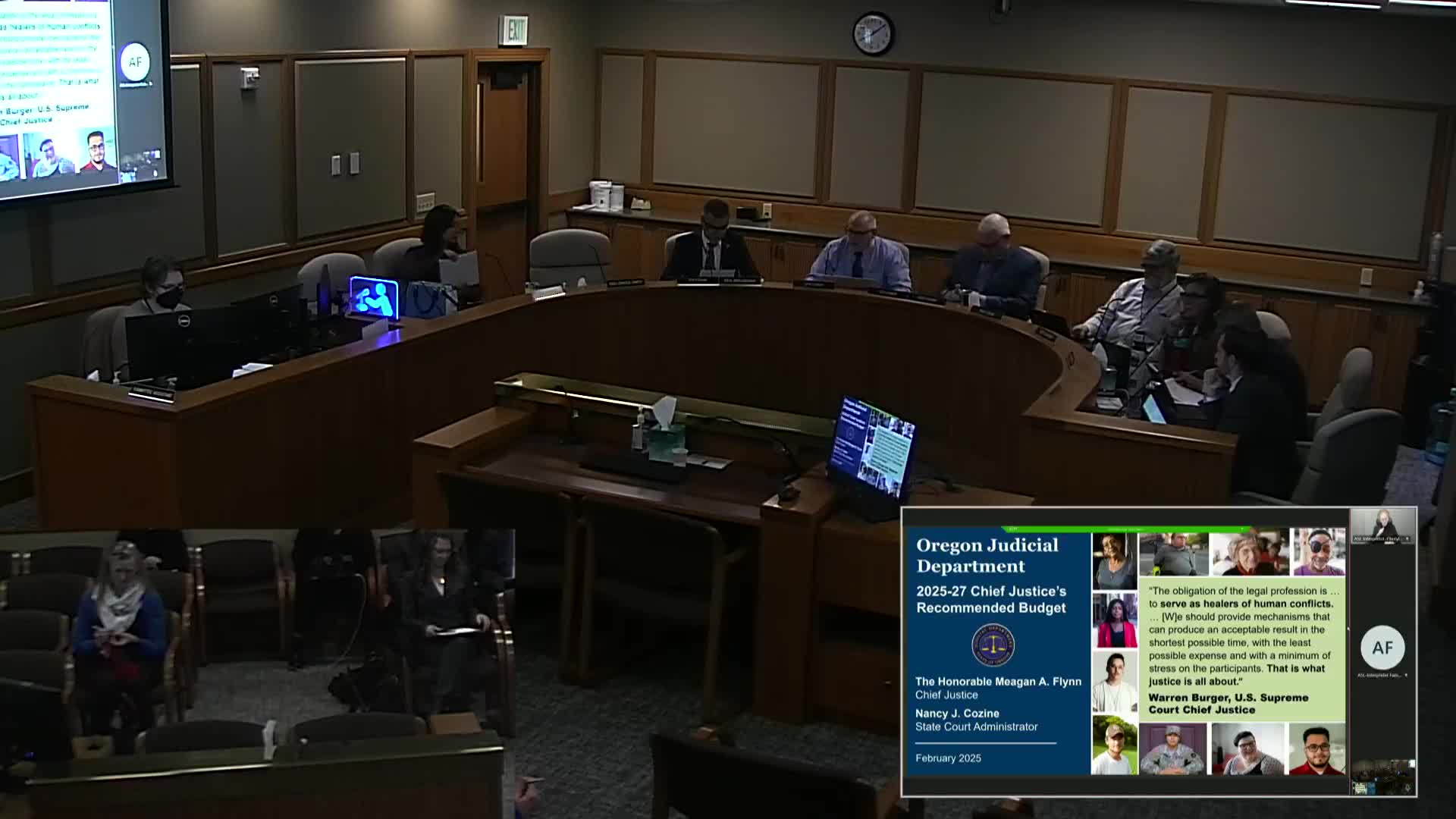
Chief Justice Megan Flynn, administrative head of the Oregon Judicial Department, told the Public Safety Subcommittee on Feb. 24 that the branch’s recommended budget is designed "to meet the needs of Oregonians and improve their experiences in our justice system." The presentation was part of an informational hearing on House Bill 5012, the primary budget measure for the Judicial Department.
The nut graf: Flynn, state court administrator Nancy Kozine and program staff outlined the scale of the unified court system and asked lawmakers to sustain recent investments, arguing continued funding is needed to handle rising filings, maintain access to justice and address aging courthouses.
Mr. Borden opened the overview with budget figures for the department’s current service level and alternative proposals. He said the department’s current service level budget totals $895,200,000 in total funds, including $845,500,000 general fund, $47,900,000 other funds and $1,700,000 federal funds and about 2,132 positions (2,085.42 FTE). He said the governor’s placeholder for the department is roughly $1.1 billion in total funds with $843,800,000 general fund, and that the Chief Justice’s recommended budget totals $1.2 billion in total funds, including $978,800,000 general fund, $243,900,000 other funds and $5,400,000 federal funds and about 2,380 positions (2,299.22 FTE).
Flynn described the Oregon Judicial Department (OJD) as the core of the judicial branch and emphasized that it is a constitutionally separate branch of government. "A well functioning court system is fundamental to democracy," she said, adding that courts must be "timely, cost effective, sensitive to impacts on people and communities, and most importantly, just." She summarized the Justice Campaign, OJD’s strategic framework that prioritizes access, user experience, safety of facilities, technology, and workforce culture.
Nancy Kozine, state court administrator, described the Office of the State Court Administrator as the operational backbone that provides human resources, budget and finance, information technology, security and programmatic support across Oregon’s 27 judicial districts. Kozine emphasized the shared-responsibility model whereby the state provides funding for personnel and technology while counties generally provide facilities and courthouse security.
Both Flynn and Kozine highlighted statewide operational pressures: about 585,000 filings annually across the unified court system; facilities that date back many decades in multiple counties; and growing pressures from several case types, including landlord-tenant filings, protective orders and juvenile delinquency. Kozine stressed that counties and the state must continue to collaborate to modernize courthouses, noting examples such as Lincoln County (built 1954) and Polk County (built 1899) that lack modern security, accessibility and HVAC systems.
The hearing was framed as the first of multiple presentation days on HB 5012. Flynn and Kozine said they would return for additional briefings and public testimony later in the week.
Ending: The subcommittee recessed after members thanked the presenters and closed the informational hearing; the department will return for day two to continue detailed briefings on proposals within House Bill 5012.