Get Full Government Meeting Transcripts, Videos, & Alerts Forever!
Get email alerts on the Public Records Sensitive Images topic
No spam. Unsubscribe anytime.
House Judiciary Committee votes to advance bill exempting ‘sensitive images’ from public records
Summary
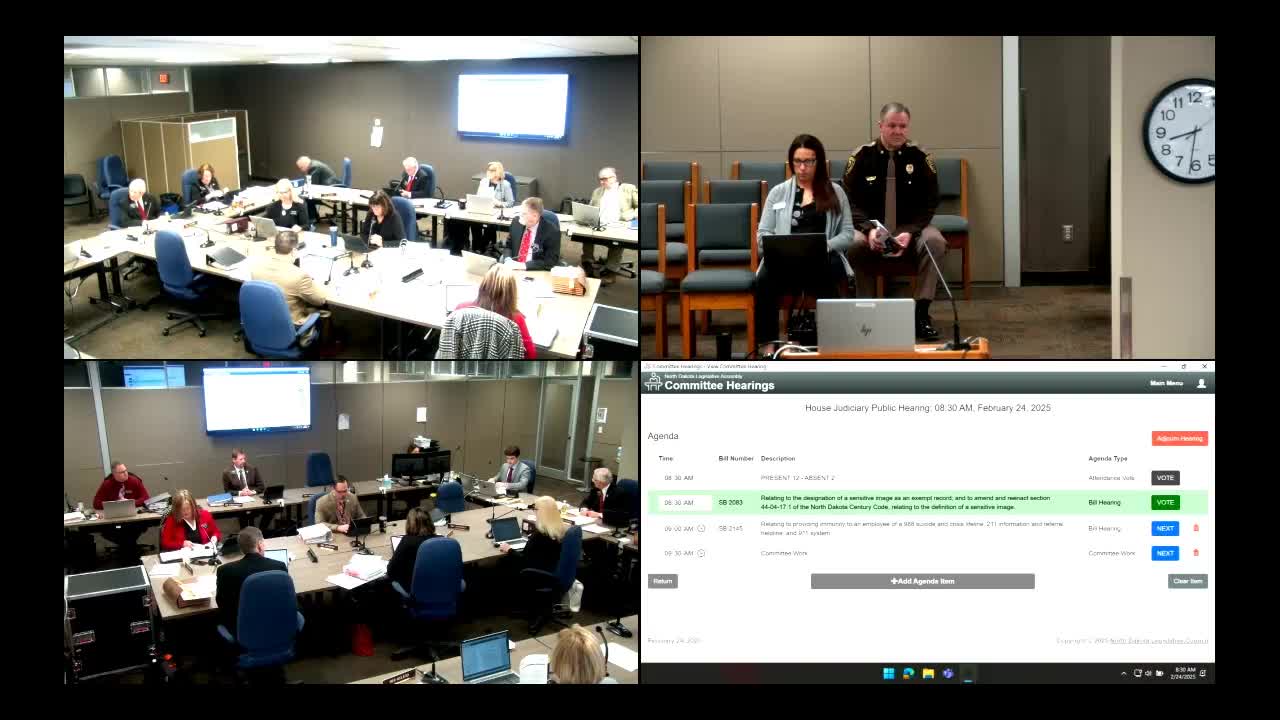
The House Judiciary Committee voted 12-0 (2 absent) to give a do-pass recommendation to Senate Bill 2083, which would add a statutory definition of “sensitive image” and make those records exempt from North Dakota open records laws while preserving agencies’ discretion to release them.
BISMARCK — The House Judiciary Committee on Tuesday voted to give a do-pass recommendation to Senate Bill 2083, a measure that would add a statutory definition of “sensitive image” to the North Dakota open records law and make those images exempt from public disclosure unless other law provides otherwise.
Senate Bill 2083 was presented to the panel by Aaron Hummel, chief of staff for the North Dakota Highway Patrol, who said the patrol asked for the change to close “holes” in the Century Code that left gruesome images and images of minors in crashes exposed to public records requests. “I’m here to provide testimony in support of Senate bill 2,083,” Hummel told the committee. He described the amendment that defines a sensitive image as “an image depicting an exposed intimate part, gruesome injury, deceased individual, or a minor,” and explained the intent: “Making these records exempt does not prohibit the release, but it does allow entities to develop policy as to who the records may be released to.”
The North Dakota Association for Justice, represented by executive director Jackie Hall, said the bill’s amended language addressed earlier concerns about overly broad exemptions. “Under chapter 12, images such as a broken leg, fainting, and other minor injuries would have been exempt,” Hall said of the original draft; she said the amended language replacing that approach with an exemption for “gruesome images” made the measure acceptable to her organization.
Committee members asked whether agencies would be able to release exempt images to parties who need them, such as family members or attorneys; Hummel replied that agencies — including the Highway Patrol — intend to craft policies allowing release to those with a legitimate need, including insurers and crash participants’ representatives.
When the committee turned to action, Representative Olson moved a do-pass recommendation and Representative McLeod seconded. The clerk recorded a roll-call vote; the motion carried 12 to 0 with two members absent. The committee named a bill carrier for the House as it prepares to move the measure forward.
Supporters said the change is intended to protect victims and minors and to give law enforcement and other agencies consistent authority to limit disclosure while still permitting release when appropriate. The bill would add a definition to section 44-04-17.1 of the North Dakota Century Code and add a new subsection to 44-04-18.7 to treat a defined sensitive image as an exempt record.
The committee closed the hearing after receiving no in-person opposition and moved the bill forward with the committee’s recommendation.
Votes at a glance: The committee recorded a 12-0 roll-call in favor of a do-pass recommendation on Senate Bill 2083; two members were absent and not voting.