Get Full Government Meeting Transcripts, Videos, & Alerts Forever!
Get email alerts on the Nominations topic
No spam. Unsubscribe anytime.
Senate Nominations Committee hears nominees for courts, agencies; public raises concerns about Texas Supreme Court concurrence
Summary
The Senate Nominations Committee heard introductions and questioning for eight nominees to state courts and agencies, discussed logistics for newly created Texas Business Court divisions and water and veterans programs, and received public testimony critical of a recent Texas Supreme Court concurrence on discrimination law.
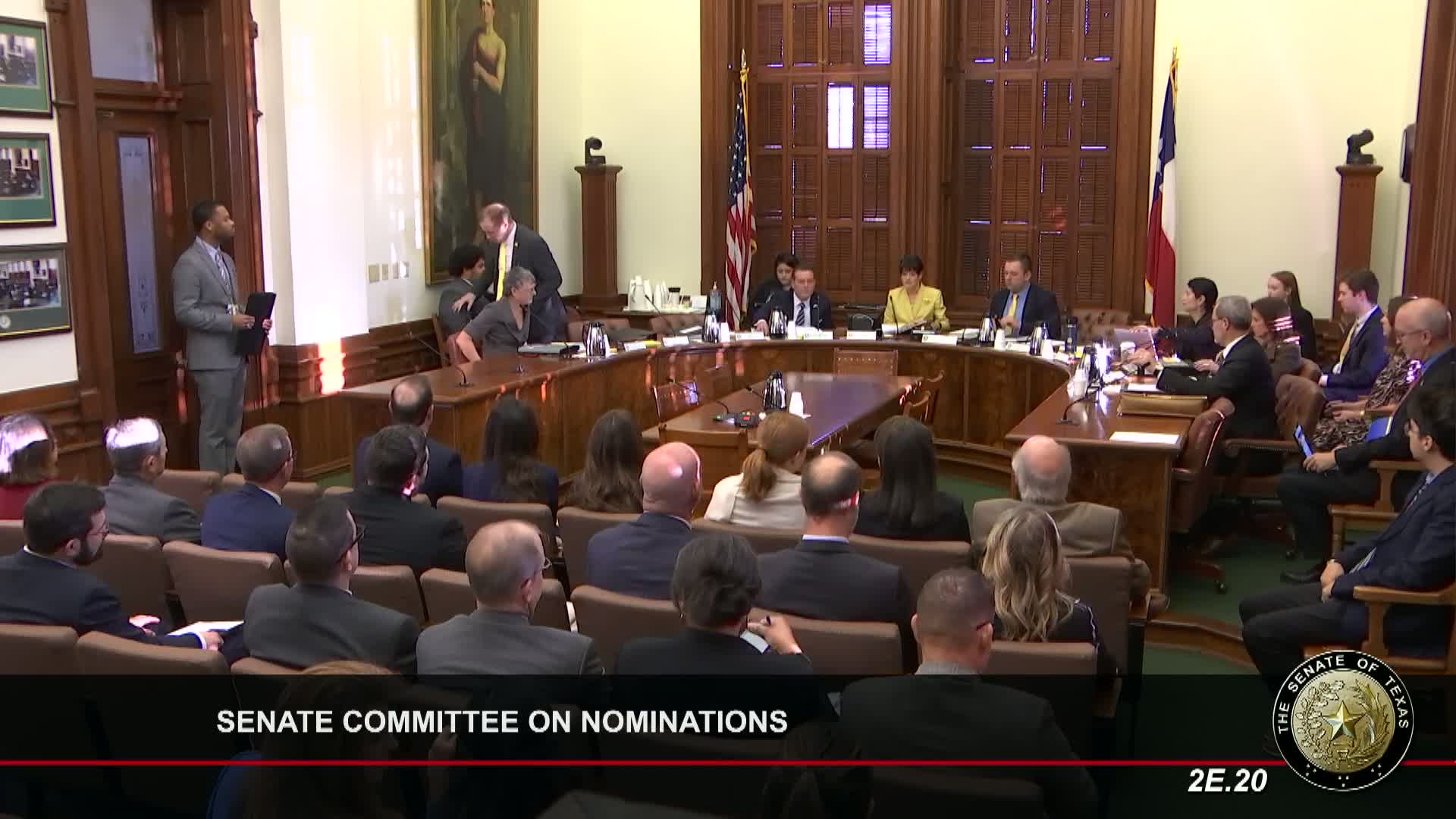
The Senate Nominations Committee convened with a quorum and opened consideration of eight nominees for judicial and executive positions, heard questions about court administration and new business-court logistics, and took public testimony raising concerns about a recent Texas Supreme Court concurrence that critics say would narrow how discrimination claims reach juries.
Committee Chairwoman Campbell said the committee had six members present and asked for adoption of proposed rules; Senator César Alvarado moved to adopt them. The committee specifically announced it would not take votes on nominees at today’s meeting.
The hearing included introductions and brief statements from nominees: a candidate for chief justice of the Texas Supreme Court, Justice Blacklock; Chief Justice Scott Brister, nominated to lead the newly created 15th Court of Appeals; judges nominated to divisions of the Texas Business Court including Grant Dorfman and Maria Lynn Barnard; reappointments and nominees for executive boards including David Eiler for the School Land Board and Laura Kerner to chair the Texas Veterans Commission; and gubernatorial appointees to the Texas Water Development Board and the Texas Workforce Commission, Tanya Miller and Joe Esparza, respectively.
Committee members questioned nominees on their records and on administrative topics. Justice Blacklock, who has served on the Texas Supreme Court since 2018, told senators the court’s duty is to “bring consistency and predictability and accuracy to the law” and said, “Our job is not to see that this side or that side wins the case … Our job is to see that the law wins the case.” Senators pressed him on how he approaches statutory interpretation, precedent and separation of powers; Blacklock described a textualist approach and said constitutional change should occur through the amendment process rather than judicial re‑interpretation.
Several senators focused on court administration and accountability. Senators asked about the Office of Court Administration (OCA), the court’s data collection work passed by the Legislature, and methods to measure judicial performance without overreliance on blunt statistical metrics. Chief Justice Brister and other judicial nominees described plans for the new 15th Court of Appeals, whose jurisdiction will include appeals from specialized business courts and suits against state agencies. Brister said the court will initially focus on producing statewide consistency in complex statutory and administrative matters.
Business court nominees explained how those courts are intended to work: judges described handling complex commercial litigation by breaking long disputes into frequent, targeted hearings that narrow issues before a final trial. Grant Dorfman described the business court’s role in providing “a cost effective, predictable, and businesslike way to resolve complex business disputes,” while Maria Lynn Barnard noted the courts’ startup logistics and use of temporary hearing and office space.
Agency nominees described program priorities. David Eiler, nominated to the School Land Board, said the board’s role now emphasizes land and resource management after the Permanent School Fund Corporation assumed many fiduciary duties following Senate Bill 1232. Laura Kerner, the governor’s nominee to chair the Texas Veterans Commission, summarized the commission’s nine program areas, including claims support that