Get AI Briefings, Transcripts & Alerts on Local & National Government Meetings — Forever.
House committee advances liquor-tax overhaul to fund alcohol-harm programs; final vote 6-4
Loading...
Summary
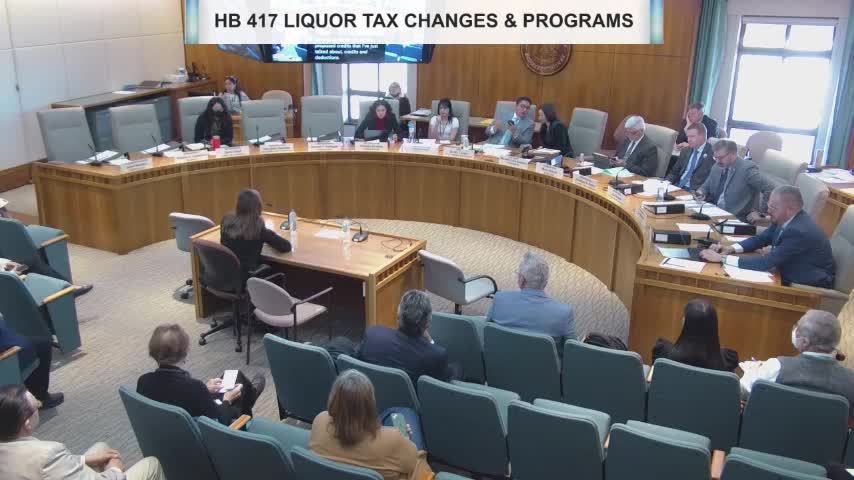
Representative Lara Cadena told the House Taxation & Revenue Committee that House Bill 4-17 would freeze the current wholesale liquor excise tax and create a new 6% retail surtax whose net proceeds would fund alcohol-harms prevention and treatment programs and a tribal-directed grant council.
Representative Lara Cadena, sponsor of House Bill 4-17, told the House Taxation & Revenue Committee on Monday that the bill would leave the existing wholesale excise in place while adding a 6% retail surtax dedicated to alcohol-harms prevention, treatment and tribal-directed programs.
"What this bill does is, on the tax side, it does 2 things," Representative Lara Cadena said. "We freeze in place the excise tax that's been in place for decades … and we impose a new liquor excise surtax at the point of sale — 6% — with the net receipts directed to programs that reduce alcohol-related harms."
The bill would discontinue a longtime direct distribution to the City of Farmington and six counties, and instead route that historic excise revenue to a new county distribution formula that weights population and alcohol-related deaths, sponsors said. The new 6% surtax would be held outside the general fund, with an initial $3 million set aside annually for research and evaluation and the remainder first directed to a council administered by the New Mexico Indian Affairs Department (IAD) to create a Tribal Alcohol Harms Alleviation Fund and related grantmaking structures.
Why it matters: New Mexico records among the highest alcohol-related death rates in the nation; proponents argued the change shifts money from the general fund to prevention and culturally appropriate treatment. Opponents said the surtax will disproportionately burden restaurants, grocery and convenience stores, and small, family-owned retail operations; they warned of added compliance costs and unintended consequences such as cross-border buying and illicit substitution.
Committee debate focused on exemptions and administrative costs. Representative Joshua Hernandez proposed and the committee adopted an amendment to exclude winegrowers, persons issued a small-brewer license and craft distiller license from the definition of retailer for the surtax; the amendment passed by committee roll call (committee vote recorded as 6 yes, 4 no). Sponsors said the carve-out was intended to protect small producers but cautioned that broad carve-outs can undermine tax equity.
Sponsors opposed further carve-outs for restaurants or on-premise consumption, calling such exemptions poor tax policy; Representative Hernandez offered an on-premise exemption later in the hearing that was defeated by roll call. The Taxation & Revenue Department told the committee implementing a new retail surtax would create a new tax administration workload (several thousand retail filers and tens of thousands of monthly returns) and estimated recurring program costs in the low hundreds of thousands to mid-seven-figure range for compliance, registration and returns processing.
Public testimony was extensive and divided. Supporters included tribal leaders, public-health coalitions and clinicians who urged dedicated funding for prevention, detox, culturally appropriate care and harm-reduction programs. Opponents included restaurant and hospitality industry groups, grocers, beer and beverage distributors and the New Mexico Business Coalition, which warned of competitive disadvantages for local restaurants and increased costs for consumers and small businesses.
Committee action: After considering multiple on-the-floor amendments that failed, the committee moved a motion for a do-pass recommendation on House Bill 4-17 as amended. The committee approved the bill for the next stage of the process by a 6-4 vote.
What the bill would change if enacted: it would (1) freeze the wholesale liquor excise tax at current rates, (2) stop the direct distribution to Farmington and six counties and replace the historical distribution with a new county formula weighted by population and alcohol-related deaths, (3) impose a 6% retail surtax on alcohol sales and (4) direct surtax net receipts to an IAD-administered council and to county-level prevention and treatment programs after a $3 million research set-aside. Implementation timing and precise program rules were the subject of committee questions and were left to administrative rulemaking and later appropriation decisions.
The committee also approved a technical amendment clarifying the bill's implementation dates and transitional distributions so payments authorized under the existing law would continue through fiscal year 2025–26 during transition.
Ending: With the committee’s do-pass recommendation, House Bill 4-17 will go to a future floor calendar for further debate and possible amendment by the full House. Sponsors, industry groups and tribal representatives all said they expect further negotiations before final enactment.