Get Full Government Meeting Transcripts, Videos, & Alerts Forever!
Get email alerts on the Criminal Prosecution topic
No spam. Unsubscribe anytime.
Criminal division requests prosecutors, flags Brady disclosures and rising post‑conviction caseloads
Summary
Deputy Attorney General John Skidmore told the House Finance Committee the criminal division seeks additional prosecutors for high‑caseload offices, is managing more Brady/Giglio disclosure alerts, and wants dedicated support for post‑conviction relief work and impeachment (Brady) processing tied to law‑enforcement personnel files.
Deputy Attorney General John Skidmore told the House Finance Committee on Feb. 21 that Alaska’s Department of Law criminal division is asking for additional prosecutors in several high‑caseload offices, and flagged growing workloads tied to impeachment disclosures (Brady/Giglio), post‑conviction relief (PCR) cases and the exponential growth in digital discovery.
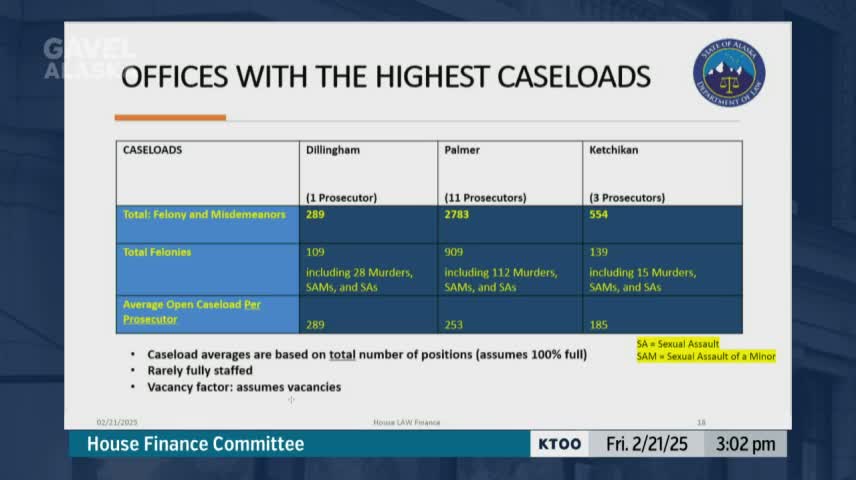
Skidmore said the division aims for an average caseload target of about 100 matters per prosecutor but many offices exceed that standard. He used three offices to illustrate the need: Dillingham (one prosecutor managing 289 open cases, including 109 felonies), Palmer (11 prosecutors with roughly 2,700 cases total; Skidmore cited an example average of 253 cases per attorney in one comparison slide) and Ketchikan (high caseloads in Southeast). He said the department’s FY26 request included three prosecutors, a paralegal and a law‑office assistant for those locations, plus support for Brady and PCR workloads.
Brady, PCR and discovery pressures Skidmore said the division had flagged more than 400 "alerts" tied to potential impeachment material in officer files that must be evaluated case‑by‑case and disclosed where applicable. He said there are roughly 376 pending PCRs (collateral post‑conviction petitions) in the system; managing those can require civil‑style discovery, depositions and extensive file reviews.
Skidmore told the committee the division seeks a dedicated Brady prosecutor and a post‑conviction attorney to handle the most serious PCRs, and asked for support staff to manage discovery and evidence review. He described discovery growth driven by body‑worn cameras and phone data as an agency‑wide problem that will require coordinated solutions with the Public Defender Agency and the court system.
Why it matters: Prosecutor staffing, Brady disclosures and PCR workloads directly affect trial readiness, case disposition timelines and the state’s ability to meet disclosure obligations. Skidmore said the department will object more aggressively to continuances that lack necessary justification to help reduce time to disposition.
Discussion vs. action: Skidmore described the division’s staffing request and described operational changes (more frequent objections to unnecessary continuances) but there were no formal votes. Committee members asked for more information on caseload standards and whether additional positions would materially change average workloads.
Ending: The division urged modest, targeted growth in prosecutor headcount and support staff to reduce caseloads, speed dispositions and manage disclosure obligations for law‑enforcement personnel files; it also said that resolving these pressures will be incremental and require coordination with courts and defense counsel.