Get Full Government Meeting Transcripts, Videos, & Alerts Forever!
Get email alerts on the Mail Theft topic
No spam. Unsubscribe anytime.
House Judiciary Committee advances bill to make mail theft a felony
Summary
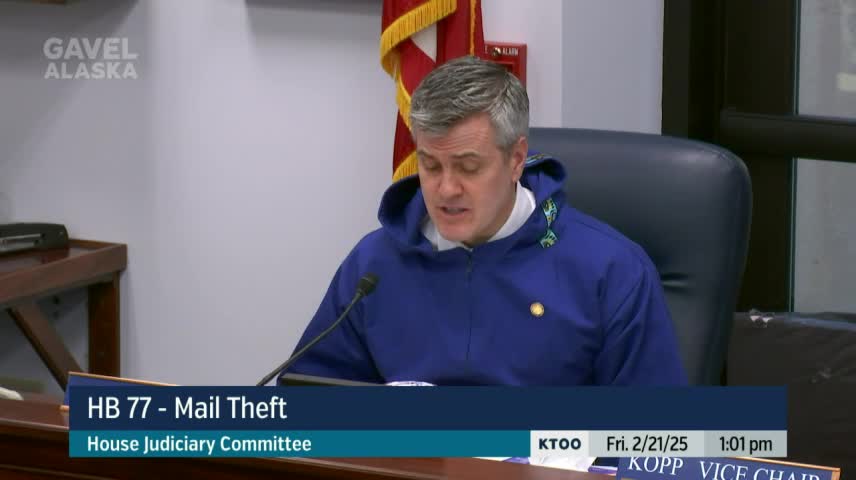
The Alaska House Judiciary Committee on Feb. 21 adopted a committee substitute for House Bill 77, a proposal to classify mail theft as theft in the second degree — a class C felony — and to expand the statute to cover packages delivered by private carriers.
ANCHORAGE, Alaska — The Alaska House Judiciary Committee on Feb. 21 adopted a committee substitute for House Bill 77, a proposal to classify mail theft as theft in the second degree — a class C felony — and to expand the definition of mail to include items sent by private carriers such as UPS and FedEx. The hearing and the committee’s adoption of the substitute took place in the Gruenberg Room at the Capitol.
The committee substitute, described to lawmakers by Ryan Sheldon, chief of staff to sponsor Representative Julie Colombe, would add private mail delivery companies to the statute’s definitions, make theft of mail a class C felony punishable by up to five years in prison and a fine of up to $50,000, and carve out exemptions for employees performing official duties at juvenile treatment, juvenile detention and correctional facilities. Sheldon told the committee the change is intended to give the state a clear statutory tool to prosecute mail theft and to deter thefts that often lead to identity fraud.
Why it matters: witnesses — including an Anchorage Police Department detective, a bank security director and a man who said he was a victim of mailed-based identity theft — told the committee that traditional mail remains important in Alaska, that seniors are disproportionately affected, and that federal prosecutors rarely take these cases because of resource constraints. “Mail theft is becoming increasingly prevalent…these crimes typically lead to identity theft, financial loss, loss of personal or legal documents,” Detective Tiffany Loughman of the Anchorage Police Department told the committee.
What the bill would change: Ryan Sheldon summarized the key provisions in the committee substitute labeled version H. Among the changes: - Definitions: “Mail” would include letters, cards, parcels or materials sent via the U.S. Postal Service or a private mail delivery company when postage is affixed, accepted, or placed in an authorized depository; “authorized depository” is defined to cover mailboxes, letterboxes and post office boxes used by USPS or a private carrier. - Scope: The substitute adds private carriers explicitly so packages delivered by commercial couriers are covered. - Exemptions: The substitute clarifies that the statute would not apply to employees performing official duties at juvenile treatment facilities, juvenile detention facilities or correctional facilities. - Penalties: The substitute treats mail theft as theft in the second degree — a class C felony with possible sentences up to five years, fines up to $50,000 and potential restitution to victims; Sheldon noted federal penalties can include larger fines.
Testimony and evidence: Detective Tiffany Loughman, who identified herself as speaking on her own behalf, told the committee she has investigated numerous mail-related thefts and identity-fraud cases and said the absence of a state mail-theft statute ties law enforcement’s hands. “Mail theft is becoming increasingly prevalent,” Loughman said, and she told members that many victims do not report theft because they do not recognize it or do not know how to report it. Loughman and the sponsor shared video clips of officers locating large amounts of seized mail during patrol encounters.
Several invited witnesses recounted impacts to victims. David Larson, who told the committee he is an 87-year-old retired teacher and a victim of mail theft and attempted identity theft, described finding that his mail had been forwarded without his consent, subsequent attempts to open credit in his name, and the lengthy effort to secure his accounts. “I personally find this really astounding that the state of Alaska does not have a mail theft statute,” Larson said.
Kelly Reynolds, security manager at Northrim Bank, said her bank has investigated multiple incidents of external fraud tied to stolen mail and supports the bill because it would allow local prosecutors and police to pursue cases without relying on federal resources. Sheldon told the committee national figures included in the packet — including a cited U.S. Department of Justice advisory and a U.S. Postal Inspection Service figure noting more than 300,000 reported incidents nationally in the last year — and that Alaska experiences higher rates of porch- and package-related theft than much of the nation.
Legal analysis: Casey Schroeder, senior assistant attorney general in the Department of Law’s criminal division, told the committee the substitute would give state prosecutors a new, state-level tool to charge mail-theft conduct without first having to value the items taken. Schroeder said prosecutors could still pursue related downstream crimes — impersonation or identity fraud — under existing statutes when the conduct supports those charges, and that in many cases multiple charges can be filed but may merge for sentencing. The Department of Law submitted a fiscal note indicating the workload could be absorbed, with the fiscal effect marked indeterminate because the number of additional prosecutions could not be precisely predicted.
Committee action: Vice Chair Kopp moved adoption of the committee substitute (work order number 34-LS0144\8) as a working document; Representative Mina initially objected but withdrew the objection, and the committee substitute was adopted and the sponsor proceeded with her presentation.
What remains unresolved: The committee substitute includes a section establishing an effective date but does not specify an exact calendar date in committee testimony. Witnesses and lawmakers also raised questions about enforcement capacity at the local and state level, given staffing shortages cited for Anchorage Police Department and Alaska State Troopers and case backlogs in felony dockets. The Department of Law said it expects the work to be absorbable but that prosecutors will continue to prioritize more serious violent offenses when setting caseload priorities.
Next steps: HB 77 received its first hearing and the committee adopted the substitute as a working document; additional committee work and scheduling for subsequent hearings or votes were not set in the hearing record. Chair Gray closed the session after previewing other upcoming Judiciary Committee hearings.