Get Full Government Meeting Transcripts, Videos, & Alerts Forever!
Get email alerts on the Public Defense topic
No spam. Unsubscribe anytime.
Public Defender Director: hiring, training and digital discovery are driving next budget questions
Summary
Terrence Haas, the appointed public defender for Alaska, told the House Finance Committee the agency has reduced caseloads since 2021 but still faces vacancies, heavy training needs for new lawyers and rising costs from digital evidence that will likely produce future budget requests.
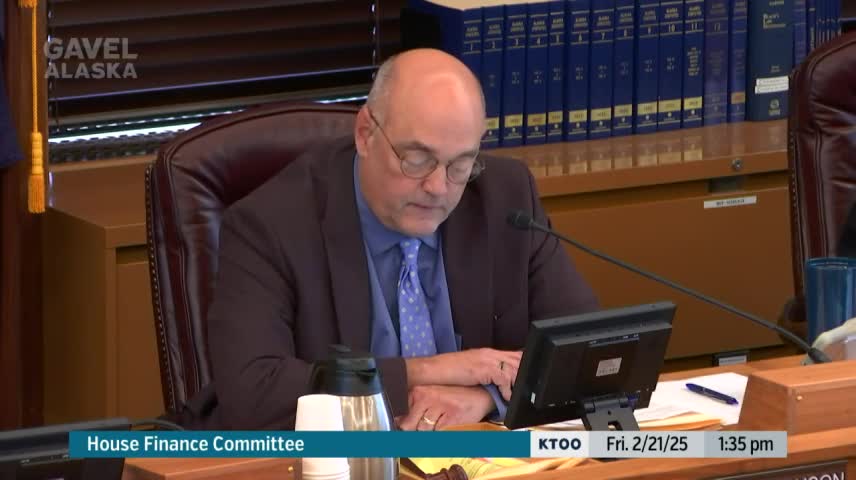
The appointed public defender for the state of Alaska, Terrence Haas, told the House Finance Committee on Feb. 21 that the agency has made progress reducing its overall caseload but continues to face recruitment, training and discovery-management challenges that could drive future budget requests.
Haas said the Public Defender Agency handles roughly 83–85% of indigent defense appointments made by the courts and that most of the agency’s work is criminal defense, with smaller teams focused on family defense and appeals and post‑conviction petitions. He told committee members the agency carried about 8,936 open and active cases in January of fiscal 2025, down from about 14,000 in 2021 and about 10,000 in 2020.
Haas said the agency has 129 permanent positions (PCNs) statewide; at the time of his testimony 7 PCNs were filled by attorneys who had been hired but not yet arrived, and 11 PCNs remained open and recruiting. He said the Public Defender Agency has 13 offices across Alaska, with the largest offices in Anchorage, Fairbanks and Palmer, and that recruiting for remote offices remains difficult. "I want to fill every spot," Haas told the committee.
Why it matters: The agency is a frontline component of Alaska’s criminal‑justice system; vacancy-driven delays and inexperienced attorneys can slow case resolution and produce downstream costs in contracting and appellate work. Committee members repeatedly pressed about trial backlogs and whether current staffing and training will be enough to continue reducing overall caseloads.
Supporting details - Practice-area staffing: Haas said roughly 20 lawyers focus on family defense, 15 on appeals and post‑conviction work and 5 on administration; the rest primarily handle criminal litigation. - Vacancies and hiring: Total PCNs 129; 7 positions had hires not yet arrived and 11 remained open and recruiting during testimony. Haas described a new deputy focused on recruitment, training and retention to reduce turnover among junior attorneys. - Caseload trend: Haas said beginning court appointments have come down modestly since 2020; he described a peak in active cases in 2021 (~14,000) and steady decline to ~8,936 in FY2025. - Training and retention: Haas emphasized that newly minted lawyers ‘‘know almost nothing about how to practice law’’ and that the agency prefers to start new lawyers on misdemeanor calendars and provide intensive supervision and training to reduce risk of later reversals or post‑conviction work. - Digital discovery: Haas warned that the exponential growth in digital evidence (body‑worn camera footage and large file sets) is creating new time and storage burdens. He said the agency will likely request technology and processing resources in a future budget but wants coordination with the Department of Law and other agencies to ensure compatible systems.
Discussion vs. action: Haas described the agency’s operational priorities and said he had no large new budget request for FY 2026 but signaled future requests may focus on discovery processing, storage and support for training. He credited recent legislative increases in attorney pay and temporary contracting authority for relieving immediate pressure; he did not present any formal motions or votes.
Ending: Committee members followed with questions about office coverage for Utqiagvik (managed out of Fairbanks), how long new hires are expected to remain in remote postings, and whether the agency’s plan to hire and train new lawyers will materially speed resolution of pretrial backlogs. Haas said progress is visible but slow and that the agency will continue to press recruitment and training efforts while coordinating with other justice actors on discovery and backlog issues.