Get Full Government Meeting Transcripts, Videos, & Alerts Forever!
Get email alerts on the Immigration Economic Integration topic
No spam. Unsubscribe anytime.
Speakers tell Alaska lawmakers newcomers add nearly $2 billion in spending power and face workforce barriers
Summary
Mara Kimmel, executive director of the ACLU of Alaska, told Alaska legislators in Juneau that immigrants and refugees bring “almost $2,000,000,000” in consumer spending power to the state and that many newcomers’ skills are underutilized.
Mara Kimmel, executive director of the ACLU of Alaska, told Alaska legislators in Juneau that immigrants and refugees bring “almost $2,000,000,000” in consumer spending power to the state and that many of those residents’ skills are underutilized.
Kimmel and presenters from Catholic Social Services’ Alaska Office for Refugees and the Alaska Literacy Program said the state lacks a coordinated infrastructure to match newcomers’ existing training and credentials to Alaska jobs and urged targeted programs — including sector-focused English instruction and recertification pathways — to increase employment and tax revenue.
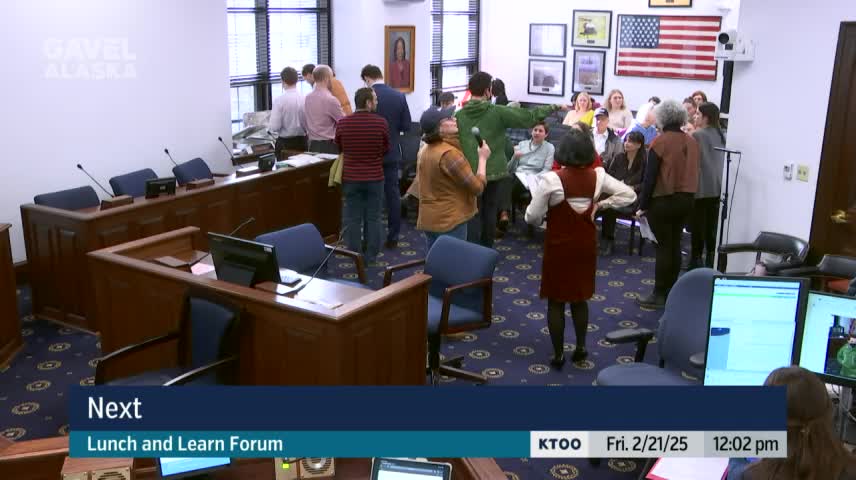
The session was opened by Senator Lukey Gale Tobin and Representative Genevieve Mina as a “short hour” of presentations about the economic impact of immigrants across Alaska. Kimmel said Alaska is already “a global crossroads,” with “over a hundred different languages” spoken and a high naturalization rate among immigrants.
Issa Resano, identified in the meeting as the Alaska State Refugee Coordinator at Catholic Social Services’ Alaska Office for Refugees, described the federally funded resettlement program’s operations and data. She said Catholic Social Services subawards to 11 nonprofit partners and provides direct or subawarded services in Anchorage, the Matanuska-Susitna (Mat Su) Valley and Delta Junction, with remote coverage for smaller communities such as Juneau and the Aleutian region.
Resano gave multi-year caseload figures: fiscal year 2021 had 21 arrivals, while fiscal year 2022 saw 504 arrivals (which she called the largest resettlement year in state history, driven by arrivals on humanitarian parole from Ukraine and Afghanistan). She said the program was serving about 1,170 enrolled clients at the time of the presentation.
Resano and partners described labor outcomes tracked through the resettlement program. She said more than 800 workers arrived through the program in the prior five years and that employment assessments identify about 40 distinct skill sets entering Alaska’s workforce. In the most recent year she cited, the program reported 294 job placements: 29% were part time (average starting wage $16.33) and 71% were full time (average starting wage $18.64). Resano said roughly 60% of resettled clients initially work in entry-level fields, while more than one-third have medium- to high-skill backgrounds but only 20% are placed in comparable positions.
Resano pointed to local training partnerships as examples of up‑skilling: a Mat Su program that pairs career-technical certifications (Kubota diesel mechanic, Greenlee electrical) with English-language instruction; and construction employers who hired Ukrainian arrivals (one employer hired more than 20 workers for roofing projects).
Deepika Ramesh Perumal, executive director of the Alaska Literacy Program (ALP), described adult basic education and sector‑specific language training designed to help immigrants move from entry-level work into credentialed careers. ALP reported that its students speak 59 first languages; that about 12% of students are refugees or in a similar status; and that a high share have prior formal education (ALP cited 59% with GED/high-school equivalent and 37% with college degrees). Perumal said many students already work — the program cited an employment figure of 88% for its students — and described a health-care “Path Academy” that issues certifications such as CPR and basic life support (64 graduates, 80% of whom pursued further training).
Speakers identified specific barriers that prevent skill-matched hiring: lack of systematic data about the larger foreign-born population, costs and complexity of credential recognition, limited English for workplace tasks, and the need for employers or supervisors who can provide bilingual on‑the‑job coaching. Kimmel urged lawmakers to “imagine the opportunities” if Alaska built infrastructure to integrate newcomers’ skills into the workforce.
Presenters also summarized immigration-status categories and federal programs as background for policymaking. Kimmel listed a range of statuses — naturalized citizens, lawful permanent residents (green card holders), employment-based visa holders, humanitarian parolees, asylum applicants, temporary protected status (TPS) recipients and Deferred Action for Childhood Arrivals (DACA) recipients — and noted these categories affect eligibility for federal programs and services, as speakers discussed the limits and complications when designing state-level supports.
The presenters did not propose specific legislation during the session but urged state investment in adult basic education, sector-focused English instruction, recertification pathways and data systems to map newcomer skills. After the formal remarks, presenters and staff remained available for questions and follow-up conversations before a committee transition at 1 p.m., the organizers said.
Sources: direct presentations at the Alaska legislative lunch-and-learn by Mara Kimmel (ACLU of Alaska), Issa Resano (Catholic Social Services, Alaska Office for Refugees) and Deepika Ramesh Perumal (Alaska Literacy Program).