Get Full Government Meeting Transcripts, Videos, & Alerts Forever!
Get email alerts on the Land Use And Development topic
No spam. Unsubscribe anytime.
Commission approves rezoning to expand truck parking at Highway 29 site, adds soil testing and extended permit deadline
Summary
Coweta County commissioners rezoned multiple parcels near Highway 29 South to allow W and W Realty to expand truck parking, approving up to 249 rentable spaces and additional conditions including a soil study and an 18‑month deadline to obtain a land‑disturbance permit.
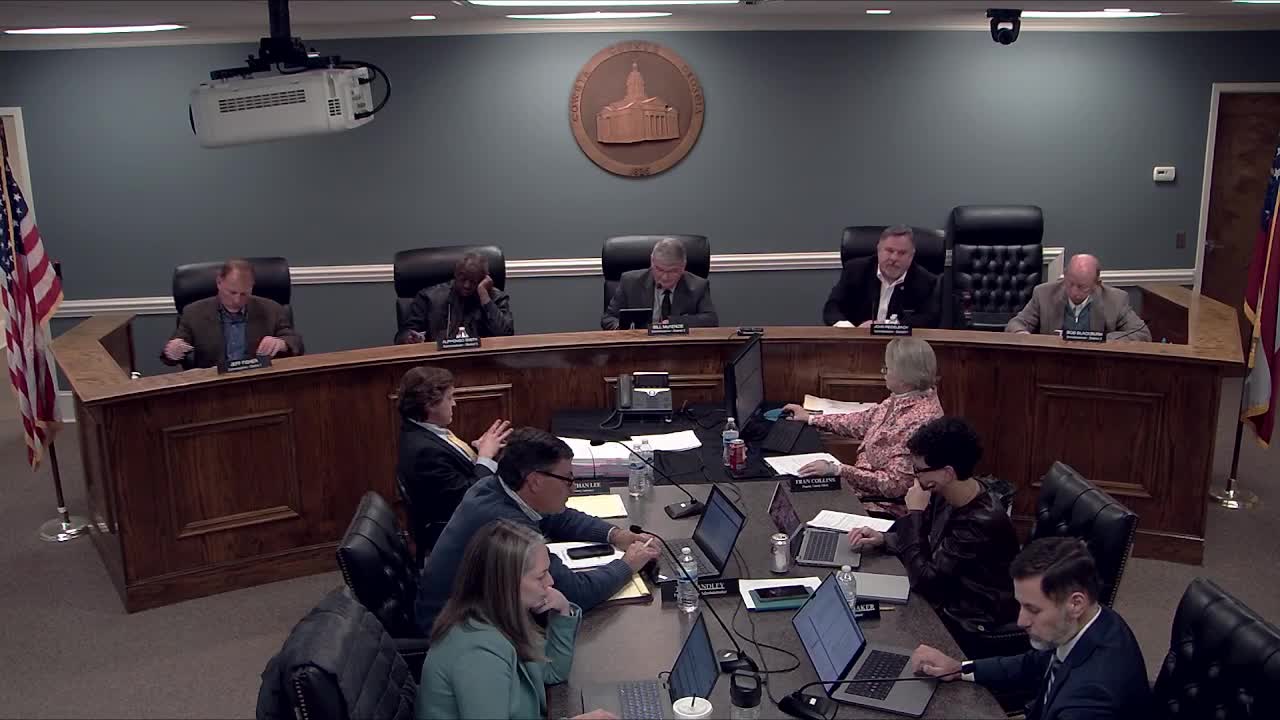
Coweta County commissioners on Jan. 23 approved a rezoning request by W and W Realty Company LLP that clears the way for expanded truck parking behind an existing travel center along Highway 29 South in Newnan.
The board voted unanimously to rezone three parcels (identified in staff materials as parcels A, B and C) from a mix of RC (Rural Conservation) and C (Commercial) to M (Industrial) to permit a larger, consolidated truck parking area. The decision included multiple staff‑recommended and Board of Zoning Appeals conditions and two additions made during the meeting: an environmental soil study and an 18‑month deadline to obtain the land‑disturbance permit (LDP).
Why it matters: The site sits adjacent to I‑85 and existing commercial uses and includes a nonconforming gravel truck parking area that the county says was established without permits. Proponents argued additional permitted parking would reduce unsafe truck parking on interstate ramps and local roads; opponents and some commissioners raised concerns about stormwater, contamination and neighborhood impacts.
Staff, applicant and traffic experts described the project and its limits. Community development staff told commissioners the proposed development would be restricted to a maximum number of rentable truck parking spaces and would need to bring the existing nonconforming gravel lot up to current ordinance standards. Verne Wilburn, the traffic engineer who prepared the DRI traffic study, told the board the study modeled 177 rentable spaces and that adding the 13 additional spaces shown on the final plan would have “almost no measurable impact” on peak‑hour traffic.
The applicant and its representatives said the truck spaces would be rented on a month‑to‑month basis and described typical usage patterns: drivers often park a personal vehicle in a rented space and use the truck intermittently, reducing turnover and peak trips. Attorney Melissa Griffiths, speaking for the applicant, said, “Each space is numbered and they're rented on a month‑to‑month basis,” and asked that the board retain the higher 249‑space limit recommended in some planning materials.
Opponents cited environmental and neighborhood concerns. Resident Joshua Lawson said the unpermitted gravel lot had likely allowed diesel and oil to reach the ground and asked the county to require testing. After discussion, the board added a condition requiring the applicant to complete an environmental (soil) study and to mitigate any contamination before further site work proceeds; the applicant agreed to that condition.
Other conditions the board approved or affirmed included: requiring the nonconforming truck parking area be brought into compliance with county codes (including stormwater controls), installing gates at entry points to control access, routing traffic through parcels included in the rezoning, and installing landscaped buffers along I‑85. The Board of Zoning Appeals had recommended a cap based on the transportation study; commissioners ultimately retained the applicant’s requested cap of 249 rentable spaces while adding the soil‑testing requirement and extending the LDP deadline from 12 to 18 months to allow environmental review and permit processing.
The rezoning and its conditions were approved on a unanimous vote. Staff will track the new conditions during plan review and enforce the LDP deadline; the motion included a stipulation that failure to obtain the LDP could trigger board action to rezone the property back.
What happens next: The applicant will submit a buffer/landscape plan and the required stormwater studies and secure permits (including the LDP). The board recorded the 18‑month deadline and the requirement that the existing gravel area be paved or otherwise brought into compliance before it may be used as rentable spaces.
Speakers quoted or cited in this article are members of the meeting record and included in the article’s speaker list below.