Get Full Government Meeting Transcripts, Videos, & Alerts Forever!
Get email alerts on the Property Tax Homestead Exemption topic
No spam. Unsubscribe anytime.
Macon-Bibb officials briefed on House Bill 581, told opt-out deadline looms
Summary
Presenters explained how House Bill 581 would apply a state-determined "floating" homestead exemption to owner-occupied properties, outlined projected revenue impacts for Macon-Bibb County, and described the March deadline and public-hearing requirements for a local opt-out.
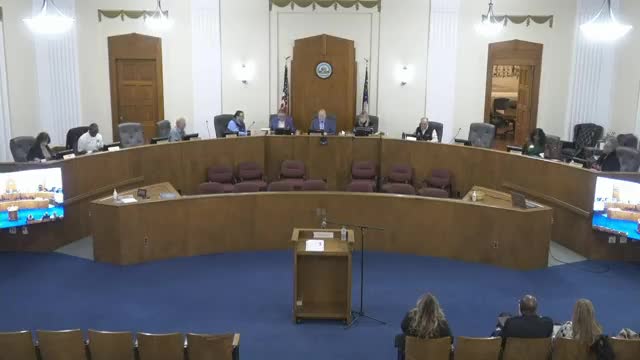
Macon-Bibb County commissioners received a detailed briefing on House Bill 581 and how the law would change local homestead exemptions if the county does not opt out.
The presentation, led by Miss Schultz with assistance from Andrea Crutchfield, chief appraiser for the Board of Tax Assessors, explained that House Bill 581 creates a “floating” homestead exemption tied to a state-determined inflationary index and a base-year assessment. Under current state law, property owners are taxed on 40 percent of assessed value; local flat homestead exemptions such as Macon-Bibb’s $7,000 exemption reduce the assessed value before that calculation.
Schultz said the Georgia Department of Revenue has issued guidance that no inflationary adjustment will be provided for the 2025 digest, meaning assessors will effectively use 2024 base values for affected properties in the 2025 tax year. “For 2025 . . . there will actually not be an inflationary number provided to tax assessors,” Schultz said. Andrea Crutchfield confirmed the $7,000 local flat exemption remains in place and that, where a local jurisdiction already has a floating base, taxpayers would receive whichever exemption produces the larger benefit.
Why it matters: The presenters gave commissioners a range of projected fiscal impacts if Macon-Bibb does not opt out. Using the assessors’ assumptions, the county’s homesteaded properties (about 23,000 parcels in 2024) could reduce local tax revenue by an estimated $8 million to $13 million by 2030, the presentation said. Presenters also reported a longer-term estimate that the county could forego $1.6 billion to $2.4 billion in inflationary growth in aggregate assessed value by 2030 under the floating-exemption model; the Department of Revenue’s final inflation index would affect those figures.
Key implementation and timeline details: Under the bill as enacted, a local government that wants to opt out must advertise the proposal in the newspaper, hold three public hearings (one of which must be on a weekday starting between 6 and 7 p.m.), pass a local resolution to opt out, and transmit that resolution to the secretary of state by March 1 for the opt-out to take effect under the current statutory schedule. Schultz noted a separate, still-pending bill (House Bill 92) would, if enacted, allow local governments to opt out on an annual basis through March 31, 2029; that bill had not passed at the time of the presentation.
Other constraints discussed: Presenters said the law also revised limits on local-option sales taxes (FLOS/OLAS) and capped additional local sales taxes at an aggregate 2 percent over SPLOST; Macon-Bibb is already at that cap and therefore could not raise an additional penny in local sales tax to offset property-tax relief tied to the floating homestead. Commissioners were also told that, if Macon-Bibb opted out, the local delegation could pursue a local act or a referendum to adopt a county-specific floating homestead tailored to local needs.
Commissioner concerns and next steps: Commissioners asked about whether veterans’ or disabled homestead exemptions would be affected; Andrea Crutchfield replied that the veterans’ disabled exemption is a separate statutory exemption and would not be altered by House Bill 581 as presented. Commissioners also pressed for clarity on how substantial changes to properties would be handled for resetting a base year; Schultz said guidance from the Department of Revenue on that point is not yet clear and that courts have previously been asked to resolve similar tax-assessment disputes.
Several commissioners voiced concern about locking the county into long-term change: presenters noted that, under the current statutory text, opting in would be in effect for 50 years absent subsequent state action. Commissioners discussed a range of approaches, including advertising the required hearings and then deciding after public input, waiting to see whether House Bill 92 passes, or drafting a locally tailored senior exemption for residents age 65 and older to target relief without the volatility tied to an inflation index.
Formal actions at the meeting: Commissioners approved the minutes from the January 2025 meeting and later voted to enter executive session on legal matters; no votes resulted from the executive session. Commission staff said the materials would be emailed to absent commissioners and that attorneys would prepare timelines and options for both opt-out and opt-in pathways depending on whether House Bill 92 moves through the legislature.
Bottom line: The briefing put the decision before the governing body as primarily a fiscal one — whether to accept the state’s floating homestead structure and its uncertain inflation index or to opt out by meeting the statutory public-notice and hearing requirements before the March deadline and then pursue a local alternative if the commission prefers.