Get Full Government Meeting Transcripts, Videos, & Alerts Forever!
Get email alerts on the Judiciary Jury Selection topic
No spam. Unsubscribe anytime.
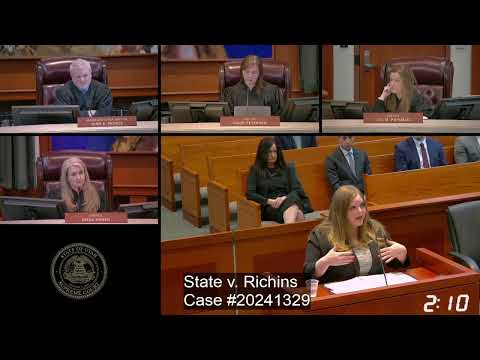
Utah Supreme Court hears challenge to presiding judge’s ban on in‑person jury selection in State v. Richens
Summary
At oral argument in State v. Richens, attorneys for defendant Corey Richens and the state of Utah asked the Utah Supreme Court to reverse two lower‑court rulings: a presiding judge’s order prohibiting in‑person voir dire and an assigned trial judge’s reconsideration to expand the venire to include Salt Lake County.
At oral argument in State v. Richens, attorneys for defendant Corey Richens and the state of Utah asked the Utah Supreme Court to reverse two lower‑court rulings: a presiding judge’s order prohibiting in‑person voir dire and jury selection under the Third Judicial District’s standing order, and an assigned trial judge’s later reconsideration to expand the venire to include Salt Lake County.
The question presented to the court centered on who decides — the assigned trial judge or the district’s presiding judge — whether “extraordinary circumstances” permit an exception to the district’s default practice of virtual jury selection. Appellant counsel Brea Johnson argued that “the standing order does not give that responsibility to the presiding judge,” and that the Code of Judicial Administration and court rules reserve case‑specific determinations to the assigned trial judge.
The state, represented by Mary Ann Decker, joined the defense in asking the court to reverse the presiding judge’s order. Decker told the justices the parties had stipulated that the media attention surrounding the aggravated‑murder prosecution constituted an extraordinary circumstance and that the parties had waived any county‑only juror requirement. “The state agrees with Ms. Richens that the presiding judge clearly abused her discretion in not deferring to the trial judge’s finding,” Decker said, adding that the state has “a very strong interest in trying this aggravated murder case in the community closest to where these alleged events occurred.”
Bryson King, counsel for Presiding Judge Scott, urged the court to decline discretionary review and defended the standing order as an administrative district policy that the presiding judge may enforce. King said a ruling that individual trial judges may hold in‑person voir dire contrary to the standing order would destabilize the Third District’s virtual jury‑selection framework and produce inconsistent results across many judges.
Justices pressed all sides on practical consequences and legal standards. The court asked whether the standing order creates a legal standard requiring a finding of “extraordinary circumstances” before the presiding judge may permit in‑person selection, or whether it instead assigns a discretionary, administrative role to the presiding judge. Counsel discussed related authorities, including the Code of Judicial Administration, criminal procedural rules cited in briefs (including rule 17.5 and rule 18), change‑of‑venue authority (rule 29(c)), and case law the parties invoked as relevant precedent.
Counsel and the court discussed logistics and timing: the trial judge plans to send jury questionnaires to about 1,500 prospective jurors, with four days set aside for jury selection in April and an anticipated four‑week trial. Defense counsel told the court that, because of that schedule, “if this court could render a ruling by February 21, even if it issues reasoning later on, it would be very helpful for the time‑sensitive nature of these proceedings.”
No final ruling was issued from the bench. The court took the matter under advisement and said it would issue a decision; justices repeatedly questioned whether the parties had preserved the correct legal issues for appellate review and whether challenges to a district standing order should be pursued through other administrative channels.
The argument focused on two discrete issues: (1) the district standing order’s allocation of authority between a presiding judge and an assigned trial judge to permit exceptions to virtual jury selection; and (2) whether the parties’ stipulated compromise to draw a venire from Salt Lake County and Summit County is permissible under statutes and rules governing juror selection. Counsel disagreed over whether the statutory language requiring jurors be drawn from the county where the trial is held is mandatory and waivable in the parties’ circumstances, and whether rule 29(c) and other provisions permit the requested relief.
The justices sought hypotheticals and doctrinal guidance on how to treat decisions that sit at the intersection of administrative policy and judicial rulings; counsel for the presiding judge emphasized the potential administrative burden and security, privacy, and logistical concerns that would follow if many trial judges made case‑by‑case exceptions to a district‑wide virtual‑selection policy.
The court did not announce a timetable for its opinion. Counsel reiterated the request for an expedited ruling to allow the trial judge to finalize the questionnaire mailing and associated scheduling.
For now, the trial judge remains the only judge who has made the case‑specific determination in the record, and the presiding judge’s order remains the subject of this appeal to the Utah Supreme Court.