Get Full Government Meeting Transcripts, Videos, & Alerts Forever!
Get email alerts on the Budget Tax Policy topic
No spam. Unsubscribe anytime.
Fulton commissioners discuss FY2025 budget, set aside reserve for DOJ costs and opt in to state homestead/sales-tax change
Summary
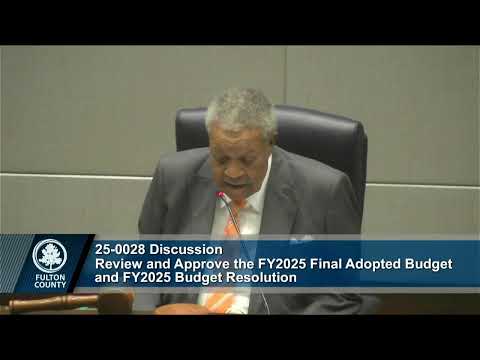
Fulton County commissioners on Jan. 8 heard the county manager and CFO present the FY2025 budget and voted unanimously to opt in to House Bill 581’s new homestead exemption and related local sales‑tax option; they also directed staff to reserve year‑end underruns while they develop plans for DOJ‑related costs.
Fulton County officials used the Jan. 8 Board of Commissioners meeting to review the proposed fiscal year 2025 budget and related state legislation that could affect property‑tax calculations and local sales tax options.
House Bill 581 (2025). The board voted unanimously to allow the county to "opt in" to the new statewide floating homestead exemption and related local sales‑tax option in House Bill 581 rather than formally opt out by the March 1 deadline. County staff described the effects: HB581 creates an additional floating homestead exemption taxpayers may receive (they will get the larger of the county’s existing exemption or the new state exemption), and offers a local option sales tax intended to be used to offset property‑tax rollback. Staff noted the new local sales tax would be subject to existing caps and intergovernmental distribution mechanics; cities that do not adopt the option would not be included automatically. The board’s recorded vote on the opt‑in motion was unanimous.
Budget presentation and proposed reserves. County Manager and CFO presented year‑end 2024 results and the FY2025 proposal. The county closed 2024 with about $239.7 million in general‑fund balance. The manager recommended keeping the FY2025 approach rules‑based (no program expansions except contractually required or life‑safety items) and proposed reserving the 2024 underruns to meet likely needs in 2025 tied to the DOJ investigative findings and consent‑decree implementation.
CFO Sharon Whitmore told commissioners that 2024 budgeted expenditures totaled roughly $954.0 million while actual 2024 spending was about $866.8 million, producing about $87.3 million between the 2024 adopted budget and actuals; after closing adjustments the county reported $19.5 million in net underruns available to carry forward.
Manager’s recommendation and proposed earmark. The county manager recommended carrying forward year‑end underruns and establishing a three‑part reserve totaling $13,903,263 (each bucket approximately $4,634,421): one portion for risk management, one for initial operational needs to implement the DOJ consent‑decree requirements, and one for facility‑related remediation tied to the same matter. The manager said those funds would be held until the board could act on specific implementation proposals as obligations and costs become clearer.
Commissioner discussion. Commissioners debated the tradeoffs between holding reserves for unknown consent‑decree costs and funding recurring or one‑time requests from county departments and justice partners (magistrate court staffing, the solicitor general’s requests for expanded court hours, sheriff overtime and retention bonuses, and arts and veterans programs among others). Several commissioners urged a balanced approach: preserve contingency for court‑ordered remedies while using a portion of otherwise underspent funds to meet some urgent departmental requests.
Board action and outstanding items. The board took a recorded vote to opt in to HB581 (motion by Vice Chair Bob Ellis, second by Commissioner Khadija Abdul Rahman); the motion passed unanimously. The transcript records a motion to adopt the FY2025 budget made during the meeting but does not include a recorded final vote on the FY2025 final adopted budget in the available excerpt. The manager and CFO recorded the proposed FY2025 figures in the packet and described the $13.9 million reserve earmark; commissioners asked for follow‑up detail on non‑agency balances, inmate service balances, and a more granular review of prior years’ underruns. Several commissioners requested mid‑year budget reviews and said they would consider smaller reallocations to address immediate justice‑system staffing, retention and community health pilot needs.
What’s next: County staff will provide the follow‑up tables and historical underrun data requested by commissioners. The county will file its position on HB581 with the state by the statutory deadline (board directed staff to let the county opt in). Implementation specifics and any board decisions to reallocate reserves or authorize targeted spending will be scheduled for future meetings and mid‑year budget review.