Get Full Government Meeting Transcripts, Videos, & Alerts Forever!
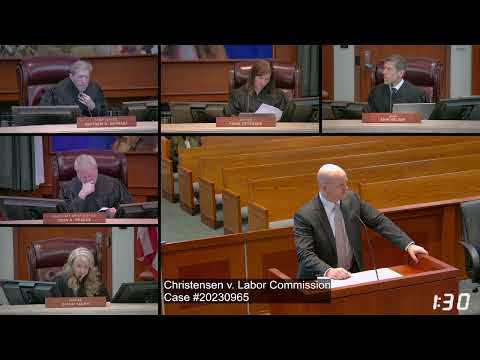
Utah Supreme Court hears arguments in Christensen v. Labor Commission over attorney fees, damages and ALJ reassignment
Summary
Christensen v. Labor Commission reached the Utah Supreme Court for oral argument, where attorneys and justices focused on four core issues: whether the Labor Commission can award attorney fees and assess their reasonableness under the Utah Anti-Discrimination Act (UADA); which damages are available for retaliation (including back pay and benefits); the causation standard applicable to retaliation claims; and whether the Commission must disclose the reason for substituting an administrative law judge (ALJ).
Christensen v. Labor Commission reached the Utah Supreme Court for oral argument, where attorneys and justices focused on four core issues: whether the Labor Commission can award attorney fees and assess their reasonableness under the Utah Anti-Discrimination Act (UADA); which damages are available for retaliation (including back pay and benefits); the causation standard applicable to retaliation claims; and whether the Commission must disclose the reason for substituting an administrative law judge (ALJ).
The case matters because the court’s rulings could change how administrative claims under the UADA are litigated: who pays fees, what monetary relief an employee can recover, how causation is proved, and what remedy exists when an ALJ is replaced mid‑proceeding.
Salt Lake County’s lead counsel, Josh Peterman, told the court that the appellate decision under review both authorizes the Labor Commission to award fees and, in his reading, treats fee awards as mandatory in some circumstances. "Not only can the Labor Commission award fees, I read the decision to indicate that it must award fees if there's a supported finding," Peterman said, arguing that the decision as applied would be in tension with established law requiring review for fee reasonableness.
Peterman pressed…
Already have an account? Log in
Subscribe to keep reading
Unlock the rest of this article — and every article on Citizen Portal.
- Unlimited articles
- AI-powered breakdowns of topics, speakers, decisions, and budgets
- Instant alerts when your location has a new meeting
- Follow topics and more locations
- 1,000 AI Insights / month, plus AI Chat