Get Full Government Meeting Transcripts, Videos, & Alerts Forever!
Get email alerts on the Administrative Law topic
No spam. Unsubscribe anytime.
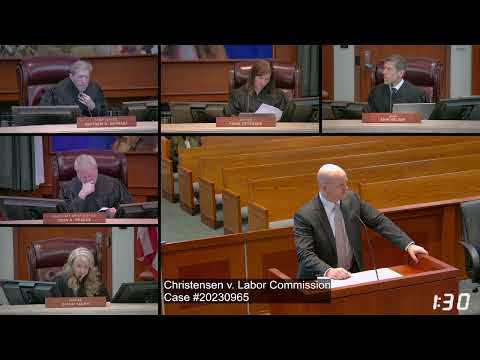
Utah Supreme Court hears arguments in Christensen v. Labor Commission over attorney fees, damages and ALJ reassignment
Summary
Christensen v. Labor Commission reached the Utah Supreme Court for oral argument, where attorneys and justices focused on four core issues: whether the Labor Commission can award attorney fees and assess their reasonableness under the Utah Anti-Discrimination Act (UADA); which damages are available for retaliation (including back pay and benefits); the causation standard applicable to retaliation claims; and whether the Commission must disclose the reason for substituting an administrative law judge (ALJ).
Christensen v. Labor Commission reached the Utah Supreme Court for oral argument, where attorneys and justices focused on four core issues: whether the Labor Commission can award attorney fees and assess their reasonableness under the Utah Anti-Discrimination Act (UADA); which damages are available for retaliation (including back pay and benefits); the causation standard applicable to retaliation claims; and whether the Commission must disclose the reason for substituting an administrative law judge (ALJ).
The case matters because the court’s rulings could change how administrative claims under the UADA are litigated: who pays fees, what monetary relief an employee can recover, how causation is proved, and what remedy exists when an ALJ is replaced mid‑proceeding.
Salt Lake County’s lead counsel, Josh Peterman, told the court that the appellate decision under review both authorizes the Labor Commission to award fees and, in his reading, treats fee awards as mandatory in some circumstances. "Not only can the Labor Commission award fees, I read the decision to indicate that it must award fees if there's a supported finding," Peterman said, arguing that the decision as applied would be in tension with established law requiring review for fee reasonableness.
Peterman pressed the court for guidance on whether the Commission may or must assess the reasonableness of requested fees and, if so, which factors are open to agency consideration. He said the Court of Appeals’ opinion contains a footnote limiting certain inquiries and that the Commission’s practice since the 2016 Injured Workers decision has been to refrain from awarding fees because of uncertainty.
Counsel for the employee, Russ Mollie, said the Court of Appeals "got it correct" in holding that Injured Workers did not bar fee awards and urged the court to permit the Commission to return to common practice: awarding fees on submission and allowing appellate review if a losing party objects. Mollie said a typical practice is affidavits and limited Commission inquiry, with appeals available for disputes over excessive or unrelated charges.
On damages, Salt Lake County argued that some monetary relief awarded to respondent Teresa Christiansen amounted to double recovery and questioned whether back pay or benefits are available without a finding of constructive discharge. County counsel argued the UADA’s remedial list is limited and that certain categories of recovery are properly denied in retaliation claims absent statutory authorization. The court’s questioning showed skepticism and sought textual and precedential support for locking out categories of economic relief that are plainly quantified (for example, the value of accrued leave).
The parties also argued about causation. County counsel advocated for a stricter "but‑for" causation standard tied to the statutory phrasing ‘‘because of,’’ while Mollie and some justices discussed whether a motivating‑factor or mixed‑motive standard more closely matches the statute and existing practice. Mollie told the court that a "because of" test that requires consideration of all evidence would be workable and is closer to a but‑for test, but that line‑drawing remains unsettled.
Finally, the Utah Labor Commission, represented by Steve Geary, urged the court not to require the agency to disclose reasons for ALJ reassignment. Geary told the court: "The answer to that question should be no," and said counsel had not identified a statutory rule or any authority requiring disclosure of the reason for a reassignment. He added that, where prejudice exists from a reassignment, remedies exist through agency review or remand and that returning a matter to the original ALJ is typically infeasible when personnel have left the agency.
Justices questioned remedies if a substitution produced unfairness and whether a second ALJ who reviews recordings should receive deference on factual credibility determinations. Counsel and a court‑appointed questioner discussed the record here (audio/video of the hearing), the timing of the substitution (after the hearing but before decision), and whether the Appeals Board and courts employ a deferential or correctness standard when a successor decisionmaker rules without having heard live testimony.
The court took the case under advisement after roughly an hour and a half of argument and questioning. Its forthcoming opinion will address attorney‑fee authority and reasonableness review under the UADA, the scope of damages for retaliation claims (including whether back pay and benefits require a constructive discharge finding), the causation standard for administrative retaliation claims, and whether agencies must disclose reasons for replacing ALJs and, if so, what remedies follow for any unfairness.
Looking ahead, the court’s rulings may affect (1) how the Labor Commission processes fee requests and whether it conducts a local reasonableness inquiry; (2) the availability of quantified economic relief in retaliation cases; (3) pleading and proof strategies on causation in administrative employment claims; and (4) procedural protections when ALJs are reassigned mid‑proceeding.