Get Full Government Meeting Transcripts, Videos, & Alerts Forever!
Get email alerts on the Covid Signature Restrictions Constitutional topic
No spam. Unsubscribe anytime.
Appeal focuses on whether Governor Cox's COVID orders and refusal to relax in-person signature rules violated sponsors' ballot rights
Summary
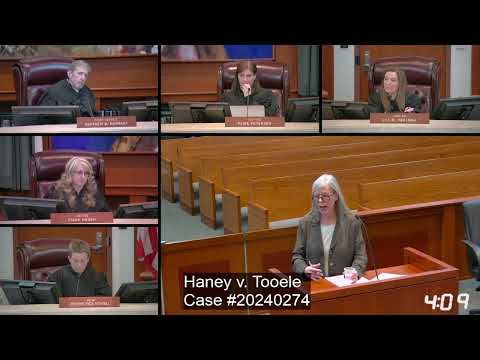
In Haney v. Tooele County the Utah Supreme Court also heard an as-applied constitutional challenge: whether Governor Cox's pandemic-era orders and his decision not to suspend in-person signature requirements during a COVID surge imposed a severe burden on sponsors' referendum rights.
Salt Lake City —The Utah Supreme Court considered an as-applied constitutional claim in Haney v. Tooele County alleging that Governor Gary R. Cox's pandemic-era actions and his refusal to suspend in-person signature requirements during a COVID spike severely burdened sponsors' ballot access and freedom of association.
Appellant counsel Janet Conway told the court sponsors were hampered while gathering signatures during a COVID surge and that the governor's public pleas to avoid contact, combined with his refusal to allow electronic signature gathering, "rendered the statute unconstitutional as applied under the extreme circumstances presented by the COVID pandemic." Conway said sponsors had obtained well over the lower 9.5% threshold but fell 763 signatures short of the 16% threshold the county applied.
Andrew Dimock, arguing for Governor Cox, urged the court to affirm the district court's dismissal of the constitutional claims. Dimock said the District Court correctly found the November 2020 executive order imposed only a less-than-severe burden and survived the intermediate scrutiny applicable to such burdens. "Severe burden is a very high burden," Dimock told the court, and he defended the governor's discretion not to suspend statutory signature rules as a separation-of-powers issue and as discretionary emergency authority.
Justices pressed counsel on the proper legal lens for review. Several asked whether the claim is an as-applied challenge to the statute itself, or a challenge to the governor's decision not to exercise emergency suspension authority. Conway characterized the claim as focused on the governor's refusal to relax in-person signature requirements after issuing an emergency order: the combination of the executive order and the refusal to suspend the statutory in-person rule was, she said, the state action that produced a constitutional violation.
Counsel debated case law on ballot-access challenges during the pandemic. Conway cited litigation where courts accommodated signature-gathering difficulties tied to pandemic restrictions and the timing of orders, while Dimock relied on cases such as Thompson v. DeWine to argue that the existence of some permitted in-person access and the textual terms of the governor's November 2020 order meant the order did not amount to a severe burden that would trigger strict scrutiny. Dimock also raised separation-of-powers and redressability concerns: he said a court declaration against the governor would be of limited practical effect because the relief sponsors seek is to have a county or municipality place the referendum on a local ballot.
Justices and counsel also discussed standing and mootness because, after the ordinance's adoption, the municipality of Erda incorporated and there are ongoing questions about whether the county's ordinance continues to control zoning on the parcels at issue or whether Erda's temporary zoning and potential vested-rights claims affect redressability. County counsel argued that redressability problems and overlapping authorities between the county and the new municipality complicate what relief a court could order.
The court took the matter under advisement.
No immediate remedy was ordered during oral argument; the court will decide whether the governor's November 2020 measures and his decision not to suspend the in-person requirement constituted state action that imposed a severe burden on ballot access and whether, procedurally, sponsors can obtain the relief they seek given subsequent municipal incorporation and vested-rights claims.