Get Full Government Meeting Transcripts, Videos, & Alerts Forever!
Get email alerts on the Land Use Referendum Signature Threshold topic
No spam. Unsubscribe anytime.
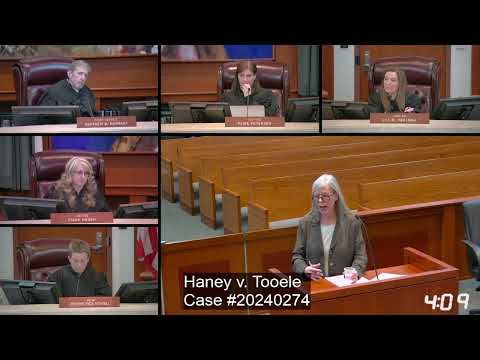
Utah Supreme Court hears dispute over whether Tooele County rezoning triggers higher referendum signature threshold
Summary
At oral argument in Haney v. Tooele County, advocates disputed whether a site-specific rezoning enacted by Tooele County is a "land use law" subject to the election code's higher 16% signature threshold or a local ordinance challengeable with the lower 9.5% threshold.
Salt Lake City —The Utah Supreme Court heard arguments in Haney v. Tooele County over whether a 2020 Tooele County ordinance rezoning parcels for a planned community is subject to the election code's higher referendum signature threshold for "land use law," or the lower signature threshold that applies to ordinary local laws.
The question matters because sponsors of the referendum collected more than the lower 9.5% threshold but fell 763 signatures short of the 16% threshold the county applied; the district court adopted the county's interpretation and refused to certify the referendum.
Appellant counsel Janet Conway told the court the election code's definition of "land use law" is ambiguous and that the district court erred in importing definitions from land-use statutes to declare the ordinance a land use regulation. "In order to resolve the ambiguity, the district court imported Ludma's definition of land use regulation," Conway said, arguing that the importation was improper and that the 2019 amendments did not make earlier precedent irrelevant. Conway also stressed the textual limits in the election code's enumerated categories and said treating all land-use-related legislative actions as subject to the higher threshold would render those limiting categories superfluous.
Counsel for Tooele County urged the court to treat the ordinance categorically as legislative and therefore as a land use regulation subject to the higher threshold. County counsel described the 2020 ordinance as more than a simple amendment: it "essentially created a new community located in a predominantly agricultural area," authorizing a mixed-use development with hundreds of units, parks, commercial uses and civic space. That, the county argued, is the prototypical example of a land use regulation that involved weighing broad policy considerations and therefore falls within the election code's higher signature requirement.
Justices asked whether the proper approach is categorical (classifying certain kinds of rezones as legislative) or ad hoc (examining whether the local legislative body actually weighed broad policy considerations in each instance). County counsel urged a categorical rule for predictability; Conway warned against collapsing the election-code categories into the broader land-use definition.
The exchange included statutory and precedent-focused points: counsel debated the effect of the 2019 amendments to the election code, past Utah cases addressing legislative versus administrative land-use actions, and whether the statute's enumerated examples limit or merely illustrate the definition of land-use law. The court also explored downstream complications raised by the ordinance's timing, including the subsequent incorporation of the municipality of Erda and whether that incorporation affects the ordinance's current legal force.
The court took the matter under advisement at the end of oral argument.
The dispute is fundamentally about how to read the election code's definition of "land use law" and how that reading determines the number of valid signatures required to force a referendum on county-enacted zoning that sponsors claim was intended to benefit a developer.
Votes at a glance: no formal votes were taken during the oral argument; the court took the matter under advisement and did not announce a decision.
What happens next: The court will issue an opinion resolving whether the Tooele County ordinance at issue is subject to the 16% signature requirement for land-use legislation or the lower local-law threshold, and whether the district court correctly resolved the statutory questions.