Get Full Government Meeting Transcripts, Videos, & Alerts Forever!
Get email alerts on the Lake Erie Water Quality topic
No spam. Unsubscribe anytime.
Ohio Lake Erie Commission requests FY26–27 funds, cites progress reducing phosphorus
Summary
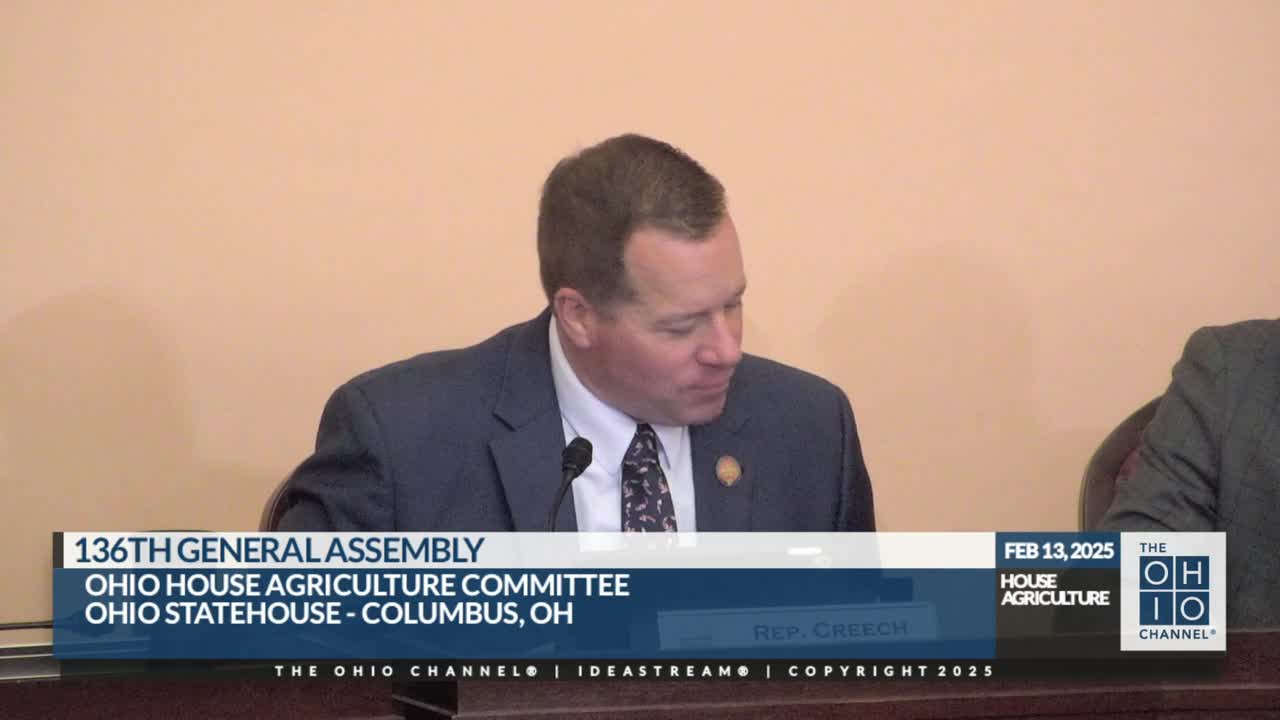
Joy Mullinex, executive director of the Ohio Lake Erie Commission, told the Ohio House Agriculture Committee that the commission’s FY26–27 budget request would help continue work to reduce nutrient runoff and manage harmful algal blooms on Lake Erie.
Joy Mullinex, executive director of the Ohio Lake Erie Commission, told the Ohio House Agriculture Committee that the commission’s FY26–27 budget request would help continue work to reduce nutrient runoff and manage harmful algal blooms on Lake Erie.
The commission, Mullinex said, coordinates across six state agencies — including the Ohio Environmental Protection Agency and the departments of Natural Resources, Transportation, Health and Agriculture — and with federal partners, researchers and local communities to implement H2Ohio, Ohio’s Domestic Action Plan and the 2025 Lake Erie Protection and Restoration Plan. “Ensuring Lake Erie’s water quality is healthy and safe remains one of Governor DeWine’s top priorities,” she said.
Mullinex told lawmakers that excess nutrients, from both agricultural and community sources, drive the annual harmful algal blooms and that those blooms are affected by many factors, especially rainfall. “The problem with harmful algal blooms will not be fixed quickly,” she said. Mullinex pointed to 2023 monitoring data showing Ohio met its 40% target for springtime dissolved reactive phosphorus loading in the Maumee River, adding: “So we know we’re making progress.”
Why it matters: Lake Erie provides drinking water for nearly 3,000,000 Ohioans, supports recreation and tourism and underpins roughly $25 billion in annual business revenue from Ohio ports and harbors, Mullinex said. The commission uses funds from Lake Erie license-plate sales to award competitive grants that implement restoration-plan objectives and leverages federal funding such as the Great Lakes Restoration Initiative (GLRI) for larger projects.
Mullinex said the commission expects to use H2Ohio funds to support two small projects to improve nutrient-tracking in the Western Lake Erie Basin and that staff are preparing an updated 2025 protection and restoration plan with broad consultation. On areas of concern (AOCs) designated under the U.S.–Canada Great Lakes Water Quality Agreement, she said three AOCs remain in Ohio — the Maumee, the Black and the Cuyahoga rivers — and with federal GLRI support the commission anticipates removing three beneficial-use impairments in the next biennium.
In question-and-answer, Representative Miller, who said he represents the Black River area, asked about timelines for delisting. Mullinex said the U.S. Environmental Protection Agency is coordinating timelines and that the commission is “tentatively looking at a 2026 delisting” for the Black River AOC, contingent on continued progress. Mullinex and lawmakers also discussed dredged-sediment reuse: the commission has funded planning and research showing some dredged material can be used as a soil amendment for farms but said projects require coordination with the U.S. Army Corps of Engineers and local stakeholders.
Committee members asked about license-plate revenue, which Mullinex said has dropped; the commission released a fourth Lake Erie license plate in December and will evaluate whether sales and revenue increase after marketing. On grant availability, Mullinex said federal grants such as GLRI are competitively awarded and can support local technical assistance; she said schools or school districts with restoration projects would need to partner with local communities to apply in competitive grant rounds.
The commission’s testimony emphasized a mix of state license-plate funds, competitive federal awards and GLRI grants to support monitoring, research, grants and projects intended to reduce phosphorus loads and restore areas not meeting the Great Lakes Water Quality Agreement goals.
Mullinex closed by noting that protecting Lake Erie remains a multiagency, multi-stakeholder effort and thanked the committee for considering Governor DeWine’s budget request for the commission.