Get Full Government Meeting Transcripts, Videos, & Alerts Forever!
Get email alerts on the Homestead Credit topic
No spam. Unsubscribe anytime.
Committee hears first testimony on bill to replace percentage property tax rollbacks with flat credits
Summary
The House Ways and Means Committee on Wednesday held a first hearing on House Bill 61, a proposal from Representatives Daniels and Thomas to convert Ohio’s homestead and owner‑occupancy property‑tax relief from percentage rollbacks and value exemptions to fixed, flat‑dollar credits and to require a local cost share for some credits.
The House Ways and Means Committee on Wednesday held a first hearing on House Bill 61, a proposal from Representatives Daniels and Thomas to convert Ohio’s homestead and owner‑occupancy property‑tax relief from percentage rollbacks and value exemptions to fixed, flat‑dollar credits and to require a local cost share for some credits.
Committee members and the bill’s sponsors framed the proposal as an attempt to simplify a long‑standing, complex property‑tax system that ties credits to property value and millage rates. Representatives Daniels and Thomas said changing credits to fixed dollar amounts would give homeowners more predictability than the current system, which they said can shrink credit amounts for recipients when home values rise and tax rates fall. The sponsors said the bill would set a flat credit equal to $750 for a standard owner‑occupancy credit (indexed to inflation) and would set the traditional homestead credit at $750 and an enhanced homestead credit at $1,500 as introduced; they also proposed replacing the 2.5% owner‑occupancy rollback with a flat credit and establishing a 50/50 state‑local cost share for the newly designed credits as introduced.
Supporters told the committee they designed the dollar amounts as placeholders to reflect roughly what a long‑standing, inflation‑adjusted rollback would have delivered to typical recipients since 2007; they repeatedly said the numbers could change as more detailed fiscal analysis is completed. Sponsors said the proposed 50/50 cost share is meant to return some of the “unvoted” revenue local governments gained during recent revaluations to households most affected by rising local levies, while acknowledging that the exact split and final dollar levels will require negotiation.
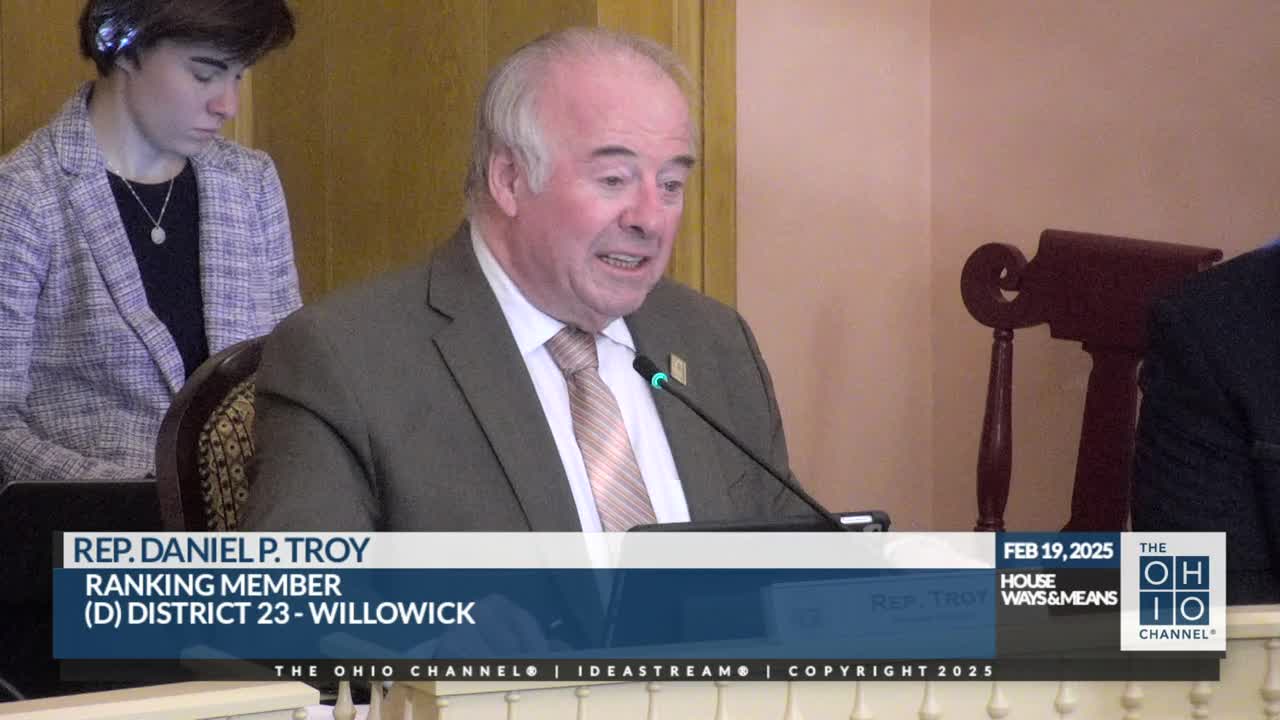
Committee members pressed sponsors on several practical and fiscal points. Ranking Member Troy and other members asked why the proposed $750 level would in many cases exceed savings under the current 2.5% rollback or the 10% nonbusiness rollback, and they asked for examples showing how the proposal would affect different communities (urban, suburban and rural areas have different shares of owner‑occupied property). Representatives asked for county‑level and municipality‑level projections and said they wanted clearer fiscal estimates before supporting any statutory change.
Members also raised administrative concerns the bill would need to address. Sponsors and committee members discussed repeated county auditor practices that sometimes lead to erroneous owner‑occupancy or homestead credits (for example, seasonal or second homes that also receive credits elsewhere). They said the absence of a statewide unique identifier for property credits complicates audits and enforcement and that county renewal and application practices vary; Ohio law technically requires annual requalification but many counties do not mail renewal forms because of costs. Sponsors suggested a local share of program cost could improve incentives for auditors to verify eligibility.
Several members asked whether converting an exemption or value adjustment to a refundable credit or partial state reimbursement could force local taxing entities to change reduction factors or raise levies to make up revenue shortfalls. Sponsors agreed that unintended consequences are possible and said the bill is designed to avoid shifting net burdens to taxpayers not eligible for credits; they repeatedly urged committee members to weigh those tradeoffs during the bill’s fiscal review.
The sponsors told the committee they have received an initial state fiscal analysis and are still working through details; they asked the committee to treat the hearing as an introduction to the concepts and to allow time for additional technical conversations and budget projections. No formal action or vote occurred at the hearing. The committee chair closed the discussion and recorded that the presentation and question period constituted the bill’s first hearing.