Get Full Government Meeting Transcripts, Videos, & Alerts Forever!
Get email alerts on the Agriculture Budget And Disease Response topic
No spam. Unsubscribe anytime.
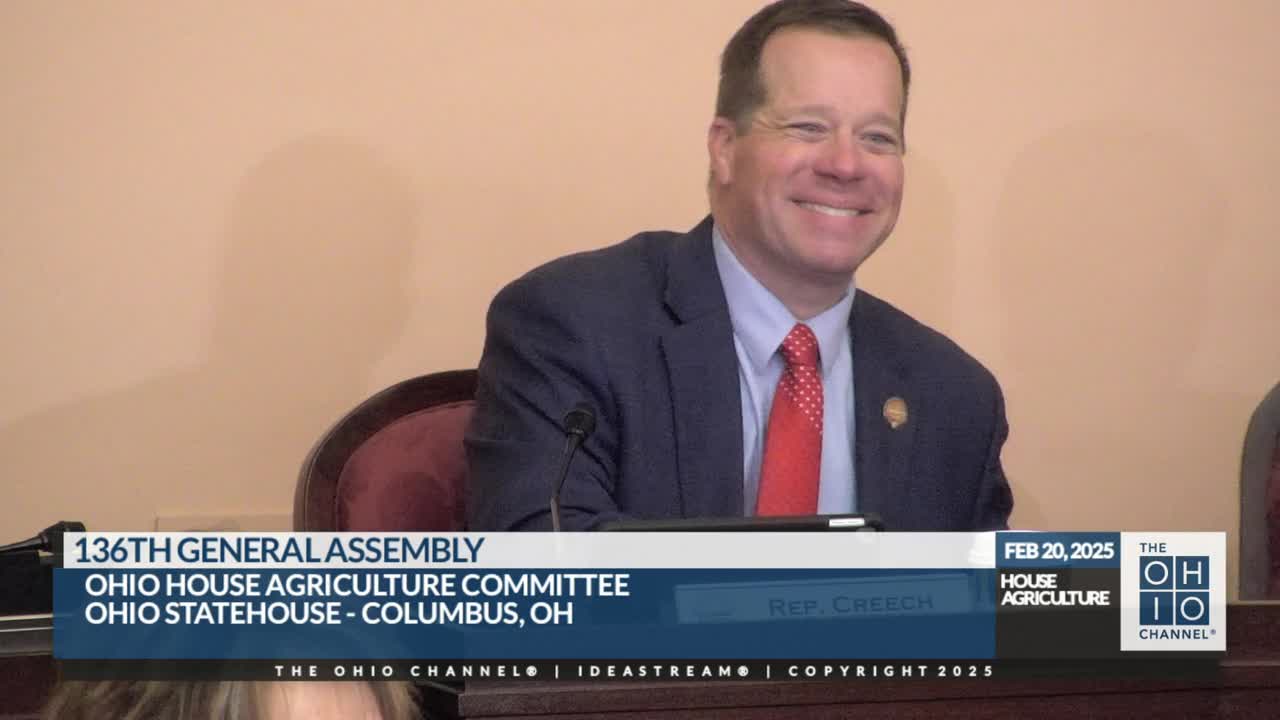
Ohio agriculture director outlines biennial budget with new animal lab, H2Ohio funding and farmland preservation aid
Summary
Director Baldridge told the Ohio House Agricultural Committee the Department of Agriculture's proposed FY26–27 budget emphasizes lab capacity and disease response, continues funding for H2Ohio, and expands farmland preservation grants; he warned the department remains in active response to highly pathogenic avian influenza.
Director Baldridge, director of the Ohio Department of Agriculture, told the Ohio House Agricultural Committee on Feb. 12 that the department's proposed biennial budget requests roughly $80,000,000 for FY 2026 and $180,900,000 for FY 2027 to support regulatory work, laboratory services and farming programs.
The budget, Baldridge said, aims to improve agency efficiency while funding “high risk issues” such as animal disease preparedness. "The mission at the department is to ensure the safety of the state's food supply, health of Ohio livestock and plants, while creating economic opportunities for Ohio farmers, food processors, and agribusinesses," he said.
Why it matters: the testimony framed laboratory capacity, disease response and farm-support reimbursements as central to the state's ability to protect agricultural producers and the food supply. Lawmakers pressed Baldridge on the department's capacity to handle a continuing outbreak of highly pathogenic avian influenza (HPAI) and on long‑term strategies to preserve farmland amid development pressures.
Key budget features and program details - Lab capacity and disease response: Baldridge said funding in the budget supports ODA laboratory services and the construction of a new animal disease diagnostic laboratory funded through recent legislation. He told the committee the lab is expected to be finished in mid‑2026 and that the department is using contracted staff to meet higher testing demand during the HPAI outbreak. He said roughly 30% of certain tests are currently performed in‑state. - HPAI response: Baldridge described the HPAI outbreak as ongoing since 2022 and said ODA remains in a response posture. He praised producers and USDA cooperation and said the department is “boots on the ground” supporting affected producers; he added that the current viral strain has shown consistent impacts on poultry production since 2022. - H2Ohio: the department said H2Ohio would continue with a $60,600,000 allocation under the proposed budget. Baldridge reported 3,200 producers participating and roughly 2,200,000 acres enrolled statewide; he said phosphorus test values show improving trends as best management practices are implemented. - Reimbursements and grants: Baldridge said about half of the department's budget is for reimbursements, citing $85,800,000 in FY26 and $83,600,000 in FY27 that will flow to farmers, local soil and water districts and fairs. - Farmland preservation: ODA reported the state's farmland preservation program currently covers 725 farms and more than 108,000 acres across 62 counties. The budget adds $1,000,000 to expand county planning grant opportunities, with $500,000 in each fiscal year.
Lawmakers' questions Vice Chair Newman asked whether the new laboratory will handle demand from the recent HPAI surge; Baldridge said the facility will add space and efficiency and that the department is hiring and contracting staff to increase capacity during outbreaks. Representative Sims pressed Baldridge about veterinary shortages and telehealth; Baldridge said the department employs more than 20 veterinarians, is engaged with Ohio State University and national partners, and is participating in conversations about using telehealth and other tools to expand veterinary reach for large‑animal producers.
What the department did not claim Baldridge described the department’s role as diagnostic and response oriented and explicitly distinguished ODA’s testing and diagnosis functions from university research labs. He did not provide a specific long‑term staffing plan or exact operating cost estimates for the new laboratory beyond confirming that the CFO is modeling operational expenses.
Ending note Baldridge closed by thanking the committee for legislative support, citing House Bill 687 and House Bill 2 as recent authorizations that enabled lab funding, and offered to answer follow‑up questions from committee members.