Get Full Government Meeting Transcripts, Videos, & Alerts Forever!
Get email alerts on the Higher Education Bonds topic
No spam. Unsubscribe anytime.
Higher Education Facilities Commission outlines bond program, reports large hospital financing and seeks small non‑GRF appropriation
Summary
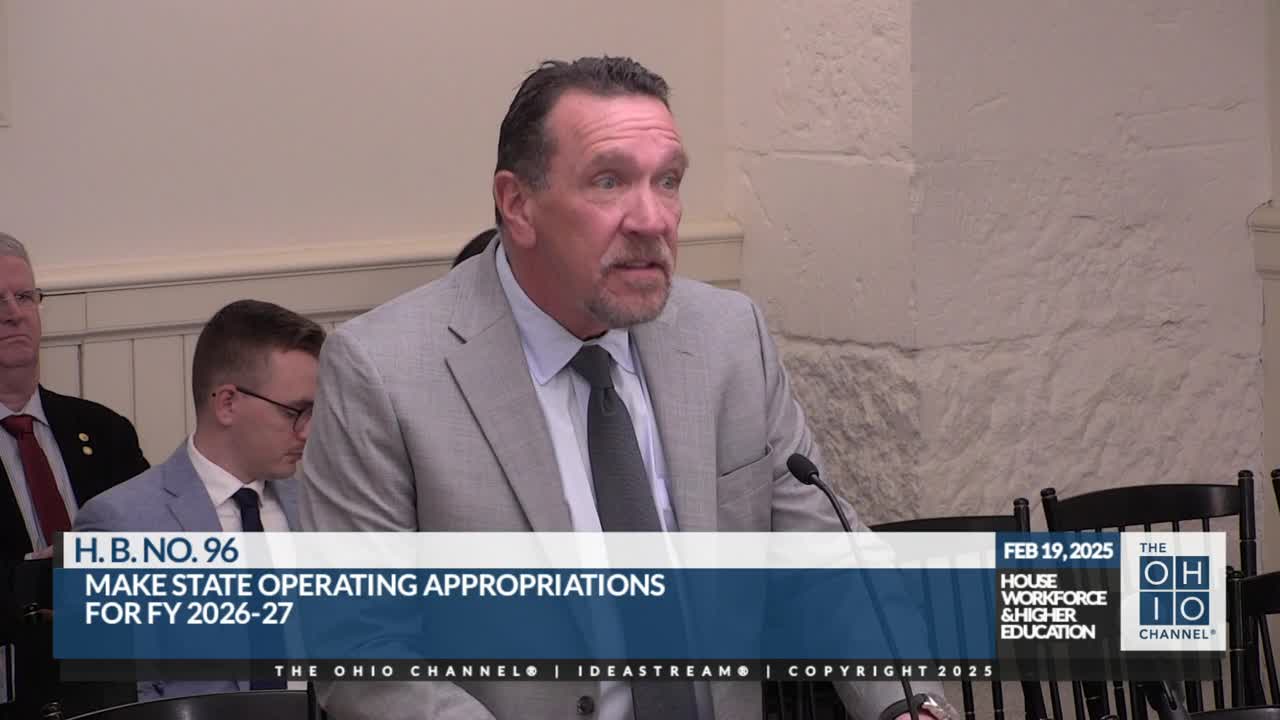
Tom Needles, chairman of the Ohio Higher Education Facilities Commission, told the House Workforce and Higher Education Committee that the commission issues tax‑exempt bonds for nonprofits and reported more than $8 billion in hospital bond issuance and estimated annual interest‑cost savings of over $80 million.
Tom Needles, chairman of the Ohio Higher Education Facilities Commission, told the House Workforce and Higher Education Committee that the commission issues tax‑exempt bonds to help independent nonprofit colleges, universities and certain nonprofit hospitals finance construction, renovation and acquisition of facilities at lower interest rates than market alternatives.
Needles said the commission was established by the Ohio Legislature in the late 1960s and that although the bonds are issued through the state, principal and interest are paid by the borrowing institutions; the state’s general revenues are not pledged. He said federal and state tax exemptions for interest on tax‑exempt bonds allow participating institutions to borrow at materially lower rates.
Since the General Assembly authorized the commission to issue tax‑exempt bonds for nonprofit hospitals (he said that change occurred in 2005), Needles told the committee the commission has issued more than $8 billion in hospital bonds and that estimated annual interest‑cost savings for nonprofits borrowing through the commission exceed $80 million based on outstanding principal and an estimated average interest rate. Needles said institutions using the program can also access more favorable financing terms and a wider investor market.
The commission’s operating costs are not paid from the general revenue fund, Needles said. Instead, the commission charges applicants a flat $500 initial fee and a second fee after bond issuance that has ranged from $3,000 to $25,000; fee revenue covers administrative costs and modest reimbursements for member expenses. For the upcoming biennium the commission seeks non‑GRF appropriation authority of $15,513 in each year, Needles said.
Representative Joe Miller asked about refunded or refinanced bond issues; Needles explained that refinancing is common and typically is used to access more favorable interest rates or to modify financing terms and that specific details depend on the individual bond issue.
No committee vote or formal action occurred during the presentation; the commission provided the details as part of the committee's review of agency operations and budget needs.