Get Full Government Meeting Transcripts, Videos, & Alerts Forever!
Get email alerts on the Behavioral Health topic
No spam. Unsubscribe anytime.
Ohio lawmakers hear overview of county behavioral health boards, funding constraints and workforce strains
Summary
The Ohio House Community Revitalization Committee received an overview of the state’s Alcohol, Drug Addiction and Mental Health (ADDM) boards, including their statutory duties, funding sources and constraints, levy coverage, workforce shortages and a pending proposal to modernize contract termination language.
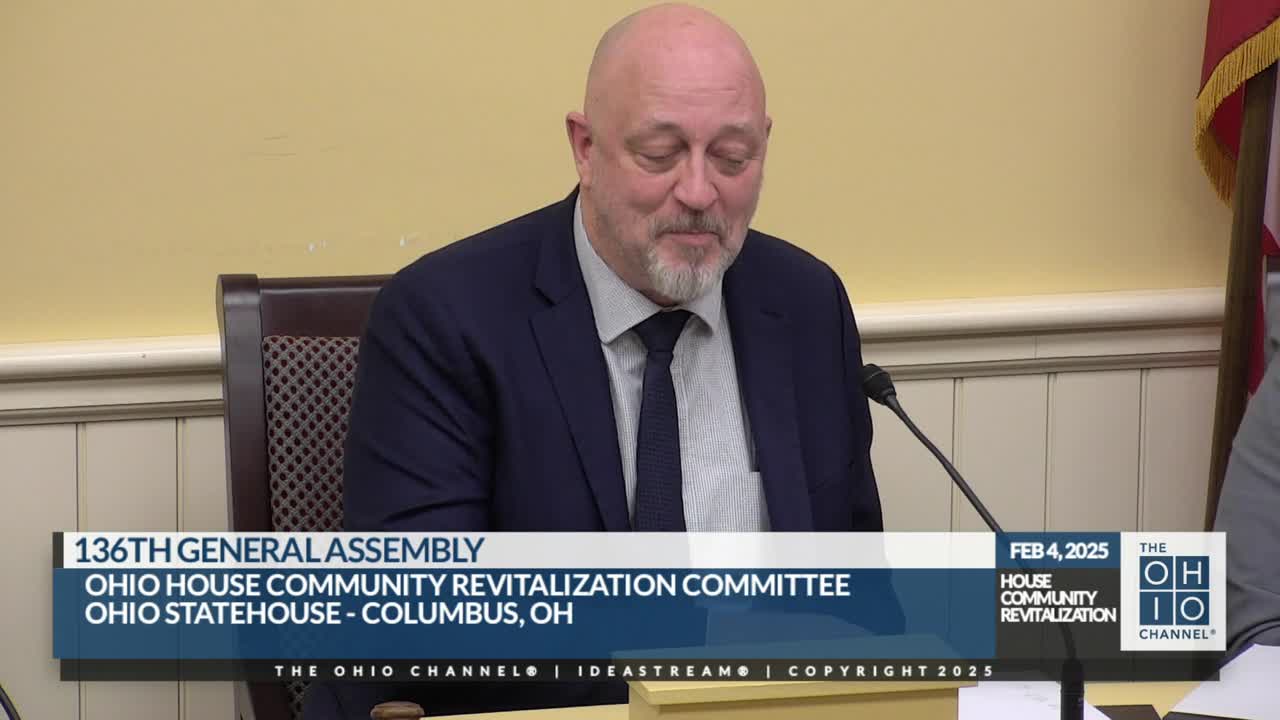
Liz Henrich, CEO of the Ohio Association of County Behavioral Health Authorities, told members of the Ohio House Community Revitalization Committee on Oct. 12 that county-level Alcohol, Drug Addiction and Mental Health (ADDM) boards serve as the public authorities that plan, fund and coordinate local mental health and addiction services across the state.
Henrich said the ADDM boards are “public bodies using public funds to contract for services in communities,” and that Ohio has 50 such boards, 19 of which cover multiple counties and 30 of which are single-county boards. She described boards as volunteer-governed bodies whose members are appointed two-thirds by county commissioners and one-third by the Department of Mental Health and Addiction Services and serve four-year terms.
The presentation outlined statutory responsibilities for the boards, including conducting a community assessment and planning cycle, recruiting local financial support, auditing contracted programs and ensuring services meet minimum standards established by the state agency. Henrich said the required local “continuum of care” includes prevention, outpatient and inpatient services and recovery supports, and that boards may contract with neighboring districts when a service is not locally available.
Henrich told the committee that ADDM boards primarily rely on a mix of federal grants, state general revenue funds and local property-tax levies. She said about 78 of the state’s 88 counties receive some levy support for mental health and addiction services and estimated roughly $700 million flows through ADDM boards for service delivery statewide. Henrich also said levy millage amounts vary but average about 1 mill.
Committee members asked how boards and legislators should respond when local providers cannot meet clients’ needs. Henrich recommended that members’ legislative aides contact local ADDM board directors for constituent service cases and said boards can often help identify available providers or community supports, but cautioned that high-acuity placements — for example, certain residential beds for youth — are not always available statewide.
On contracting and accountability, Henrich acknowledged a longstanding statutory requirement that boards give 120 days’ notice for substantial contract changes or terminations. She said her association and provider partners have spent months negotiating compromise language that would instead emphasize clearer transition-of-care planning in contracts, rather than only specifying a fixed notice period. “We talked more about what does the contract need to say when the two parties are negotiating, and how do we plan for … a transition of client care,” she said.
Several members pressed for more flexible state funding. Henrich said the association is advocating for more flexible state general revenue language to allow boards to move funds between program areas within the continuum of care while maintaining accountability. She said much of the recent growth in state funding has been targeted to specific programs and that boards would benefit from the ability to reallocate funds to meet changing local needs.
Committee members also raised workforce concerns. Henrich cited workforce shortages as a major driver of access problems and pointed to existing efforts — including fellowship programs and peer-support certification — to attract and retain staff. She suggested legislative support for sustainable compensation and predictable regulatory expectations could help recruitment and retention.
No formal motions or votes were taken. Chairman Click closed the hearing by thanking Henrich and the committee, and members said they expect to continue engagement with the association and boards as budget and statutory language proposals move forward.