Get Full Government Meeting Transcripts, Videos, & Alerts Forever!
Get email alerts on the Mental Health topic
No spam. Unsubscribe anytime.
NAMI Ohio urges legislature to expand community mental-health supports as prisons fill care gaps
Summary
Luke Russell, executive director of NAMI Ohio, told the House Community Revitalization Committee that Ohio’s mental-health system lacks a person-centered continuum of care, leaving families and jails to fill critical gaps and pushing policy priorities toward housing, day services, care coordination and workforce supports.
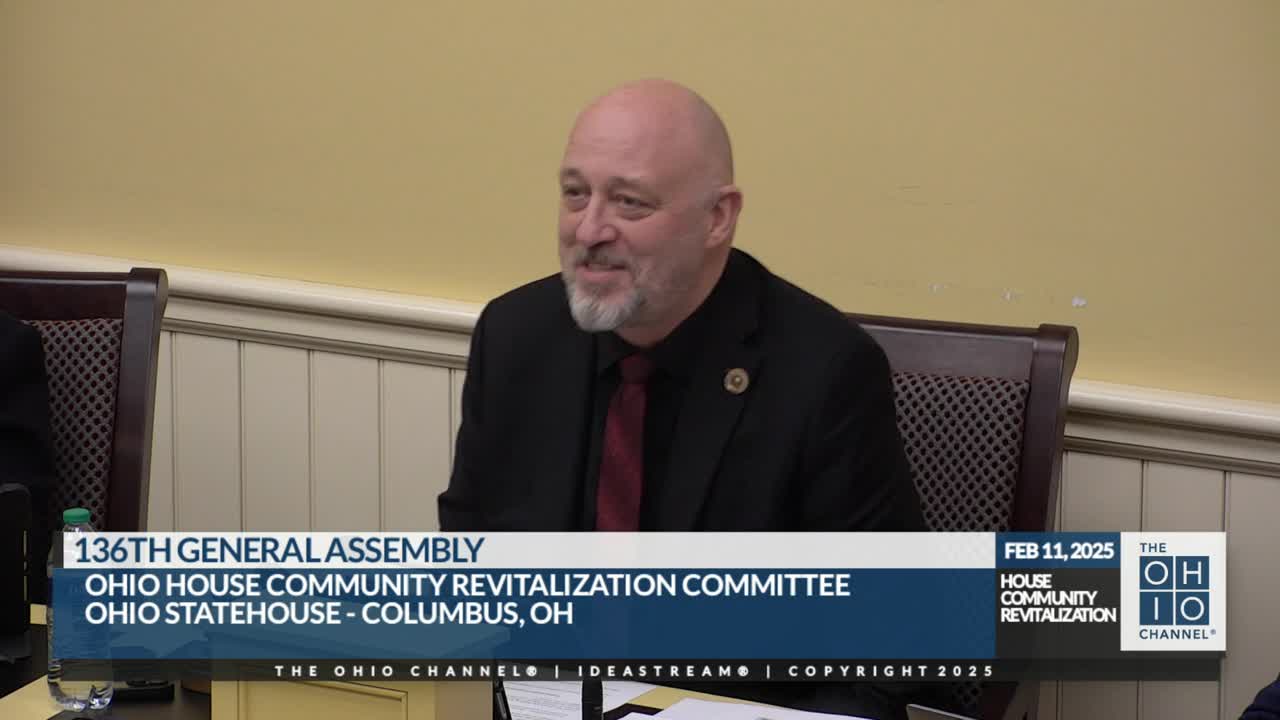
Luke Russell, executive director of the National Alliance on Mental Illness (NAMI) Ohio, told the House Community Revitalization Committee on Oct. 12 that Ohio’s mental-health system lacks a person-centered continuum of care and that families and correctional facilities are increasingly providing care for people with serious mental illness.
“We are proud that we are the largest mental health advocacy organization in the country representing 500,000 Ohio citizens and their families,” Russell said. He told the committee NAMI Ohio has 39 affiliates covering 85 of the state’s 88 counties and stressed that “family members families living with mental illness provide 80% of the caregiving.”
Why it matters: Russell said the shortage of civil inpatient beds and community supports forces many Ohioans with serious mental illness into prisons, jails, homeless shelters and substandard housing. He described a system where state hospital capacity is heavily used for forensic purposes, and argued that investing in housing, day services, care coordination and workforce pay would reduce expensive hospital and jail stays.
Russell listed the services and programs NAMI Ohio provides and helps certify, including signature education classes such as NAMI Family-to-Family, peer-led supports like NAMI Connections, veteran-focused NAMI Homefront offerings, campus outreach and a statewide helpline and chat function. He said NAMI Ohio’s helpline averaged about 300 calls per month prior to September, with roughly 10%–20% of those classified as crisis calls; he also cited that 988 callers are resolved on the call more than 80% of the time.
Committee members pressed Russell on specific gaps and policy options. Representative Gross, chairing the Medicaid committee, asked about disappearing inpatient beds and whether correctional facilities were effectively serving as de facto providers. Russell said Ohio has roughly 1,100 state hospital beds and that about 94% of those beds serve forensic needs — patients in the hospitals for competency restoration or related criminal-justice reasons — leaving few civil beds for people who need inpatient care for treatment rather than restoration.
“We need more civil beds,” Russell said, and added that the state also needs “a more holistic system” that includes housing, day programs (which he described as clinical day treatment or clubhouses), and stronger care management. He noted that a single week in a state hospital can cost about $1,000, and that community services can be far less expensive if they keep people stable and out of hospitals or jails.
On crisis response, Russell described Ohio’s Crisis Intervention Team (CIT) training as a long-standing program and encouraged legislators and family members to request CIT-trained officers when police are dispatched. “Ask for a CIT officer. They’re trained, they know what to do,” he said, and said many communities are pairing CIT officers with mental-health clinicians or using mobile crisis teams so fewer people go to emergency departments.
Ranking Member Brewer and others asked what policy changes legislators could pursue. Russell recommended strengthening the continuum of care, improving reimbursement rates for day treatment so providers can sustain those services, expanding peer- and family-peer support certification and training, and addressing workforce shortages — including high vacancy rates for case managers that Russell said can reach about 40% for some providers.
Russell also described NAMI Ohio’s advocacy and partnerships: involvement with the Stepping Up initiative to reduce jail populations, collaboration with the Department of Rehabilitation and Corrections on reentry needs, work on family peer-support certification, and a statewide blueprint effort that aims to show cost savings from community-based services.
Committee members raised related topics including early intervention for youth, the role of social workers attached to police departments, language and cultural barriers for immigrant populations, and how dementia among aging caregivers affects families. Russell said NAMI works with local affiliates and partners — citing examples in Clark County, Athens, Cleveland and other Ohio communities — and that those local partnerships help link families to services and training.
The committee did not take formal action on Russell’s testimony; members invited follow-up and Russell offered to provide additional information and support. The committee adjourned after the question-and-answer period.
Sources and attributions in this article come from the committee transcript and the speakers listed below.