Get Full Government Meeting Transcripts, Videos, & Alerts Forever!
Get email alerts on the Public Media topic
No spam. Unsubscribe anytime.
Ohio public media and Ohio Channel ask legislature to sustain statewide broadcasting network
Summary
Officials from the Broadcast Educational Media Commission, Ohio Channel and public broadcasters told the House Workforce and Higher Education Committee the governor's budget would fund operations, maintenance and content development across a statewide public-media network and warned aging equipment and rising costs threaten service continuity.
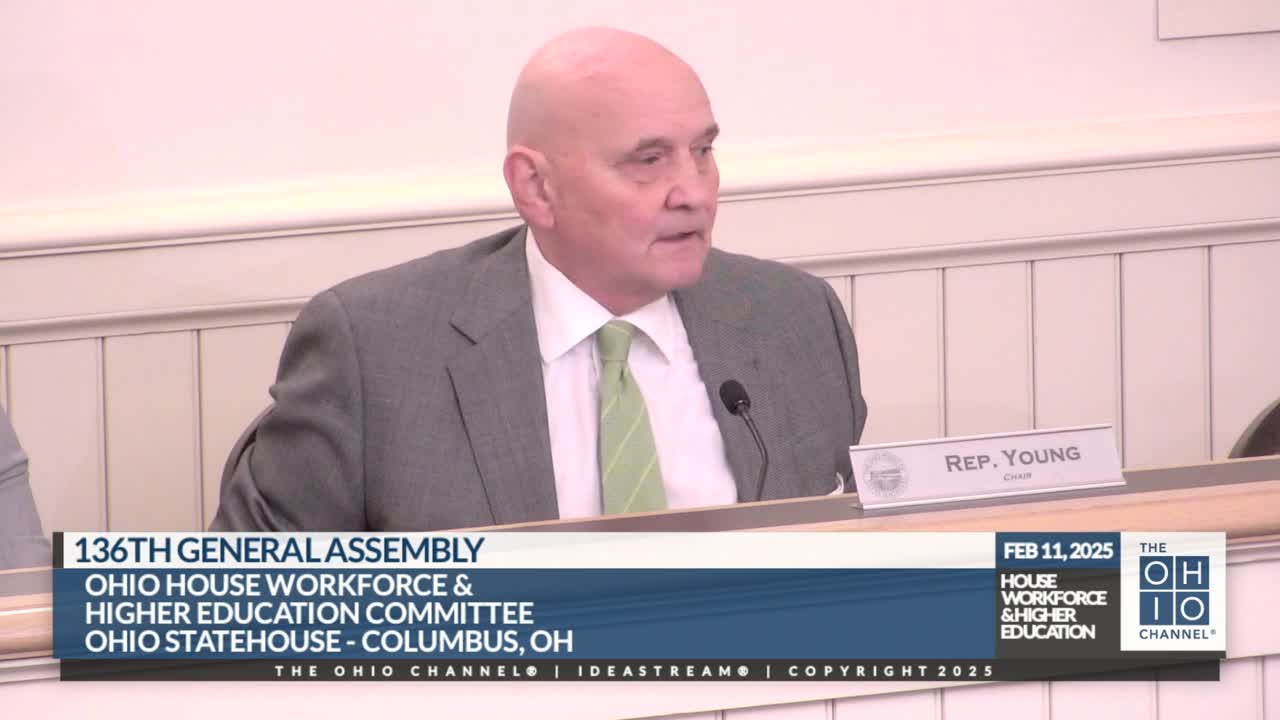
Chairman Young and members of the House Workforce and Higher Education Committee heard testimony Feb. 4 from leaders of Ohio's public-media system seeking continued state support for the Broadcast Educational Media Commission (BEMC) and its partners, including the Ohio Channel, the Statehouse News Bureau and public TV and radio stations across Ohio.
Why it matters: BEMC is the state-funded interconnection that delivers legislative proceedings and other government programming to Ohioans. Witnesses said the network also provides emergency messaging, education content for classrooms and services for Ohioans with visual impairments. They told the committee that maintenance, equipment replacement and content-development funding are needed to keep the system operating and to adopt emerging broadcast standards.
Executive director Jeffrey Phillips told the committee the request covers four budget lines inside the BEMC package and that the agency serves as the state funding source for the Ohio Channel, the Statehouse News Bureau and Ohio public broadcasters. "These three have answered the call," Phillips said. He described BEMC as the agency that "links them together so your constituents across Ohio can see what's happening here in the Statehouse." Phillips said the commission supports an amendment to increase the content-development line by $195,000 to fully fund requests from television, radio, radio-reading and multimedia partners.
Kitty Lensman, president and CEO of Public Media Connect and spokesperson for the Ohio Alliance for Public Telecommunications, told lawmakers public media reaches more than 11.8 million Ohio residents and provides emergency-alert services, professional development for teachers and multimedia educational materials. "This budget represents a modest increase, and one we have not received for almost 10 years," Lensman said, adding that state support is a cornerstone allowing stations to leverage community fundraising.
Megan Wyckoff, executive director of Ohio Government Telecommunications / the Ohio Channel, described the channel's role producing objective coverage of government proceedings and providing archived content. Wyckoff said the governor's recommendation helps offset rising contract, hardware and software costs needed to keep archival and live services online. Dan Schellenbarger, general manager of Ohio Public Media Services, told the committee the system's statewide fiber and connectivity make Ohio a "gold standard" for government broadcasting, and he described technical upgrades needed to adopt next-generation broadcast standards (ATSC 3.0) and to preserve decades of archived material.
Committee members pressed for detail on spending and revenue. Representative Williams asked why a non-GRF media services line jumped from $500 in FY 2025 to $50,000 in FY 2026; Phillips said those are non-GRF funds BEMC received from prior video-conferencing activity and licensing agreements and that the money would be used to address aging equipment over a multi-year phase-in. Phillips also said current appropriations are $10.6 million and that the recommended lines were submitted as requested by the commission.
What was not decided: The hearing was for testimony; no formal votes or committee actions were taken on the record. Witnesses said they would provide committee members with a breakdown of how state funds are allocated among 32 entities (television, radio, radio-reading services) and with maps showing coverage and population reach.
Looking ahead: Speakers asked the committee to preserve the funding relationship that supports statewide archival access, emergency alerts and educational programming.