Get Full Government Meeting Transcripts, Videos, & Alerts Forever!
MassDEP webinar: study finds fragile biosolids network, evaluates PFAS controls and costly treatment options
Summary
Massachusetts Department of Environmental Protection and consultants presented Part 1 findings and Part 2 preliminary results on how PFAS regulation could affect sludge/biosolids disposal capacity, treatment options and costs, and recommended state and utility-level responses.
The Massachusetts Department of Environmental Protection presented findings from two studies on wastewater sludge and PFAS management during a public webinar, saying the state’s sludge-disposal network is “very fragile” and that stricter limits on land application could shift material to more costly and higher‑emission disposal methods.
Kathy Baskin, assistant commissioner for MassDEP’s Bureau of Water Resources, opened the webinar and described the studies as an effort to give policymakers “a more informed way to have that conversation with the legislature.”
The studies, summarized by consultants from Brown and Caldwell and Tye and Bond, assessed where sludge is generated and sent, the greenhouse‑gas and capacity impacts of disposal endpoints, and a wide set of technology and policy options to reduce PFAS loadings and manage biosolids if land application is restricted.
Part 1 findings and network snapshot
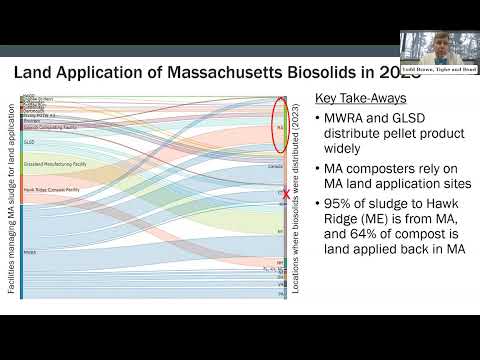
Consultant Todd Brown summarized Part 1, which quantifies the Commonwealth’s sludge flows in 2023 and maps processing and disposal destinations. “In total for the year 2023, there were about 165,700 dry tons of sludge generated statewide,” Brown said. Of that total, the study found 39% was processed and land applied, 37% was incinerated (in Massachusetts and nearby states), and 14% was landfilled in New York, Vermont, New Hampshire, Maine and Massachusetts.
Brown and other presenters described the system as operating at or near capacity with “essentially no spare capacity” to absorb disruptions or projected growth; Part 1 projects roughly 12,000 additional dry tons in coming years for which destinations were not identified. Consultants warned that closing or…
Already have an account? Log in
Subscribe to keep reading
Unlock the rest of this article — and every article on Citizen Portal.
- Unlimited articles
- AI-powered breakdowns of topics, speakers, decisions, and budgets
- Instant alerts when your location has a new meeting
- Follow topics and more locations
- 1,000 AI Insights / month, plus AI Chat