Get Full Government Meeting Transcripts, Videos, & Alerts Forever!
Get email alerts on the Biosolids Pfas Management topic
No spam. Unsubscribe anytime.
MassDEP webinar: study finds fragile biosolids network, evaluates PFAS controls and costly treatment options
Summary
Massachusetts Department of Environmental Protection and consultants presented Part 1 findings and Part 2 preliminary results on how PFAS regulation could affect sludge/biosolids disposal capacity, treatment options and costs, and recommended state and utility-level responses.
The Massachusetts Department of Environmental Protection presented findings from two studies on wastewater sludge and PFAS management during a public webinar, saying the state’s sludge-disposal network is “very fragile” and that stricter limits on land application could shift material to more costly and higher‑emission disposal methods.
Kathy Baskin, assistant commissioner for MassDEP’s Bureau of Water Resources, opened the webinar and described the studies as an effort to give policymakers “a more informed way to have that conversation with the legislature.”
The studies, summarized by consultants from Brown and Caldwell and Tye and Bond, assessed where sludge is generated and sent, the greenhouse‑gas and capacity impacts of disposal endpoints, and a wide set of technology and policy options to reduce PFAS loadings and manage biosolids if land application is restricted.
Part 1 findings and network snapshot
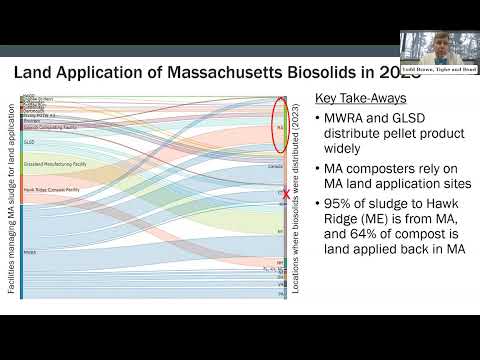
Consultant Todd Brown summarized Part 1, which quantifies the Commonwealth’s sludge flows in 2023 and maps processing and disposal destinations. “In total for the year 2023, there were about 165,700 dry tons of sludge generated statewide,” Brown said. Of that total, the study found 39% was processed and land applied, 37% was incinerated (in Massachusetts and nearby states), and 14% was landfilled in New York, Vermont, New Hampshire, Maine and Massachusetts.
Brown and other presenters described the system as operating at or near capacity with “essentially no spare capacity” to absorb disruptions or projected growth; Part 1 projects roughly 12,000 additional dry tons in coming years for which destinations were not identified. Consultants warned that closing or restricting one disposal pathway—most notably land application—could force a shift to incineration or landfill disposal, which carry higher greenhouse‑gas impacts and other environmental tradeoffs. As Bill Brower of Brown and Caldwell put it, “incineration has about doubled the greenhouse gas impact of the land application options and landfilling and monofilling is more than 4 times the greenhouse gas impact.”
Sources, monitoring and PFAS ubiquity
Part 2 work is examining how PFAS concentrations in influent, effluent and sludge would interact with policy choices. The team analyzed samples reported to MassDEP’s PFAS data portal, finding that a common set of PFAS compounds appears frequently in influent and effluent samples, while sludge often contains a somewhat different mix and occasional spikes at individual plants.
The consultants performed mass‑balance analyses at example plants and found that industrial dischargers can represent a meaningful fraction of some plants’ PFAS loads—approaching about 40% for some species at one facility—while at other plants industrial contributions were low. Todd Brown summarized that result: at some POTWs, “it likely does make sense to explore source reduction, through industrial pretreatment,” but at others, household and commercial sources dominate and will limit the potential benefit of pretreatment alone.
Treatment and volume‑reduction technology options
The report evaluates three classes of responses: upstream source control, onsite plant interventions (including full‑flow liquid treatment and sludge treatment), and regional or third‑party facilities. Volume‑reduction steps such as dewatering, anaerobic digestion and thermal drying reduce the mass of biosolids to manage but do not directly remove PFAS. More technically targeted PFAS destruction or removal options for sludge include pyrolysis, gasification and supercritical water oxidation; for full‑flow liquid treatment, options evaluated include granular activated carbon and ion‑exchange systems.
Consultants presented lifecycle cost estimates (capital plus 20 years of O&M) and translated annualized costs into an approximate per‑household rate impact for typical utility sizes. They emphasized these are high‑level estimates; implementation costs would vary by site and could be offset by grants. For existing sewage sludge incinerators, the team modeled installing emissions control systems such as regenerative thermal oxidizers (RTOs) to reduce PFAS air emissions; one example estimated a capital cost near $30 million for a larger facility and about $10 million for a smaller facility, with an additional annual O&M cost on the order of $3 million at the larger site—roughly 15% of that facility’s 2025 operations and maintenance budget, the presenters said.
Regulatory context and state policy options
Presenters reviewed federal and interstate developments. They noted that EPA designated PFOA and PFOS as hazardous substances under CERCLA in 2024 and recently released a draft biosolids risk assessment. The consultants described a range of approaches used by other states: several states have adopted tiered thresholds (for example, a low threshold around ~20 parts per billion below which land application continues, intermediate thresholds that trigger additional controls, and higher thresholds that prohibit land application), while Maine and Connecticut have pursued broader bans on land application.
Consultants and MassDEP staff outlined potential roles for utilities and the state: utilities can pursue industrial pretreatment where feasible, increase monitoring and reporting, implement volume‑reduction projects, and consider regional treatment facilities. The state can establish land‑application limits, provide regulatory clarity for emerging PFAS treatment technologies, fund piloting and full‑scale projects, and promote regional facilities through guidance and financing.
MassDEP next steps
MassDEP said Part 1 is posted on its website and that Part 2 will be finalized later this year; the department is also launching an additional study to expand sampling and characterization of influent, effluent and sludge PFAS concentrations. Leldon Langley, division director of watershed management at MassDEP, said the aim is to use the study results to inform legislative and regulatory discussions and to avoid “unintended consequences” when crafting limits or support for treatment infrastructure. “PFAS is...ubiquitous in our environment in a variety of different media,” Langley said, and MassDEP staff continue to work with industrial users and the Office of Technical Assistance to identify alternatives and pretreatment opportunities.
The webinar concluded with an outline of the tradeoffs MassDEP and municipalities must weigh—environmental and public‑health implications of PFAS in soils and waters versus greenhouse‑gas emissions, costs to ratepayers, and the practical limits of available disposal and treatment capacity. The Part 2 report and the department’s new sampling effort are intended to provide additional data to guide those decisions.