Get Full Government Meeting Transcripts, Videos, & Alerts Forever!
Get email alerts on the Open Meeting Law Guidance topic
No spam. Unsubscribe anytime.
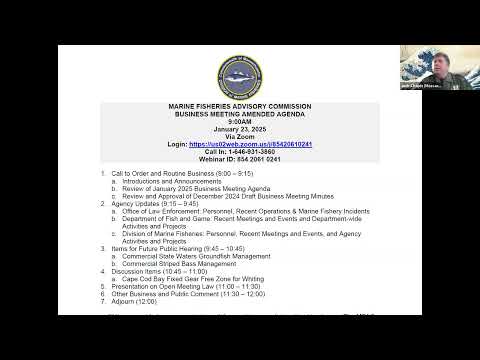
General counsel reviews open meeting law guidance; commission to clarify agenda specificity and communication rules
Summary
The Department of Fish and Game general counsel reviewed Massachusetts open‑meeting requirements for agenda specificity, public-notice timing and prohibitions on serial deliberations; commissioners were advised to include topic-specific agenda items and avoid quorum communications outside public meetings.
Jennifer Sula, general counsel for the Department of Fish and Game, briefed the commission on open meeting law requirements (Mass. Gen. Laws ch. 30A §§ 18–25 and 940 CMR 29), focusing on agenda specificity, 48‑hour notice, and serial communication prohibitions.
Why it matters: Recent guidance from the Attorney General’s office emphasizes that general placeholders (for example, “comments from the chair” or “new business”) do not satisfy the specificity requirement when a topic was reasonably anticipated more than 48 hours before a meeting; failure to provide sufficient notice in some cases can nullify votes.
Sula summarized determinations and examples from the Attorney General’s office: agendas must list topics with “sufficient specificity” so members of the public can decide whether to attend; routine or recurring vague items do not meet the standard. She said if an item is of particular public interest that was known more than 48 hours before the meeting, it should be placed on the notice and not discussed anew under a generic placeholder. The attorney general’s office has nullified votes where councils discussed material matters under nonspecific agenda headings.
Sula also reviewed serial-communication rules: a deliberation is any communication among a quorum about public business; email chains, sequential phone calls or social‑setting conversations that create a quorum’s deliberation can violate the law. She advised commissioners to avoid email exchanges among multiple members and to route constituent inquiries through staff when appropriate so the commission can address issues at public meetings. Commissioners asked practical questions about public comment, other business and conference settings; Sula recommended using “other business” for genuinely unanticipated items that arose within 48 hours and to request formal agenda placement for items of public interest.
Direction from the meeting: commission staff will adapt agenda language to be more specific where feasible and publish guidance to commissioners about serial communications and best practices for handling constituent inquiries.