Get Full Government Meeting Transcripts, Videos, & Alerts Forever!
Get email alerts on the Enforcement Lobster Landings topic
No spam. Unsubscribe anytime.
MEP, DMF clarify nighttime lobster-landing window; new patrol boat expected
Summary
Massachusetts Environmental Police and the Division of Marine Fisheries discussed enforcement steps for lobster landing rules, confirmed a February landing-time ban, and said a new 41-foot patrol boat will increase offshore enforcement capacity this spring.
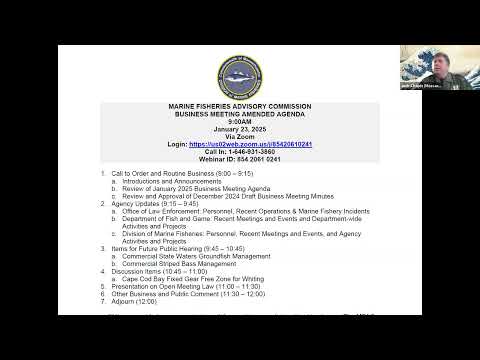
Captain Chapin of the Massachusetts Environmental Police (MEP) briefed the Marine Fisheries Advisory Commission on law-enforcement items including conflicts between shore-based fishermen and federal draggers, derelict gear work, and recent public-safety reports.
Why it matters: The meeting clarified an existing landing-time restriction for lobsters that takes effect Feb. 1 and discussed enforcement priorities and new patrol capability that officials said will boost enforcement in harder-to-patrol areas off the Lower Cape and Nantucket Sound.
MEP reported efforts with the Division of Marine Fisheries (DMF) to address conflicts between local fishermen and federal draggers landing lobsters from federal waters. Captain Chapin said MEP is “in the process of working with DMF to discuss potential solutions to help mitigate these issues.” He also told the commission that a recent report to police in Wellfleet about possible rodenticide in shellfish tanks was investigated and found to be false; the Department of Public Health was notified and the former employee involved was issued a no‑trespass order.
Dan McKeonan, director of the Division of Marine Fisheries, answered a specific enforcement question about night landings. “From February 1 to the thirtieth, it is unlawful to land from 8 p.m. to 6 a.m.,” McKeonan said, citing the state regulation. Commissioners raised enforcement concerns and asked to coordinate with DMF and MEP; McKeonan and others suggested that industry representatives — including MLA leadership — could sit in on enforcement discussions.
On patrol capability, Captain Chapin told the commission: “We’ve got a new 41 offshore patrol boat arriving soon.” He said after scheduled maintenance and training the craft should be operational this spring or early summer and will increase MEP’s waterborne coverage, particularly off the Lower Cape and Nantucket Sound.
The commission did not take formal votes on enforcement items; commissioners asked staff to continue coordination with DMF and to include industry representatives in planned enforcement discussions.
A follow-up item: commissioners asked staff to circulate enforcement contact information and to notify industry stakeholders when joint DMF/MEP enforcement meetings are scheduled.