Get Full Government Meeting Transcripts, Videos, & Alerts Forever!
Get email alerts on the Right To Repair Digital Electronics topic
No spam. Unsubscribe anytime.
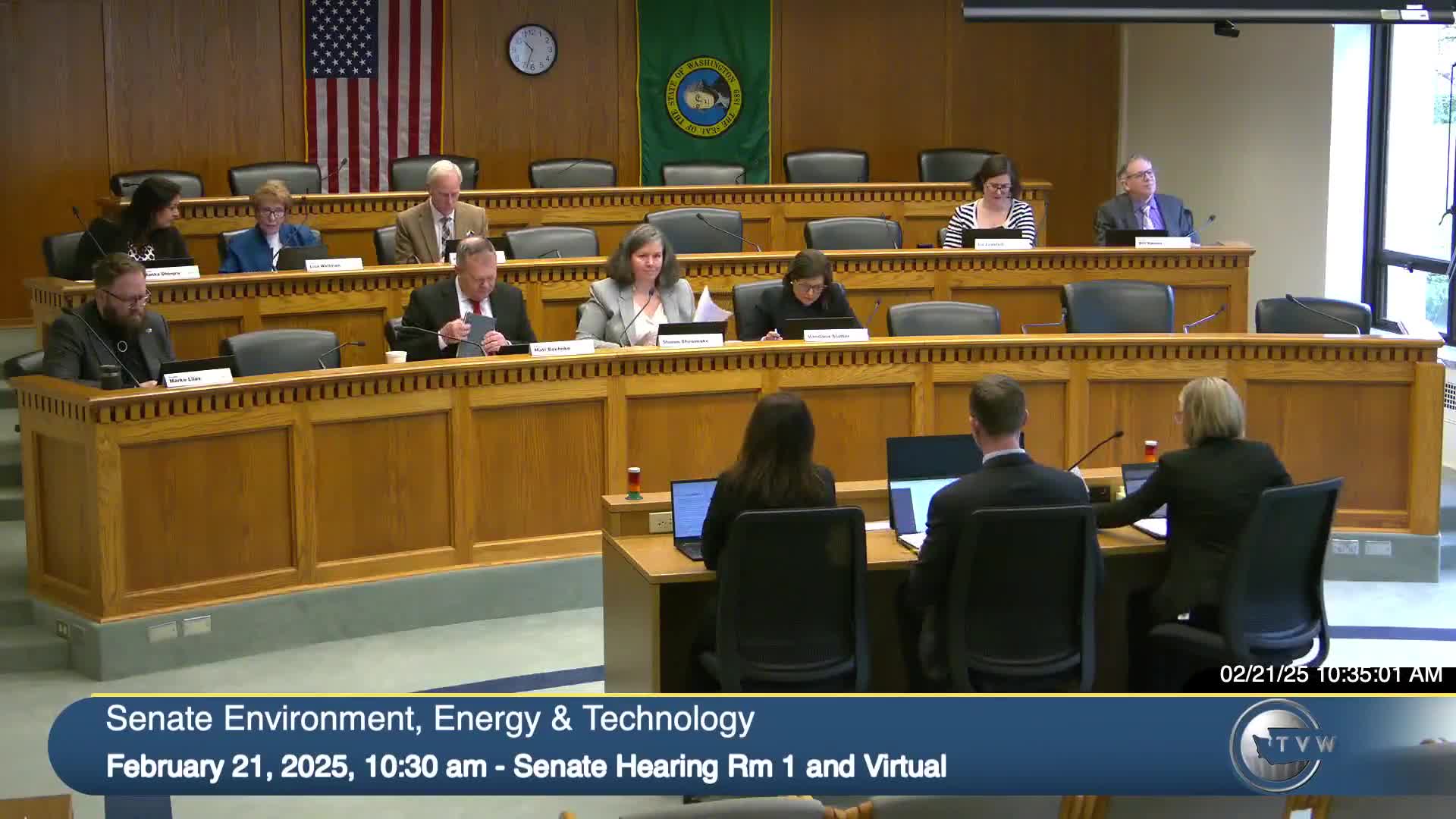
Senate committee advances 'right to repair' measure after substitute fails amid security, industry debate
Summary
Senators debated a substitute modeled on Colorado and amendments that would limit manufacturers' obligations; the substitute failed but the bill received a due‑pass recommendation and was reported to rules subject to signatures.
The Senate Environment, Energy & Technology Committee considered Senate Bill 5,423, a Right to Repair bill for digital electronic products, including proposed substitutes and amendments that senators said balance repair access with device security and brand protections.
Staff briefed the committee that SB 5,423 would require original manufacturers of digital electronic products, starting Jan. 1, 2026, to make parts, tools and documentation available to independent repair providers on fair and reasonable terms, with enforcement through the Consumer Protection Act. The staff summary said the proposed substitute offered by Sen. Wellman would limit parts to those provided by manufacturers to authorized repair providers and add exemptions such as source code and biometric part pairing rules; a B1 (and A) amendment would add an exception that exempts the requirement if the manufacturer provides an equivalent or better replacement product at no charge to the customer.
Sen. Wellman — who offered the substitute and amendments — urged the committee to adopt language modeled after Colorado to preserve security while expanding repair access. "I think it is a way to move forward, that allows the right to repair... while still maintaining brand identity," she said, adding that companies such as Apple and Google have worked with similar language in other states.
After caucus and executive session, a motion to adopt the proposed substitute failed. Committee members voted on the substitute with a roll‑call indication of "6 opposed, 5 in favor," and the chair announced the proposed substitute had failed. Committee members then voted to send the bill forward with a due‑pass recommendation to the Rules Committee; the chair announced "The bill has passed subject to signatures." The committee did not record a detailed roll‑call for that final due‑pass action in the hearing record.
The record includes sponsor‑proposed narrow exemptions for biometric components, a carve‑out that manufacturers need not provide source code, and an amendment that would excuse manufacturer obligations if the manufacturer supplies an equivalent replacement product at no charge. The committee did not finalize which of the offered amendments (B1 or A) would be attached in the rules packet; members discussed but did not resolve technical details in committee.
The committee's action advances SB 5,423 to the Rules Committee with the recommendation that it receive further consideration; staff and senators signaled ongoing negotiation over precise amendment language and consumer‑protection provisions.