Get Full Government Meeting Transcripts, Videos, & Alerts Forever!
Get email alerts on the Clean Vehicles Delink Carb topic
No spam. Unsubscribe anytime.
Heavy‑duty industry urges delinking from California rules as committee hears mixed views on clean‑vehicle policy
Summary
Supporters of SB 5091 told the Senate Environment, Energy & Technology Committee that delinking from California standards is needed to avoid cost and infrastructure shortfalls for heavy trucks; clean‑vehicle advocates said repeal would undermine the state's greenhouse‑gas goals and jobs in the clean‑tech workforce.
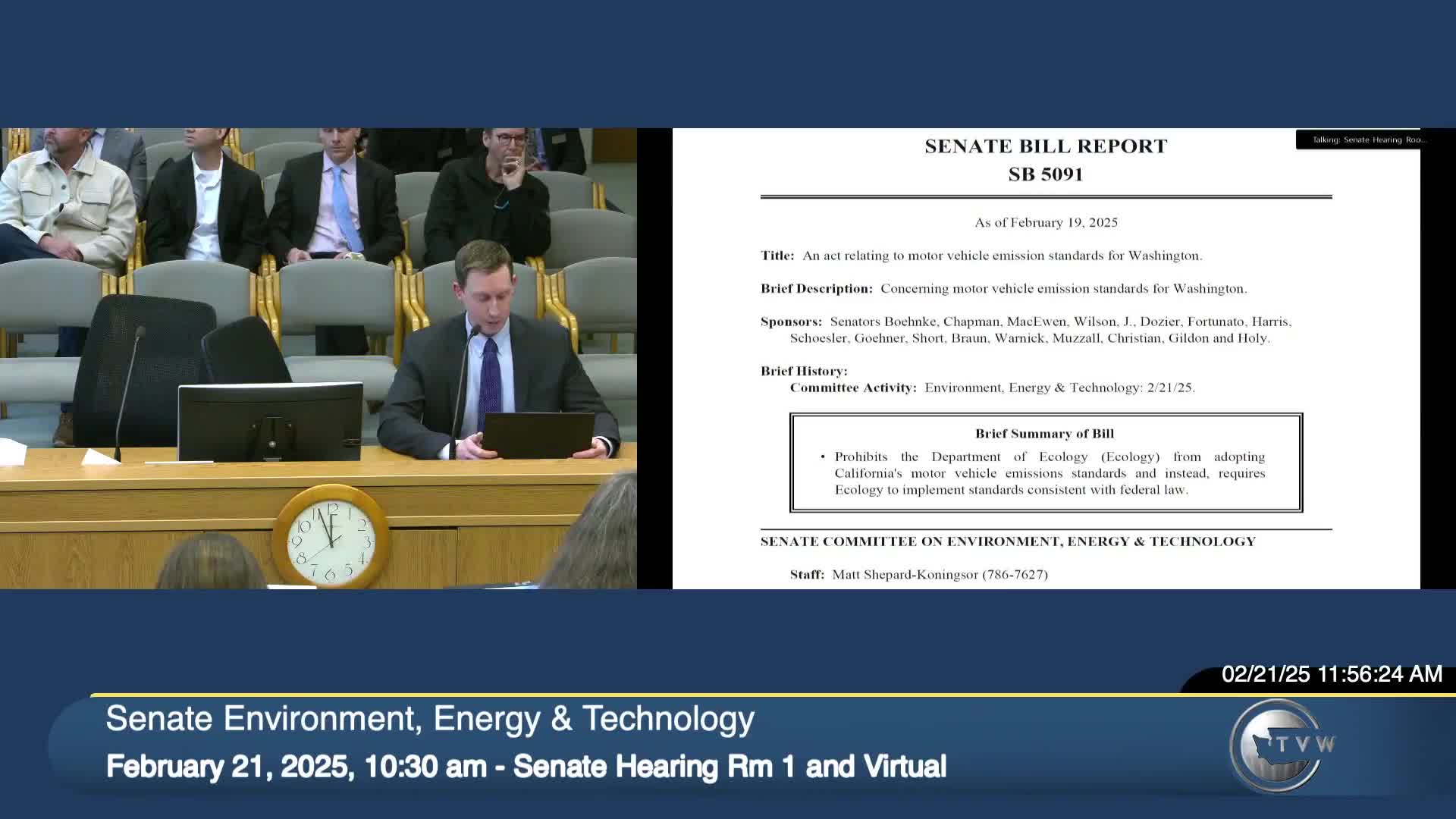
The Senate Environment, Energy & Technology Committee heard testimony on Senate Bill 50 91, which would remove Washington's authority to implement California motor vehicle emission standards and require Ecology to adopt federal standards instead. Staff briefed members that under the federal Clean Air Act states may follow either federal or California standards; Washington currently follows the California‑aligned Clean Vehicles Program.
Sponsor Sen. Matt Behnke said the bill is intended to give Washington more flexibility to address local industry and energy‑capacity challenges, particularly in the medium‑ and heavy‑duty truck sector. "The trucking industry needs time to overcome some of these initial challenges," Behnke said, citing energy capacity and limited vehicle options.
Construction, trucking and dealer groups urged the committee to pass the bill to delink from the California Air Resources Board rules or to delay implementation. The Associated General Contractors, truck dealers and dealer groups described steep cost and market disruptions for class 7–8 trucks: multiple witnesses said a new electric class‑8 tractor can cost roughly $500,000 to $560,000 versus $300,000 for a diesel truck; battery electric trucks were called heavier by roughly 10,000–20,000 pounds and shorter‑range (speakers cited 150–250 miles), and charging times were described in some testimony as multiple hours. Several dealers and fleet operators said orders have fallen to near zero where CARB‑style rules were implemented and warned of lost sales, lost jobs and companies shifting purchases out of state.
Supporters of the state's clean‑vehicle rules and electric‑vehicle advocates said keeping Washington aligned with California standards is essential to meeting greenhouse gas reduction targets and to preserving the growing clean‑energy and charging workforce. Joel Creswell of Ecology told the committee that Washington's adoption of zero‑emission vehicles under the Clean Vehicles Program will reduce greenhouse gas emissions by an estimated 8 million metric tons per year by 2030 compared with 2021. Labor and environmental groups urged the committee to "throw some cold soup on this bill," saying rollback would hinder progress on pollution and climate.
Several witnesses proposed compromise approaches: industry representatives asked for implementation delays, infrastructure investment, or carve‑outs for specific vocational vehicles such as utility bucket trucks. Department of Ecology and employer groups also warned that a repeal could reduce the number of zero‑emission vehicle models available to Washington consumers and would make it harder to meet state statutory climate goals.
No committee vote was taken at the hearing. Testifiers on both sides submitted written materials and asked the Legislature to work on a transition that addresses charging infrastructure, vehicle availability and cost for medium‑ and heavy‑duty fleets.