Get Full Government Meeting Transcripts, Videos, & Alerts Forever!
Get email alerts on the State Government & Elections topic
No spam. Unsubscribe anytime.
Senate committee advances bill to give Legislature formal role in ending gubernatorial emergencies; substitute requiring majorities wins
Summary
On Feb. 21, 2025 the Senate State Government, Tribal Affairs and Elections Committee adopted Substitute B to Senate Bill 5434, a measure establishing procedures for the Legislature to terminate or modify gubernatorial emergency orders. The committee also recommended confirmation of three gubernatorial appointments.
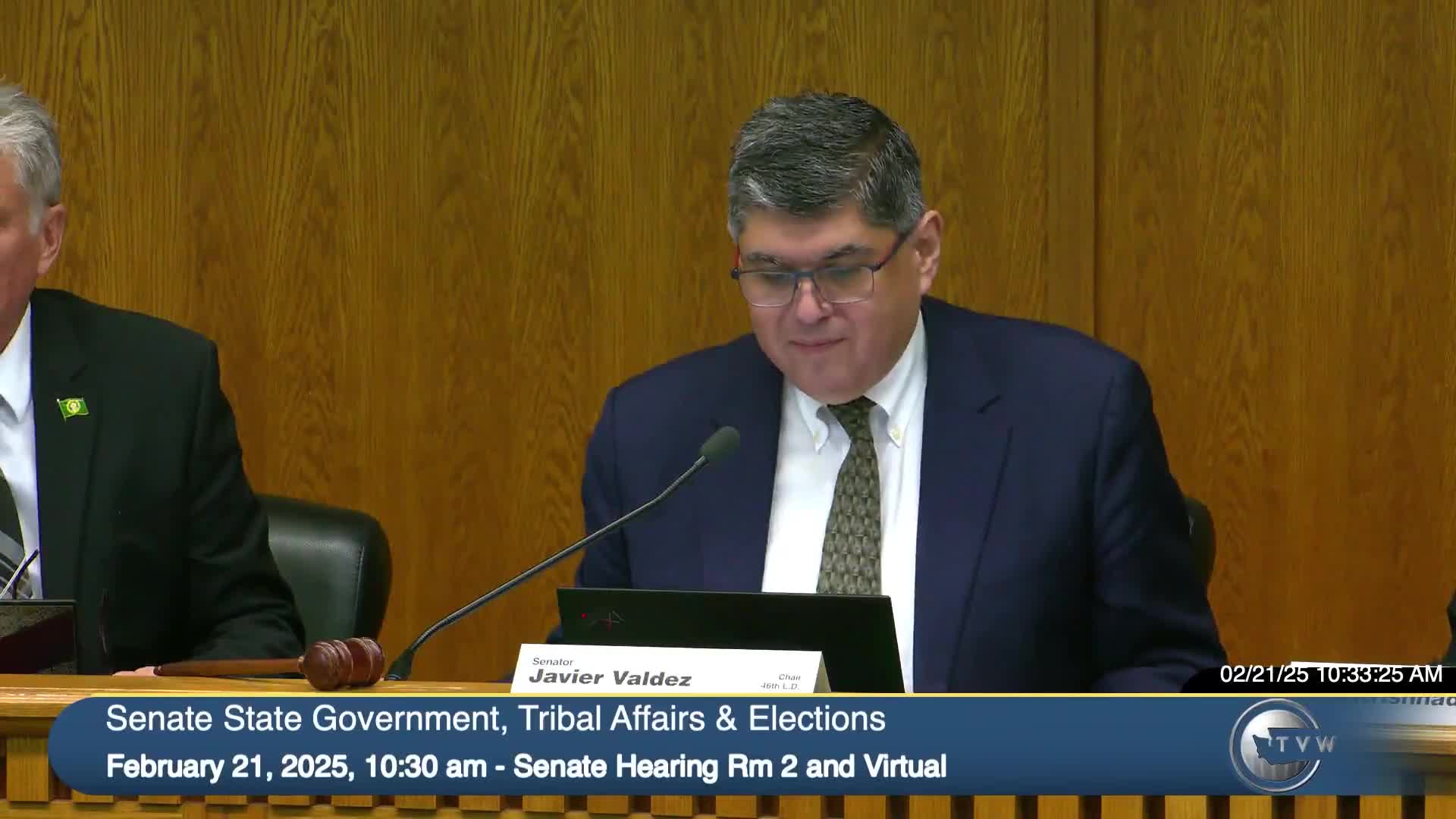
The Senate State Government, Tribal Affairs and Elections Committee on Feb. 21, 2025 adopted proposed Substitute B to Senate Bill 5,434 and recommended it for further consideration in the Rules Committee.
For the record, Danielle Creach, staff to the committee, told members the bill "concern[s] legislative oversight of gubernatorial powers during a declared emergency," and that a fiscal note and two proposed substitutes were available. The bill is intended to create procedures for the Legislature to terminate a state of emergency both when it is in session and when it is not, and to change how the Legislature would handle executive orders issued during an emergency.
The bill drew debate over how much power the Legislature should have to end or modify emergency orders and how to structure consultation with emergency management authorities. Proposed Substitute A, offered by Senator Wilson, would have removed a 30‑day limit on certain executive orders, required legislative consultation with the Emergency Management Division of the Washington Military Department before termination, and provided methods for legislative termination, modification or extension of executive orders that prohibit activities after an order has been in effect more than 60 days. Proposed Substitute B, offered by Senator Valdez, removed the procedures for legislative extension of executive orders and instead added procedures for legislative termination of executive orders.
Senator Wilson said the substitute she offered was the product of bipartisan work that included "input from the governor's office and others," and described it as an "improved bill." Opponents raised concern that language in Substitute A would allow any two legislative caucuses to trigger a termination process, and argued that ending an emergency should require the support of a majority of both chambers. As Danielle Creach explained during questioning, two caucuses could submit a written letter to the governor to start the termination process, but actual termination or modification of an executive order would require passage of a concurrent resolution by the Legislature.
Senator Short and others spoke in favor of the bipartisan work on Substitute A and said the substitute reflected processes used during the COVID‑19 emergency. Several members said they appreciated consultation with the governor's office but were not comfortable with language that they said would allow two caucuses to initiate termination without a broader majority requirement. Senator Fortunato said the substitute's changes could limit members' ability to represent constituents when the Legislature is out of session. Senator Marcelli said the bill was "still a work in progress" but supported moving it forward to continue negotiations.
The committee first voted on Substitute A; the substitute was not adopted. The committee then moved to Substitute B. Substitute B passed on a voice vote, and the committee voted to report Substitute B with a "do pass" recommendation and forward it to the Rules Committee.
In the same meeting the committee also considered three gubernatorial appointments. The committee voted to report the following nominations with a recommendation that they be confirmed: Lisonbee Brooks (gubernatorial appointment no. 9206), David Puente Jr. (gubernatorial appointment no. 9212) and Douglas North (gubernatorial appointment no. 9095). The chair ruled each nomination had received a confirmation recommendation "subject to signatures." The transcript records only voice voting; individual tallies were not specified.
The committee chair noted that Feb. 21 was the House‑of‑Origin policy cutoff and said members intended to continue work with the sponsor and the governor's office to refine the bill before floor action.