Get Full Government Meeting Transcripts, Videos, & Alerts Forever!
Get email alerts on the Public Health Authority topic
No spam. Unsubscribe anytime.
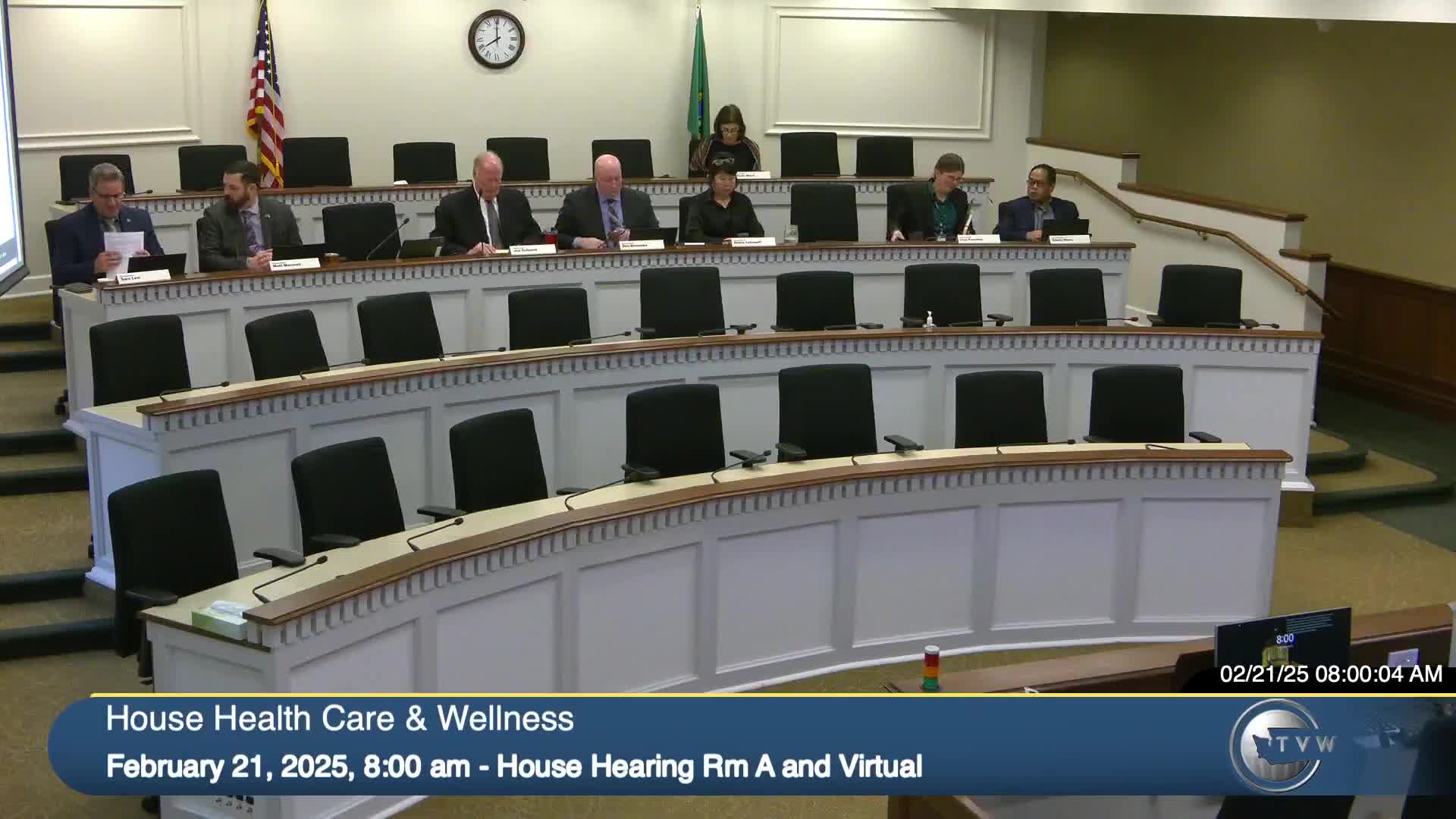
House Health Care & Wellness Committee advances multiple health bills after heated debate over public health authority
Summary
In an executive session Feb. 21, the House Health Care & Wellness Committee reported out several health-care bills — including a contested substitute on public-health responses to communicable diseases — after extended debate and a series of failed amendments.
The House Health Care & Wellness Committee met in executive session Feb. 21 and voted to report out a package of health-related bills, including a substitute to House Bill 15-31 on public-health responses to communicable disease outbreaks that drew extended debate over the proper role and authority of public-health officials.
The committee voted to report the proposed substitute for House Bill 15-31 (H099.1) out of committee with a "do pass" recommendation. The substitute, which the committee discussed at length and amended unsuccessfully on multiple motions, passed the committee vote 11-7 with one member excused.
The session also reported out substitute or amended versions of bills on provider and insurer contracting (House Bill 15-89), a registry of health-care ownership and affiliations (House Bill 16-86), prosthetics and orthotics coverage (House Bill 16-69), newborn screening rules (House Bill 16-97), a certificate-of-need exemption for state-operated hospitals (House Bill 17-55) and a measure requiring plans that cover prescription hormone therapy to allow a single 12-month refill (House Bill 19-71). Votes and final tallies are listed in the "Votes at a glance" section below.
Why it matters: The most contested item, substitute House Bill 15-31, would require state and local public-health responses to communicable disease outbreaks to be guided by the best available science and evidence-based practices. Opponents warned the language could either enable mandates in future rulemaking or strip officials of authority; supporters said the substitute simply ties public-health action to science. The debate included repeated attempts to add provisions limiting emergency powers, adding business remedies, or expanding individual exemptions; committee members rejected those amendments before passing the substitute.
Key discussion points
- Public trust and scope of authority: Several members described eroded public trust in public-health agencies since the COVID-19 pandemic and urged either more legislative oversight or clearer limits on emergency powers. Representative Stevie said, "COVID taught us a lot ... there were a lot of things going on that information wasn't being reported, and they created a lot of mistrust." Representative Marshall repeatedly pressed for legal checks on health officers and said some amendments were intended to ensure that actions taken without peer-reviewed evidence carry consequences.
- Clinical judgment and provider protections: Representative Marshall argued for protections for clinicians who provide off-label or emerging treatments, saying during debate, "physicians ... had their licenses suspended, or completely revoked" after using treatments they believed appropriate. Supporters of the substitute countered that the bill as written requires public-health responses to be based on the best available evidence and does not itself create mandates.
- Business impacts and legal remedies: Some members sought amendment language to allow businesses to challenge public-health orders in superior court and to recover damages; those amendments were not adopted.
- Registry and transparency (House Bill 16-86): Committee members discussed a proposed substitute that would require registering entities (parent companies, holding companies or organizations that own or control more than one health-care entity) to submit ownership, affiliation and services data to the Department of Health. Representative Lekanoff, speaking when moving the substitute, said the registry is intended to "set the foundation for a registry to allow the state and the people of the state to better understand where healthcare is, who which entities own which providers and other things like that." The substitute adds tiered registration fees to cover administrative costs and sets enforcement timelines and civil penalties.
- Insurance and provider contracting (House Bill 15-89): The substitute would require the Office of the Insurance Commissioner (OIC) to publish certain analyses, require marked contract changes and a clean copy of contracts, require fee-schedule notice of 60 days, prohibit carriers from penalizing providers for appeals, and allow OIC fines up to $5,000. Sponsors said the changes are intended to encourage more providers to participate in insurance networks.
- Prescription hormone therapy refill (House Bill 19-71): The committee adopted one amendment (BLAKE 2 17) that permits plans to continue to use drug-utilization management strategies that are not otherwise prohibited. Other amendments proposing parental-consent limits for minors, lab-confirmation requirements and other clinical standards were rejected. Representative Macri said the bill addresses access concerns, calling it "a very, important and life affirming step" for people facing disruptions in access to care.
Votes at a glance
- Substitute House Bill 15-31 (H099.1) — public-health response to communicable disease outbreaks: reported out with a do-pass recommendation. Final tally: 11 ayes, 7 nays, 1 excused. (Multiple amendments considered; none of the contested amendments listed in the record were adopted.)
- Substitute House Bill 15-89 — provider and insurance carrier contracting practices: reported out with a do-pass recommendation. Final tally: 16 ayes, 2 nays, 1 excused.
- House Bill 16-40 — subject interstate medical licensure compact licenses to the Uniform Disciplinary Act: reported out with a do-pass recommendation. Final tally: 18 ayes, 0 nays, 1 excused.
- Substitute House Bill 16-86 — ownership/affiliation registry reporting to Department of Health (substitute reported): reported out with a do-pass recommendation. Final tally: 12 ayes, 6 nays, 1 excused.
- Substitute House Bill 16-69 — prosthetics and orthotics mandate (substitute incorporating adopted amendment): reported out with a do-pass recommendation. Final tally: 16 ayes, 2 nays, 1 excused.
- Substitute House Bill 16-97 — newborn screening panel timing and process: reported out with a do-pass recommendation. Final tally: 18 ayes, 0 nays, 1 excused.
- House Bill 17-55 — certificate-of-need exemption for state-operated hospitals (elective percutaneous coronary interventions): reported out with a do-pass recommendation. Final tally: 18 ayes, 0 nays, 1 excused.
- Substitute House Bill 19-71 — 12-month refill requirement for prescription hormone therapy (with incorporated amendments): reported out with a do-pass recommendation. Final tally: 11 ayes, 7 nays, 1 excused.
What happens next
Each bill that passed the committee with a do-pass recommendation will move to the next stage in the House for scheduling and further floor action. Committee members who opposed several measures said they want follow-up work and stakeholder engagement on implementation details and rulemaking to avoid unintended consequences.
Representative comments (selected)
Representative Stevie, on public trust after COVID: "COVID taught us a lot ... there were a lot of things going on that information wasn't being reported, and they created a lot of mistrust."
Representative Marshall, on provider protections and disciplinary actions: "Physicians ... had their licenses suspended, or completely revoked," describing cases where providers faced discipline after offering treatments they believed appropriate.
Representative Lowe, on public health's role: "Public health should gather information and data and recommendations and inform decision making."
Representative Macri, on access to hormone therapy: calling the bill "a very, important and life affirming step" for people facing disruptions in care.
Ending
Committee members signaled they expect continued negotiations and stakeholder meetings on the most controversial provisions — especially those touching public-health emergency powers, provider protections and the scope of reporting for the proposed ownership registry. The committee recessed after reporting these bills out with do-pass recommendations.