Get Full Government Meeting Transcripts, Videos, & Alerts Forever!
Get email alerts on the Food Security Strategy topic
No spam. Unsubscribe anytime.
Committee hears bill directing WSDA to craft statewide food‑security strategy by 2027
Summary
House Bill 19‑87 would require the Washington State Department of Agriculture to develop a statewide food security strategy by July 1, 2027, coordinating state agencies, the Food Policy Forum and nonprofit partners to address hunger, environmental health disparities and agricultural resilience.
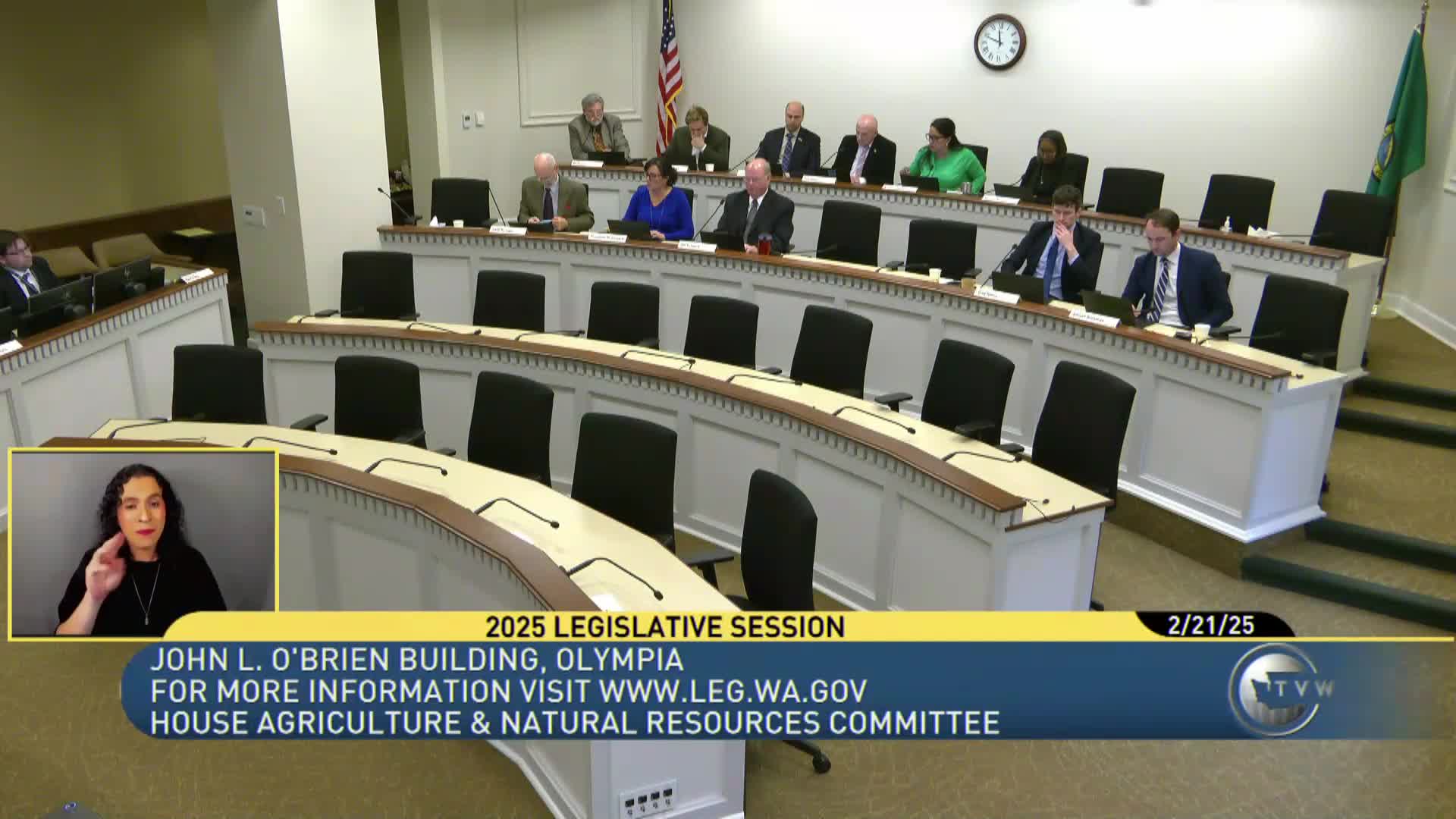
The House Agriculture and Natural Resources Committee on Feb. 21 received a staff briefing and broad public testimony on House Bill 19‑87, which would direct the Washington State Department of Agriculture (WSDA) to develop a statewide food security strategy addressing hunger, environmental health disparities and agricultural resilience.
Rebecca Lewis, committee staff, said the bill requires WSDA to convene several state agencies, the food policy forum and nonprofit hunger‑relief organizations, and to consult with agricultural‑resilience and food‑access experts. The strategy must define food security in terms of access and affordability, identify ways to support land access and adaptive agricultural practices, enhance nutrition and food‑security education and encourage urban agriculture. The department must deliver the completed strategy to the Legislature by July 1, 2027. A fiscal note is available in the committee’s electronic bill binder.
Rep. Christine Reeves (chair and prime sponsor) framed the bill as a systems‑level response to a fragmented food‑security network. Reeves described personal and constituent experience with food insecurity and said the strategy would identify gaps and coordinate programs—ranging from WIC and school meals to farm viability—to keep food available and affordable.
WSDA’s Katie Raines told the panel the agency is prepared to lead the work, citing WSDA’s convening role in the Washington Food Policy Forum and experience coordinating COVID‑era food‑security responses. Raines outlined three implementation scenarios for the department with increasing costs depending on the degree of interagency coordination and community engagement.
Stakeholders from production, distribution and hunger‑relief organizations endorsed the bill and emphasized practical barriers. Bree Elzey of the Washington Farm Bureau urged bottom‑up engagement with farmers and logistics specialists to address barriers to food donation and distribution; Jay Gordon (testifying as an eighth‑generation farmer) highlighted recent losses in processing infrastructure that threaten farm markets and urged attention to both small and large operations. Eric Williams of Second Harvest Inland Northwest described the logistics of collecting and distributing donated food and stressed the importance of preserving first‑harvest sources for food‑bank supply chains. Claire Lane of the Anti‑Hunger & Nutrition Coalition and Aaron Chazewski of Food Lifeline urged a strategy that centers community‑based solutions and partnerships with non‑governmental providers.
Supporters said a coordinated, statewide strategy could make emergency food systems more efficient, help keep farmers in business, and improve long‑term food access. WSDA and advocates asked lawmakers to ensure the strategy meaningfully engages front‑line organizations and maintains core programs for food safety and assistance.
WSDA emphasized three implementation scenarios with variable costs and invited committee collaboration; the department said sustaining core programs—food safety, farm assistance and existing emergency‑food efforts—would be a priority while the strategy is developed.