Get Full Government Meeting Transcripts, Videos, & Alerts Forever!
Get email alerts on the Marine Mammal Management topic
No spam. Unsubscribe anytime.
House Ag Committee advances memorial asking Congress to ease MMPA limits to address sea‑lion predation on salmon
Summary
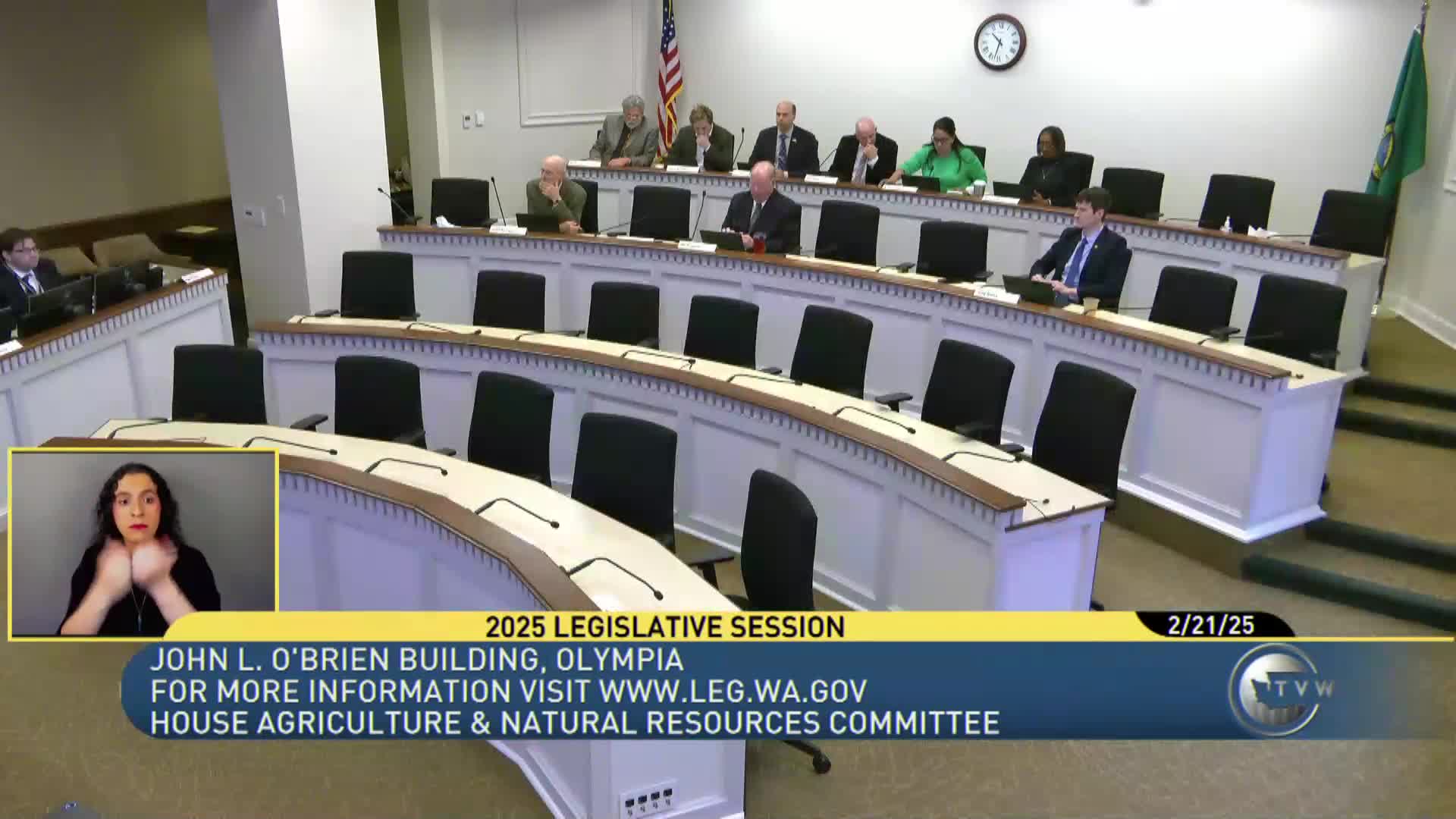
On Feb. 21 the House Agriculture and Natural Resources Committee voted to report House Joint Memorial 4004 urging Congress to modify the Marine Mammal Protection Act to give states and tribes more flexibility — including lethal removal in some cases — to manage pinniped predation on endangered salmon across Washington waters.
The Washington House Agriculture and Natural Resources Committee on Feb. 21 voted to report House Joint Memorial 4004, a legislative request that Congress modify the Marine Mammal Protection Act (MMPA) to allow additional adaptive management tools — including lethal removal of certain pinnipeds — to protect endangered salmon stocks in Washington.
The memorial, advanced out of committee by voice vote and reported with a due‑pass recommendation, asks Congress to allow states and tribes greater flexibility to use management measures “including lethal removal for pinniped predators of endangered salmon stocks across all marine shorelines of Washington and the Puget Sound.” The committee recorded a unanimous 11‑0 vote in favor when the motion was announced as reported out.
Supporters told the committee predation by California sea lions and other pinnipeds has become a substantial obstacle to salmon recovery. Prime sponsor Rep. Rob Chase (4th Legislative District) described firsthand accounts from river users and said pinnipeds “kill up to half the catch” at key locations on the Columbia River, arguing that federal change is needed so managers can reduce predation. Chelsea Martin of Modern Electric Water Company said, “Sea lion populations have exploded by more than 300% since 1975,” and urged the memorial as a bipartisan tool to “restore balance.” Nelo Pisenich of the Coastal Conservation Association of Washington said lethal removal would be used only to protect ESA‑listed salmon and steelhead and that the removals would affect “less than 0.0001% of the total population.”
Opponents cautioned the memorial risks unintended ecosystem consequences and that the science does not show lethal removal will reliably recover salmon. Dr. David Bain of Orchard Conservancy testified, “We oppose this bill. . . . Killing pinnipeds is the wrong approach.” Shanti Nelson said the bill “is ill informed and would be ineffective,” warning that removing pinnipeds could increase other predators and harm Southern Resident killer whales’ recovery. Conservation groups and multiple individual testifiers urged continued emphasis on habitat restoration, barriers correction and other nonlethal measures.
Tribal representatives and others urged attention to co‑management tools and limited federal exemptions that already exist under the MMPA and related NOAA Fisheries processes. Timothy Green, who identified himself as chairman of the Macaw Bridal Council in his testimony, referenced treaty authorities and the difficulty tribes have experienced in navigating federal permitting for marine mammal take.
The memorial asks Congress to alter the federal MMPA process — it does not change state or federal law by itself. Staff explained the MMPA currently permits states to apply to NOAA Fisheries for authorizations to lethally remove individually identifiable pinnipeds that negatively affect certain salmon stocks, and noted a 2018 congressional change created an additional Columbia River process. The memorial seeks broader authority covering Washington shorelines and expanded tribal eligibility.
Committee members who spoke in favor said the measure is intended to provide management flexibility, not to eliminate pinniped populations. Representative Orcutt said the memorial would seek “some controls” in riverine and nearshore areas where predation is concentrated, and Representative Nance cited examples of heavy predation at man‑made chokepoints such as the Hood Canal Bridge.
The committee’s action sends the memorial to the next legislative step with a due‑pass recommendation. Because the measure is a memorial urging congressional action, it creates no immediate legal change; any modification to the MMPA would require federal legislation or administrative action by NOAA Fisheries.