Get Full Government Meeting Transcripts, Videos, & Alerts Forever!
Get email alerts on the Housing Affordable Housing topic
No spam. Unsubscribe anytime.
House committee hears bill to let cities, counties offer sales-tax remittance for affordable housing
Summary
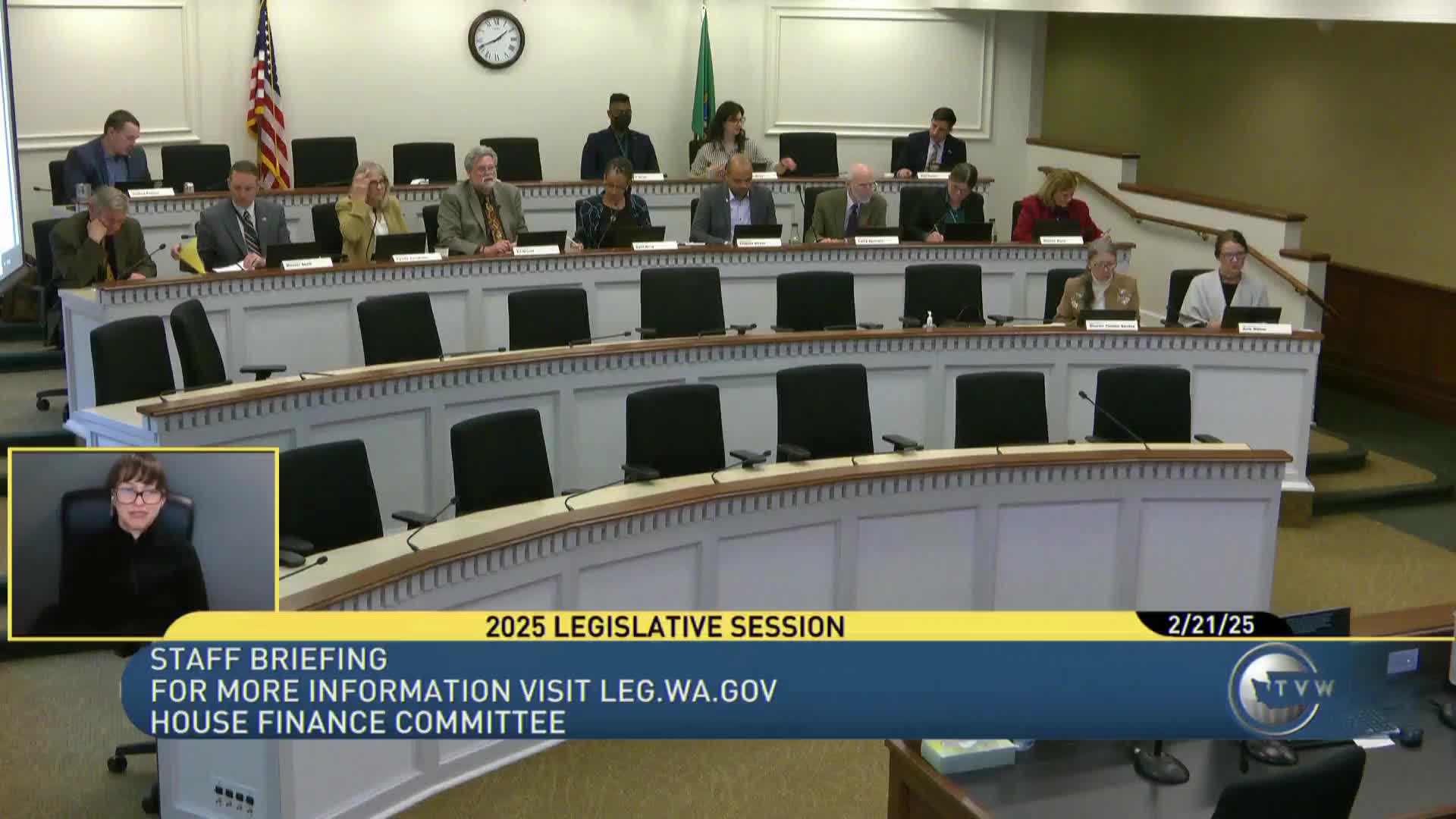
House Finance Committee members heard testimony Feb. 21 on House Bill 1717, which would authorize cities and counties to create a local sales and use tax remittance program for qualifying affordable housing projects beginning Jan. 1, 2026.
House Finance Committee members heard testimony Feb. 21 on House Bill 1717, which would authorize cities and counties to create a local sales and use tax remittance program for qualifying affordable housing projects beginning Jan. 1, 2026.
Under the bill, an eligible project must commit at least 50% of units to low-income households and guarantee affordability for 40 years; eligible organizations include nonprofit and for-profit developers, public housing authorities, and entities eligible under Washington State Housing Finance Commission rules. If approved, 50% of the state and local sales and use taxes paid by the eligible organization on construction would be remitted to the developer; the other 50% of the state portion would go to the authorizing city or county and must be used for acquiring, constructing, operating or maintaining affordable or permanent supportive housing, or for related behavioral health services.
“Residential development costs have risen about 36% since 2020,” Nicholas Carr, Governor Ferguson’s senior policy advisor for housing, told the committee in support of the bill. Carr described a recent project that pencils at roughly $603,000 per unit and said the remittance program would help close funding gaps and incentivize mixed-income development.
Local housing providers and developers urged passage. Courtney Acuff, policy and advocacy manager at Tacoma Pierce County Habitat for Humanity, said the remittance would “allow qualified developers and housing providers to apply for reimbursement of sales and use tax incurred during the construction or rehabilitation of affordable housing projects” and would encourage reinvestment in construction quality and tenant services. Ryan Donahue of Habitat for Humanity Seattle King and Kittitas Counties told the committee his organization paid more than $3 million in sales and use tax since 2021 and argued a remittance would enable more production.
County and city representatives said the program gives local governments another tool. Curtis Steinhauer of the Washington State Association of Counties called it “a local option revenue source and the opportunity to incentivize affordable housing development within their jurisdictions.” The Association of Washington Cities also supported the bill, noting past uptake of optional local authority when provided by the Legislature.
Department of Revenue staff told the committee the bill would reduce state general fund revenue: an estimated $3.5 million decrease in fiscal year 2028 and $3.6 million in fiscal year 2029, with a total biennial impact of about $7.1 million for 2027–29, assuming four projects start each year beginning in fiscal 2027. The DOR also estimated local revenue gains and said administrative costs would be incurred to set up and run the program.
Supporters said the bill is voluntary for local governments, can be tailored by local ordinance and could be combined across jurisdictions through interlocal agreements. Eligible organizations would be required to file annual compliance reports for 40 years after issuance of a certificate of occupancy; if a remittance is canceled the previously exempted taxes would become due.
Proponents included housing authorities, Habitat chapters, local affordable-housing coalitions and the governor’s office; multiple witnesses described active pipelines of projects that could benefit from lower development costs. Critics did not appear in the hearing record. The committee did not take a vote at the hearing.
The sponsor, Representative Ari Levitt, described the remittance as one tool among many needed to address Washington’s housing shortfall and emphasized local flexibility in program design.
The bill’s fiscal note, project and compliance timelines and procedural details were discussed in committee questioning; staff said JLARC review and a 10-year sunset were included in the bill’s tax preference language.
The committee left the bill in public hearing; no final action was recorded during the Feb. 21 hearing.