Franklin Public Schools proposes $80.4 million FY26 budget to address $3.6 million structural deficit; hearing opened and closed
Loading...
Summary
The Franklin School Committee opened and completed a public hearing Feb. 4 on a proposed $80,395,338 FY26 operating budget ( $88,869,181 with grants and revolving funds) intended to address a $3.6 million townwide structural deficit.
The Franklin School Committee opened and completed a public hearing on its proposed Fiscal Year 2026 budget on Feb. 4, presenting an $80,395,338 operating request ( $88,869,181 including grants and revolving funds) that school leaders said is structured to address a $3.6 million townwide structural deficit.
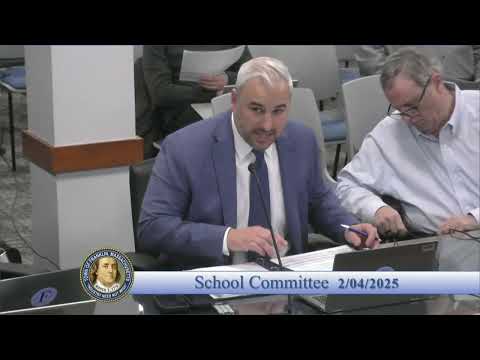
Superintendent Lucas Gere led the presentation with interim School Business Administrator Janna Malati and consultant Dr. Dutch at the table. Gere said the recommended operating budget “represents $80,395,338,” and framed the request as intended to preserve class sizes, sustain mental- and behavioral-health services and implement a reorganization intended to produce recurring savings.
The committee and staff described three budget priorities: stabilizing core systems, reallocating existing resources rather than increasing total FTE, and completing multi-year plans begun in prior years. Malati summarized the totals in the presentation and repeated the district-wide figures, noting the operating request and the $88.87 million figure when grants and revolving accounts are included.
Nut graf: School leaders told the committee the FY26 request depends on resolving a townwide structural deficit and that, if the district receives less than the recommended amount, staff, restored positions and programming could be reduced. Committee members pressed staff for line-item detail on transportation, special education and school-based supports during the line-by-line review that followed the presentation.
Major numbers and drivers - Operating budget (proposed): $80,395,338 (reported as a 3.78% increase over FY25). - Total with grants and revolving funds: $88,869,181. - Structural deficit the budget assumes solved: $3,600,000 (described repeatedly by staff as a townwide figure). - Savings from the district reorganization: approximately $1,800,000, realized partly by reducing about 20 positions through reorganization and reclassification. - Transportation: staff reported a 12.2% contract increase for FY26 compared with FY25; presenters said the current contract resulted from a competitive bid process and that the district received a single bid for the contract in its latest procurement. - Health insurance: staff cited an approximately 13% projected increase as a cost driver. - Special education: leaders said in‑district programs (the district’s GOALS and REACH programs were cited) generate multi‑million-dollar savings by avoiding more expensive out‑of‑district placements; staff estimated roughly $5,000,000 in cost savings by keeping certain students in district programs.
Reorganization, staffing and class size District leaders described a reorganization that unified middle-school programs, reclassified some positions, restored previously cut positions in order to maintain class-size targets and reduced net positions where economies of scale were identified. Gere and staff said the reorganization allowed the district to restore some elementary teacher positions and reallocate roles (for example, department heads at the middle school who will also carry teaching assignments). The administration repeatedly emphasized these were reclassifications and restorations tied to the reorganized school structure, not unconstrained additions to staffing.
Special-education costs and unpredictability Staff explained that contracted special-education services fluctuate year to year depending on student needs and placements. They noted that residential or out-of-district placements, neuropsychological and clinical services, or the addition of specialized classrooms can change the tuition and contracted-services totals during the fiscal year. The presentation also described state revenue streams that support special-education costs — including circuit-breaker funding — but staff warned circuit-breaker receipts depend on state appropriations and program formulas and are not guaranteed to fully offset local costs.
Transportation and procurement Committee members asked about the transportation increase. Staff said the district runs periodic competitive procurements for bus service; the current contract reflected the terms bid when the contract was awarded and the district received a single bid in that procurement cycle. The superintendent noted factors tied to the post‑COVID market for vendors and to tiering and run structure (one‑tier, two‑tier, three‑tier routes) that affect contract pricing.
Grants and restricted funds Malati and Gere explained that some revenue shown as “revolving” or restricted (for example, funding associated with education services for students residing in an emergency assistance shelter) must be used for the direct benefit of those students. The emergency-assistance shelter funds are state receipts applied to the education of affected students, staff said.
Public and committee questions Members of the committee and members of the public asked for clarifications on numerous line items during the line-by-line review: how positions were reclassified and where positions are charged in the budget book; the scope and duties of department heads, team chairs, instructional coaches, instructional technology teachers and educational support professionals (ESPs); and how the district defines its payroll and FTE counts. Staff provided role descriptions and said certain apparent FTE changes reflected internal reclassifications or cleanups of how staff were charged to lines in FY25 versus FY26.
Formal actions and next steps The School Committee voted to open the FY26 public budget hearing at the start of the meeting and, following the line-by-line review and public input, voted to close the public budget hearing later in the same meeting. The committee scheduled a formal vote on the recommended budget for the next regular meeting (Feb. 11) and staff said the capital requests process for separate one-time projects will proceed through the town’s FinCom and council concurrent calendar.
Quotes from the meeting “We put our best foot forward,” Superintendent Lucas Gere said, describing the budget and the district’s assumptions; Gere also said the budget “represents $80,395,338” and that it is based on solving the $3.6 million structural deficit. Staff later reiterated that revolving and grant funds tied to specific programs must be spent for the direct benefit of those students (for example, students residing in the emergency assistance shelter).
Ending: The committee completed its line-by-line review and closed the FY26 public budget hearing. The School Committee will consider a formal vote on the recommended FY26 operating budget at its Feb. 11 meeting; staff said additional documents, line-by-line clarifications and comparative data will remain available to committee members and the public in the interim.