Get Full Government Meeting Transcripts, Videos, & Alerts Forever!
Get email alerts on the Indecent Exhibitions H230 topic
No spam. Unsubscribe anytime.
House State Affairs Committee advances bill to restrict minors’ access to certain ‘indecent exhibitions’ after hours of testimony
Summary
The House State Affairs Committee voted to send House Bill 230, a proposal to restrict minors’ access to certain “indecent exhibitions,” to the House floor with a due-pass recommendation after testimony from supporters, performers, parents and legal advocates.
The House State Affairs Committee voted to send House Bill 230, described in testimony as a measure to restrict minors’ access to “indecent exhibitions,” to the House floor with a due-pass recommendation after public and expert testimony for and against the bill.
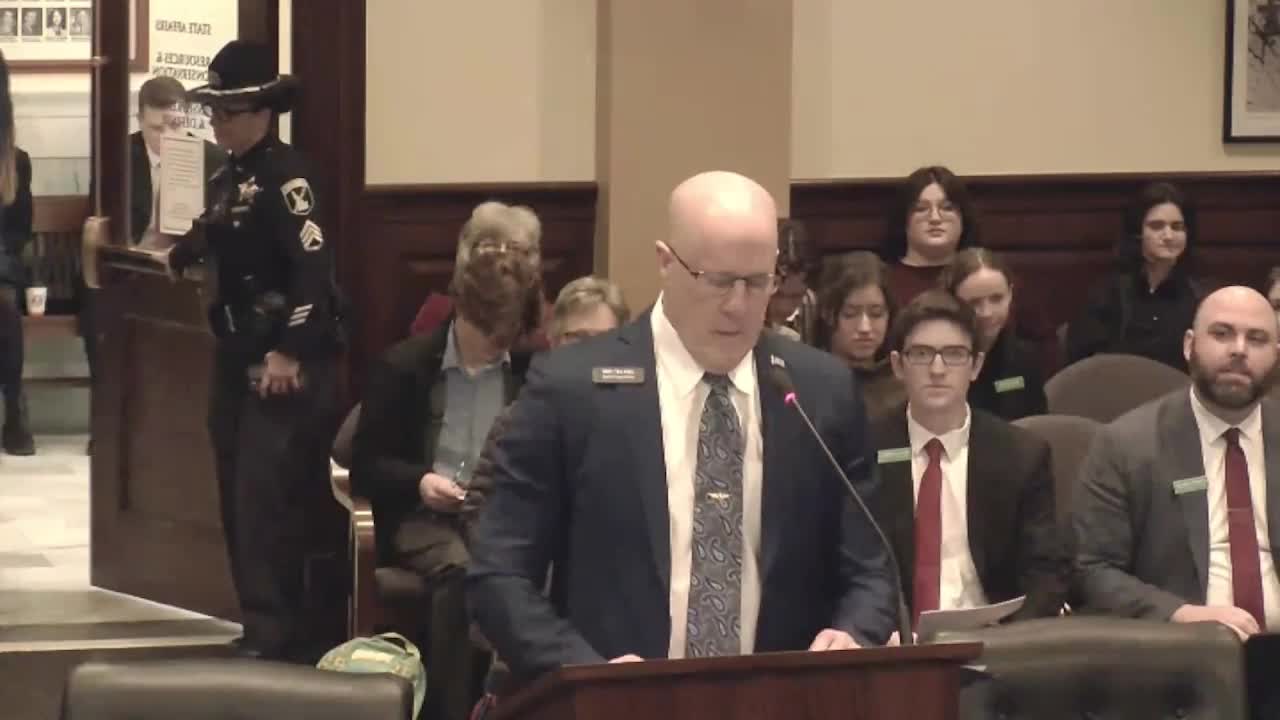
Committee sponsor Rep. Ted Hill, a Republican from District 14, told the committee that “House Bill 230 creates a duty of care for organizers, hosts and performers of indecent exhibitions to take reasonable steps to restrict the access of minors.” Hill said the bill is intended as a time, place and manner regulation and “adults can still host, organize and perform indecent exhibitions so long as they check IDs at the door.”
The bill’s primary legal framework, Edward Clark of the Idaho Family Policy Center told the committee, uses the Federal Communications Commission’s indecency standard. Clark summarized that the standard requires both “indecent conduct” and conduct that “would be patently offensive to an average person applying contemporary community standards.” He also described three affirmative defenses added after stakeholder meetings: a host may avoid liability if it holds a legally enforceable contract forbidding prohibited exhibitions; the parent or legal guardian of a minor 14 or older may accompany the child or provide written consent for ticketed events; and the bill explicitly excludes cheer and dance performances sponsored by secondary schools or institutions of higher education.
Supporters urged passage on child-protection grounds. Paul Luehr, a pastor in Boise, said the bill would “protect the innocence of Idaho children” and Mary Ellen Nurse described an incident she says occurred at a public festival in Boise when a performer allegedly danced around a prayer circle. Hill read into the record that the Idaho Family Policy Center had provided a petition of 7,665 signatures and cited polling the group reported showing “70% of likely Idaho voters” favor restrictions to protect minors.
Opponents, including performers, parents and youth advocates, said the bill is vague and risks censoring artistic expression and will chill family-friendly events. Doctor Sarah Lynch, describing herself as a public-safety liaison, said a doctored video from an incident in Coeur D’Alene spurred prolonged litigation and warned the bill’s language could “embolden dangerous groups” that have targeted events. Kai Bostick, 14, speaking for Human Rights Idaho, said, “I am 14, and I oppose H230 because this bill is so big that venues will not know what exactly qualifies, so that they’ll end up just banning minors to completely void lawsuits.” Performer Vincent Diaz said the measure will “empower groups” to target family-friendly events and predicted constitutional challenges that would require taxpayer-funded defense.
Committee members pressed sponsors and counsel on definitions and enforcement. Representatives asked what qualifies as “primary” or “secondary” characteristics referenced in the bill’s definition of provocative dances or gestures; Rep. Hill and Mr. Clark said the language was drafted with input from outside counsel and stakeholders and stressed the two-part indecency test (conduct + patently offensive standard) would be decided by a jury applying contemporary community standards. Clark said any civil action would be brought on behalf of a harmed child by a parent or guardian ad litem, and that the bill contains no criminal penalties.
Votes at a glance - Motion to adopt minutes from Monday, Feb. 17 — passed. (motion recorded and carried) - Motion to introduce RS 32-265 (small-brewer parity) — passed. - Motion to introduce RS 32-349 — passed. - Motion to introduce RS 32-412 (elections consolidation/filing/early voting timelines) — passed. - Motion to send House Bill 230 to the House floor with a due-pass recommendation — passed; Representatives Achilles and Green recorded as voting no.
The committee’s decision advances the bill to the full House, where debate and any amendments would occur. Several witnesses said they expect constitutional litigation if the bill becomes law; sponsors argued the measure is tuned to withstand First Amendment review by relying on the FCC indecency standard and adding specific affirmative defenses for hosts and educational performances.
Ending notes: The committee heard eight public testifiers in person and three virtually, according to the committee clerk’s announcements during the hearing. The bill’s detailed definitions and affirmative defenses — including the host-contract and parental-consent provisions — were repeatedly cited by the sponsor and the bill proponent Edward Clark as key drafting choices made after stakeholder consultations.