Get Full Government Meeting Transcripts, Videos, & Alerts Forever!
Get email alerts on the School Safety Armed Staff topic
No spam. Unsubscribe anytime.
Rep. Ted Hill introduces bill to allow armed, POST-trained school employees; debate focuses on training, costs and confidentiality
Summary
Rep. Ted Hill introduced RS 32,342 to authorize school employees to carry concealed, loaded handguns after POST-certified training and recurrent qualifications; committee members questioned costs, liability, ammunition limits and school-board authority. The committee voted to introduce the proposal for a formal hearing.
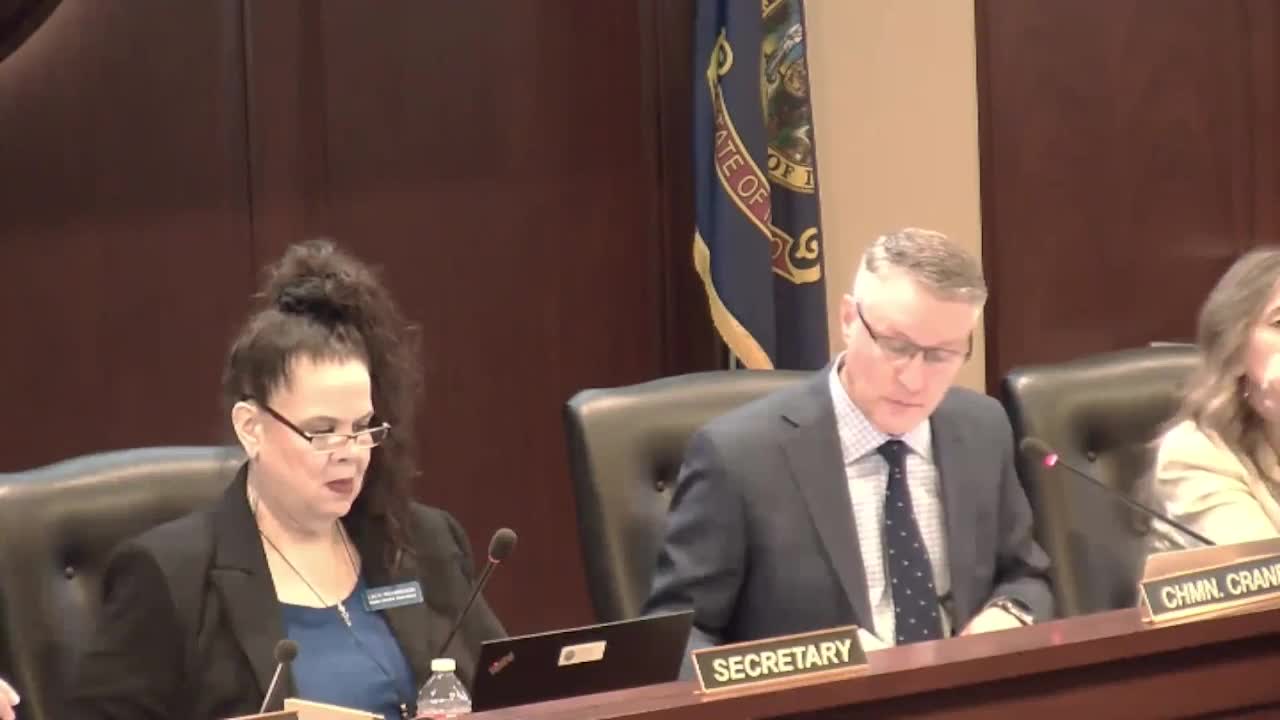
Rep. Ted Hill, R-District 14 of Eagle and Emmett, on Wednesday introduced RS 32,342, a proposal to allow school employees who complete specified POST-certified training to carry concealed, loaded handguns on school property.
The measure, Hill said, would expand a 2023 law and set training and qualification standards so armed employees would receive scenario-based instruction comparable to law-enforcement training. "The best way to solve this problem is to have armed guards," Hill said, adding that the training could include shooting about 1,500 rounds and that the statewide cost to station armed guards at every school would be "about $120,000,000." He said the program would use POST trainers and that individuals would decide whether to participate.
Supporters, Hill said, intend the measure to be set by state law rather than leave the decision solely to local school boards. "We're coming in to protect you," he told the committee, arguing the bill would create a top-down standard for training and authority to carry.
Opponents and questioning members pressed on details the draft does not settle. Rep. Green asked whether the cost of POST training would fall to the individual or the school district; Hill responded the cost would likely be borne by the individual and estimated it at "$500–$600" per participant. Rep. Boyle and others asked for clarity on whether training would be delivered by sending employees to POST or by contracted, POST-certified trainers; Hill said POST-certified trainers statewide would operate as independent contractors.
Members also questioned operational specifics in the draft. The bill restricts authorized firearms to handguns and authorizes hollow-point ammunition for loaded, concealed handguns; Rep. Gary asked why nonlethal options were excluded and Hill replied Hollow-point rounds were recommended by police because they are less likely to pass through walls. The draft requires range qualification twice a year and recurrent active-shooter refresher training conducted with district armed employees and local law enforcement.
Several members raised liability and governance concerns. Rep. Beggar asked whether employees would be personally liable for actions taken while carrying; Hill said, "You are responsible for whatever you do with that gun," adding "every bullet has a lawyer hooked to it." Rep. Kiehlis and others objected to the bill’s confidentiality provisions, which require boards to maintain the names of armed employees as confidential records; Kiehlis said that secrecy could undercut deterrence and transparent oversight. Hill countered that local knowledge and informal dissemination would still create a deterrent effect.
Hill said local school boards would retain some authority to set the scope of required training levels but that the bill is intended to prevent boards from an outright ban on employees who meet the statutory standards. Several members said the issue required a full hearing for more fiscal and implementation details; Rep. Green requested the fiscal note clarify who pays for POST training.
The committee voted to introduce RS 32,342 so the measure can proceed to a formal hearing. The motion to introduce was made by Rep. Alfieri and carried on a voice vote with no roll-call tally recorded in the transcript.
The bill will return to the committee for a public hearing with more detail on costs, liability insurance, school-board authority and operational coordination with local law enforcement.