Get Full Government Meeting Transcripts, Videos, & Alerts Forever!
Get email alerts on the Legal Notices topic
No spam. Unsubscribe anytime.
House panel advances bill to move public legal notices online, prompting fierce testimony from newspapers and county officials
Summary
Representative Jeff Ehlers, the bill sponsor, asked the House State Affairs Committee on Wednesday to approve House Bill 166, legislation that would allow public legal notices to be published on a state-run website rather than (or in some cases in place of) paid newspaper publication.
Representative Jeff Ehlers, the bill sponsor, asked the House State Affairs Committee on Wednesday to approve House Bill 166, legislation that would allow public legal notices to be published on a state-run website rather than (or in some cases in place of) paid newspaper publication.
The move “will save taxpayers,” Representative Jeff Ehlers said, noting state savings from Transparent Idaho and an estimated $500,000 one-time cost and $300,000 ongoing maintenance for a state site. He asked the committee to advance the bill to the floor.
Supporters argued the change would modernize access and reduce cost. “Somewhere around 90% of Idahoans have internet coverage,” Ehlers said, and a state website would ultimately centralize notices that now appear in many places.
Opponents — led by newspaper publishers and county officials — said the proposal would reduce notice readership and shift costs. Matt Tranquil, president and publisher of the Idaho Press, told the committee that legal notices represent only a tiny share of county budgets and warned that moving notices to a government-run site would require new staff and systems paid for by taxpayers: “Shifting legal notices to a government-run website would result in unnecessary redundant spending,” Tranquil said.
Several publishers offered web-traffic comparisons. Pam Morris, publisher of the Idaho Mountain Express, cited Similarweb data showing Idaho newspapers’ combined monthly unique visitors far exceed the Idaho State Comptroller’s website. “Moving legal notices to the state's website would make government processes nearly invisible to Idahoans,” Morris said.
Speakers representing newspapers and the Newspaper Association of Idaho emphasized that idahopublicnotices.com, a private, industry-funded service, already provides free online access, email alerts and keyword notifications at no cost to end users. Clint Schroeder of the Newspaper Association of Idaho said the private system is fully funded by newspapers and integrated with Transparent Idaho, and warned that a government-run site would duplicate existing services and increase government costs.
County officials and the Idaho Association of Counties provided partial cost data suggesting local governments already spend meaningful sums on publication and that some jurisdictions would see different fiscal impacts. Sarah Westbrook, representing the Idaho Association of Counties, said 32 of 44 counties reported a yearly average that “would be a significant amount” and emphasized local budget concerns.
Several committee members raised access and permanence concerns. Representative Barbieri said paper records are a permanent archive and expressed skepticism about the reliability and permanence of an electronic archive. Representative Alfieri said the essential question is “who controls the distribution of information” and said he opposed giving the state sole control.
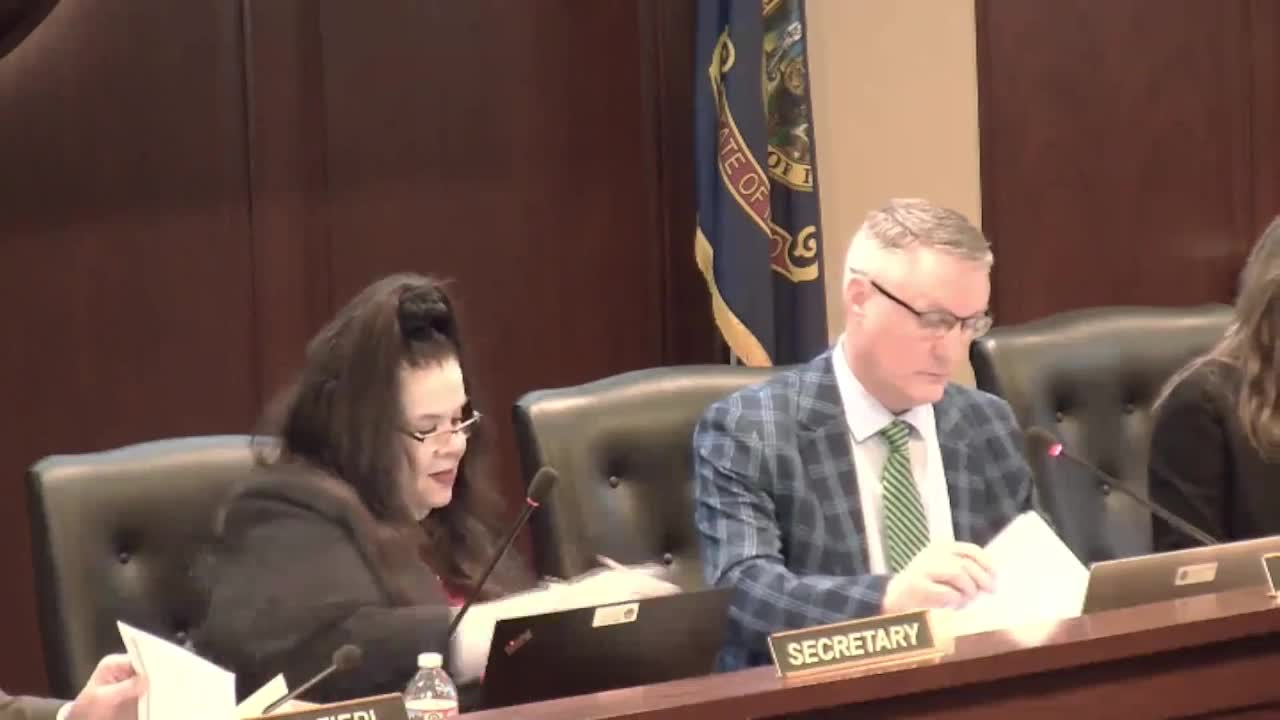
Representative Scott moved that the committee send House Bill 166 to the floor with a do-pass recommendation. The roll call vote was 8-7 in favor; the committee chair announced, “Motion carries 8 to 7.”
The committee hearing included multiple questions about specifics: whether private-party notices (for example, foreclosures or probate notices) would shift their publication cost to taxpayers, whether counties without local newspapers would be served, and how archival permanence would be guaranteed. Sponsors responded that private-party notices could be placed on the proposed state site “may” be placed there and that the bill includes an initial staggered rollout for state agencies followed by local governments, plus options for abbreviated printed notices linking to the website.
The committee did not adopt amendments during the hearing; members asked sponsors to provide additional cost details and metrics before further consideration on the floor.
Votes at a glance: The committee voted to send House Bill 166 to the floor with a do-pass recommendation; the recorded tally was 8 yes, 7 no.
The bill now proceeds to the House floor for additional debate and amendment. No effective date or final changes beyond the introduced language were adopted by the committee.