Get Full Government Meeting Transcripts, Videos, & Alerts Forever!
Get email alerts on the Transit Security topic
No spam. Unsubscribe anytime.
Seattle committee hears regionwide push to restore order on buses and trains after driver killing
Summary
At a Feb. 8 Transportation Committee roundtable, Seattle, King County and Sound Transit officials and union leaders described stepped-up enforcement, new behavioral-health teams and expanded ambassador programs intended to improve rider and operator safety after the Dec. 2024 killing of a King County Metro operator.
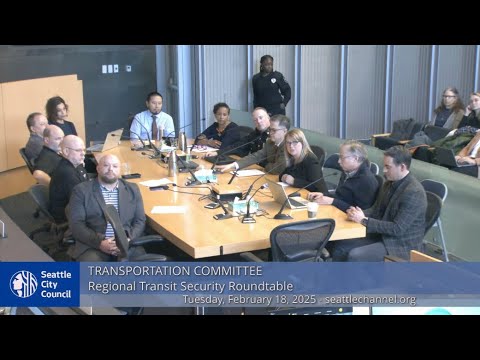
The Seattle City Council Transportation Committee held a regional roundtable on transit security on Feb. 8, 2025, bringing together city, county and Sound Transit officials, union leaders and business representatives to discuss steps to improve safety on buses and trains after the Dec. 18 killing of King County Metro operator Sean Yim.
The meeting opened with Rob Sacca, chair of the Transportation Committee, describing recent incidents and urging a regional response. “This kind of behavior does not engender the type of public confidence and trust in the average member of the public that we need,” Sacca said.
Why it matters: Committee members and witnesses said fears about safety are reducing ridership and putting transit investments at risk. ATU Local 587 leaders told the council that public transit is “at a tipping point and at a crossroads,” and urged coordinated action from cities, the county and the state. Officials described a mix of enforcement, outreach and capital measures already underway or planned to change conditions on the system.
King County Metro General Manager Michelle Allison said Metro has shifted from a traditional law-enforcement-led model toward what she called a “care and presence” model that adds behavioral-health teams, transit ambassadors and more transit security officers alongside Metro Transit Police. Allison acknowledged the agency’s grief over Operator Yim’s death and said Metro would continue adjusting deployments and tactics based on incident data.
Metro Transit Police Chief Todd Murrell described Operation Safe Transit, a regional initiative launched in 2024 to restore a criminal-justice “backstop” after a period when many low-level offenses were not leading to booking. Murrell said the program began as a limited pilot in May, expanded systemwide in June 2024, and that “we have just crossed the threshold today, 475 arrests for crimes on our system,” characterizing those arrests as a small number relative to total daily boardings but a sign of increased proactive activity by deputies.
Sound Transit Deputy CEO Moises Gutierrez said Sound Transit is balancing faster incident response and prevention work, including station activation (lighting and cleanliness), expanded security staffing and a text-reporting line for riders. “The safety of our passengers, operators, and broader community is our number 1 priority at Sound Transit,” he said.
From the city, interim SDOT Director Adi Emery outlined capital and right-of-way approaches—sidewalks, improved crossings and bus-zone upgrades— and said the 2024 transportation levy includes funds for transit passenger safety. Natalie Walton Anderson, Chief of Public Safety for the mayor, described a “place-based” downtown activation pilot that combines enforcement, outreach and city services and said the mayor’s office is coordinating treatment beds and outreach to connect people with services.
Union and business voices: ATU Local 587 leaders urged faster, stronger action and criticized years of what they called permissive enforcement. “We will spend billions more in the next decades expanding it. All that investment is placed in jeopardy if operators don't feel safe,” said ATU representative Greg Woodfill. John Scholes of the Downtown Seattle Association told the committee that a safe transit system is critical to downtown recovery.
Council funding and next steps: Council members noted recent budget and levy actions that direct money to transit safety. Rob Sacca and other council members described roughly $9 million in levy funding earmarked over eight years for increased transit safety work, and separate budget allocations of $1 million in 2024 and $1 million in 2025 for King County’s ambassador program, behavioral-health teams, and additional transit security personnel. SDOT staff said implementation agreements are being finalized and that some hires and contract work could begin within weeks of executed agreements.
What remains unsettled: Officials and council members repeatedly raised the need for clearer, more consistent response protocols across jurisdictions—who responds when an incident is reported on a vehicle or at a stop—and urged more rapid scale-up of ambassador staffing, curbside/stop upgrades and operator partitions. Metro said it is moving toward a phased retrofit and installation of stronger operator partitions and larger protections on new coaches, but detailed retrofit timelines will be coordinated with labor.
The committee discussed follow-up briefings and regional coordination, and members said they plan further oversight, including possible work in the council’s public-safety committee. The meeting closed with the chair saying the committee will continue monitoring implementation and partnerships across agencies to improve transit safety for riders and operators.