Get Full Government Meeting Transcripts, Videos, & Alerts Forever!
Get email alerts on the Judiciary Budget topic
No spam. Unsubscribe anytime.
Judiciary asks for more staff, warns of growing caseloads and security costs
Summary
At a Joint Finance Committee hearing, the judicial branch outlined budget requests including additional magistrates for the Court of Chancery, funding for interpreter services, and relief for court security and family-court accounts, while Chief Justice Seitz urged support for judicial independence amid rising, expedited caseloads.
The Joint Finance Committee heard a detailed review of the judicial branch budget and related requests Thursday, including funding for additional Court of Chancery magistrates, expanding interpreter services and changes to how some court positions are funded.
The judiciary told the committee that its courts are handling more and faster business and commercial disputes than in the past, and asked for continued staffing and budget adjustments to keep pace. Chief Justice Seitz said the courts are “deciding more complex disputes with high profile litigants than ever before,” and asked legislators to protect judicial independence as caseload pressure and public attention rise.
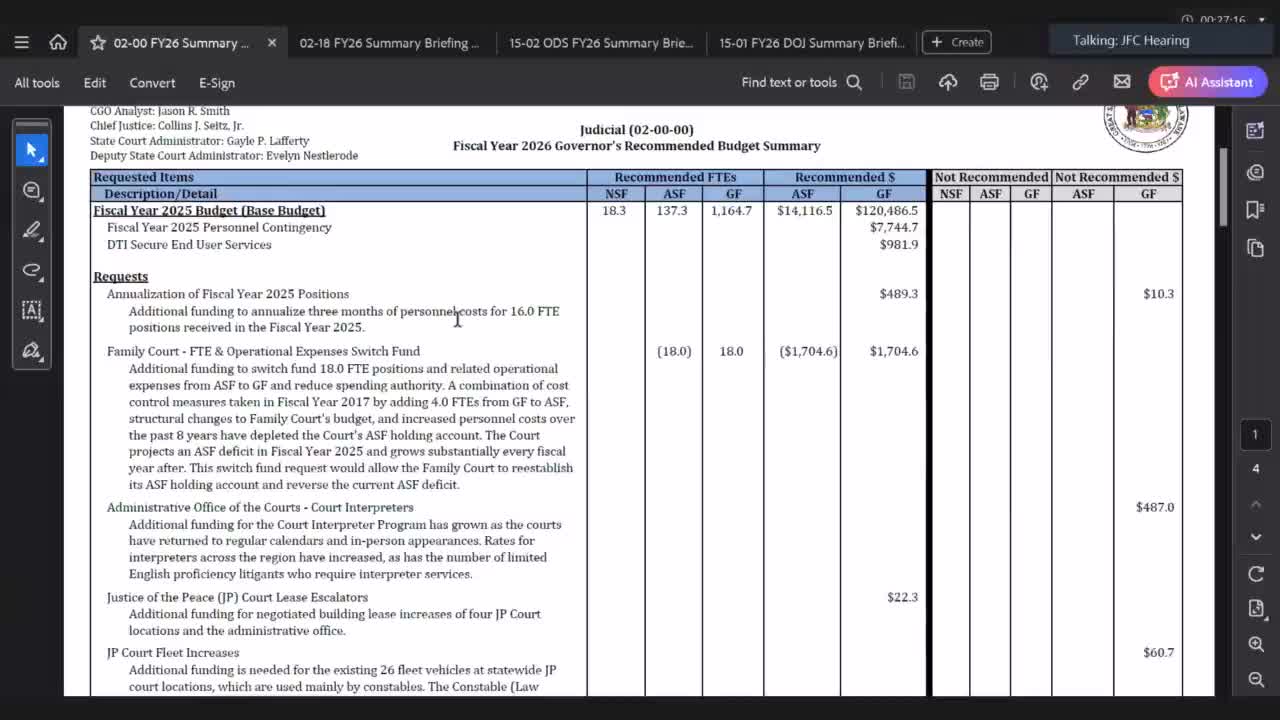
The budget presentation identified multiple recommended and non‑recommended items. The Court of Chancery is in the second year of a two‑year plan to add magistrates and their support teams; the judiciary said the new magistrates increase the court’s capacity to resolve cases quickly and take pressure off vice chancellors. Officials explained some earlier magistrates did not receive full support teams when they were created, and the current request would backfill those teams for existing magistrates as well as staff the newly approved positions.
Budget staff told lawmakers the family‑court and JP‑court fee lines that once supported personnel have seen revenue declines and rising personnel costs, producing projected deficits. Jason, the committee’s presenter on the judicial review, said the family‑court ASF (special fund) “receives money from Title IV‑D from the Social Security Act, which is the Federal‑State Child Support Enforcement Program,” and that revenues have been flat or declining while expenses have increased. As a result, several positions formerly supported by ASF funds have been proposed to be “switch funded” to the General Fund so the courts do not run persistent deficits.
Interpreter services also drew attention. The judiciary said demand has risen as courts return to regular calendars and in‑person proceedings, and that increases in interpreter pay in neighboring states have driven up costs. The budget package showed a $487,000 request for court interpreter services that was not recommended by the Office of Management and Budget; the Chief Justice told the committee the judiciary is funded at about $523,000 for interpreters but expects to spend more than $1 million this year on those services.
The committee also discussed short‑term court relocations and leases tied to space needs in the Leonard L. Williams Justice Center. Brian Maxwell, director of the Office of Management Budget, said a temporary JP‑court location was found on Market Street as part of an interim move while chancery space is reconfigured. The budget includes a modest lease adjustment to support moving JP Court 20 from the seventh floor of the Leonard L. Williams building to nearby leased space while chancery uses that footprint.
Chief Justice Seitz framed the requests as responses to real workload and security pressures. He said the courts are conducting a branch‑wide security audit after a nationwide rise in threats to judges and highlighted the court’s national profile — including frequent expedited, high‑value business cases — as a reason to preserve institutional independence: “I ask you to consider the importance of judicial independence,” Seitz told the committee.
The committee asked staff and the judiciary for follow‑ups on specific line items, including the locations and lease costs for JP court facilities and the revenue outlook for the family‑court ASF lines. Lawmakers also sought more detail on which magistrate positions and support teams had been funded previously and which items are new. The hearing record shows the judiciary will return with additional information on revenue sources and staffing histories.
Looking ahead, the Chief Justice urged legislators to weigh requests in the context of the courts’ expedited dockets and the risks of understaffing: with many business disputes expedited, judges must shift schedules quickly to hear urgent matters. The judiciary said it would brief the committee again during budget markup and provide requested follow‑up on revenue, lease costs and vacancy data.
The committee paused the judicial briefing for later votes and public comment and asked staff to provide the requested financial and location details before final markup.