
Sierra Madre holds community session on furniture, accessibility and makerspace for renovated library
Get AI-powered insights, summaries, and transcripts
Subscribe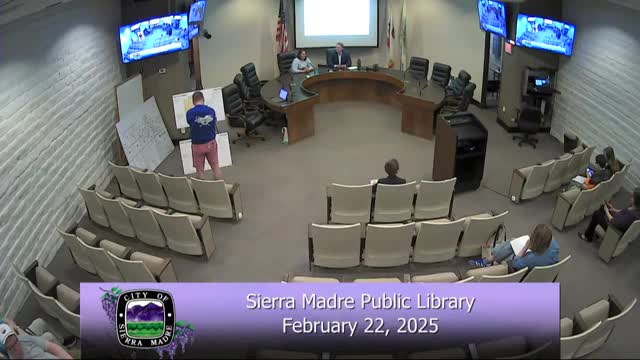
Summary
City staff and TSK Architects presented interior design concepts at a Saturday community meeting, outlined a roughly $1.2 million fundraising target for furniture and equipment, confirmed a makerspace, and sought public input on seating, accessibility and outdoor furnishings.
City staff and consultants on a Saturday morning asked Sierra Madre residents for input on furniture, accessibility and flexible spaces for the city’s renovated library, while outlining a roughly $1.2 million fundraising target for furniture and equipment and confirming a makerspace in the lower-level program area.
The meeting brought together library staff, trustees, designers from TSK Architects and residents to review renderings and ask what types of seating and fixtures the community wants in the children’s room, teen room, quiet reading areas and the community meeting room.
“we really wanna hear from the community about what type of furniture you would like to see in the library,” said Jonathan from TSK Architects, who led the presentation and showed renderings of seating arrangements, study pods, and flexible storage systems.
Why it matters: the furniture, fixtures and equipment (FF&E) are being funded separately through donations and grants rather than the building grant; choices will shape accessibility, programming and how often movable items must be stored or moved between levels.
“This will be the first time our library will be ADA compliant,” said Leila Regan, the city librarian, as staff and consultants emphasized designing for patrons of all ages and abilities. Accessibility consultant Kira Bender urged flexible and sensory-friendly seating for children and teens with disabilities. “Furniture really relates a lot to that… flexible seating, alternative seating… can be a great way to incorporate accessibility,” Bender said.
Budget and procurement April Waltman, introduced as the project’s furniture expert, told the meeting, “with the budget, we're looking at about 1,200,000.0 to include equipment, and that's also with a 20% contingency.” Waltman said the equipment line included about $40,000 that was already on the construction equipment schedule.
The meeting made clear FF&E choices will be guided by fundraising led by the Sierra Madre Library Foundation and donor support; the city has contracted TSK Architects to manage FF&E procurement services. Foundation representatives asked residents to visit SierraMadreLibraryFoundation.org to learn about giving and noted grant opportunities are being pursued to support accessibility-related items.
Program and furniture priorities Staff and residents discussed a range of priorities: soft lounge seating versus standard chairs, movable tables and chairs for the community meeting room, low tables and playful seating for children, group and solitary study options for teens, and storage solutions so furniture can be stowed when spaces are reconfigured.
Leila Regan said the project team had heard strong community interest in a makerspace, and the city “did decide to do a makerspace downstairs,” a flexible, roll-away module that can house 3-D printers, a Cricut and sewing machines and be stored when not in use.
Design details and logistics Jonathan and Waltman said they plan to keep the library’s mid-century modern aesthetic while providing a variety of seating types, including some built nooks and study pods. For the south-facing outdoor reading balcony, Jonathan said the team will specify UV-resistant outdoor furniture because the balcony receives seasonal sun.
Staffing and operations Library staff said the renovated building will include improvements for staff workflow—break room space, a cart corral and dedicated storage for meeting-room furniture—so the team won’t need to roll tables into stacks as in the old building. Staff also noted recurring public programs and requests for power/USB ports in tables; Trustee Catherine Addie suggested movable side tables with built-in USB charging.
Timeline and construction issues Project staff said the construction team found unanticipated conditions in the existing building—undocumented columns, damaged framing and foundation work that required adjustments—but reported they remain generally on track for substantial completion in early 2026. Leila Regan said the temporary library will remain open through January 2026 (possibly into February) and that the very latest full reopening could be June 2026, depending on final coordination and the book-matching process.
Public input and next steps Attendees were invited to leave sticky-note feedback on display boards at the temporary library and to email comments to city library staff. The design team said they will return later with more specific furniture options for community review once budgets and procurement steps are clearer.
Ending: The session closed after roughly 45–50 minutes of presentation and public comment, with staff encouraging further input on seating, sensory-friendly options, and makerspace programming.