Get Full Government Meeting Transcripts, Videos, & Alerts Forever!
Get email alerts on the Rule Change Etv 805f topic
No spam. Unsubscribe anytime.
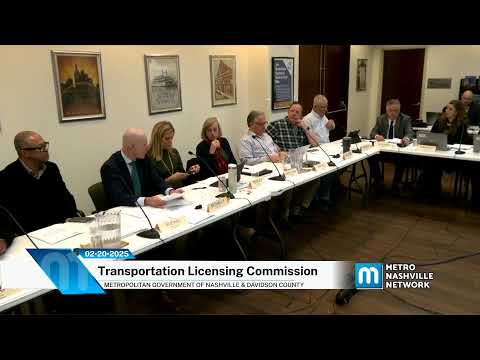
TLC rejects NDOT-backed amendment to allow some sightseeing and party vehicles downtown during 4–6 p.m.
Summary
The Metropolitan Transportation Licensing Commission on Feb. 26 voted to decline a proposed amendment to rule 805(f) that would have permitted some entertainment transportation and sightseeing vehicles to operate in the downtown core between 4 and 6 p.m. after a licensed traffic engineer certified they would keep up with traffic flow.
The Metropolitan Transportation Licensing Commission on Feb. 26 voted to decline a proposed amendment to rule 805(f) that would have let some entertainment transportation and sightseeing vehicles operate in the downtown core between 4 p.m. and 6 p.m. if a licensed traffic engineer’s study showed the vehicle could keep up with the flow of traffic.
The change, advanced by Nashville Department of Transportation (NDOT) staff as part of the Connect Downtown implementation, would have added preapproval of an engineer and a traffic-study requirement to the rule. After public comment and more than two hours of discussion among commissioners, a motion to decline the amendment carried on a voice vote.
Why it matters: The 4–6 p.m. period is a recognized afternoon peak when NDOT said slow-moving vehicles have previously caused severe congestion in the downtown core. NDOT officials told the commission the addendum was intended to let vehicles that demonstrably do not impede traffic re-enter the core without undoing Connect Downtown’s congestion-reduction goals.
At the hearing, Sam Reed, representing Old Town Trolley, said the company’s hop-on, hop-off service carries large numbers of visitors and that the firm’s vehicles and operations differ from party buses. “Our buses hold up to 50 people,” Reed said, adding that restoring service during the early evening would bring customers to downtown cultural institutions and businesses that supplied letters of support.
Opponents of the amendment raised concerns about fairness, cost, enforcement and definition. Michael Winters, who operates sightseeing and party-style electric vehicle tours, warned the proposed process could favor operators that can afford repeated, costly engineering studies and described what he said were route approvals that already let some operators use state-funded WeGo bus stops. “My fear is this is very potentially another rule change that has closed door meetings … that potentially benefit one company,” Winters said.
Janette Barker of the Nashville Downtown Partnership told commissioners she opposed the amendment on traffic and policy grounds, saying slow-moving vehicles “add an undue burden to the thousands of Nashvillians and visitors who are trying to move in, out, and through downtown.” She urged clearer language about where approvals would apply and warned the amendment could push congestion into narrower corridors outside the no-go zone.
NDOT’s presentation came from the agency’s staff member who introduced the Connect Downtown study and the rule addendum. The NDOT representative said the proposed paragraph would require a traffic study by a Tennessee-licensed engineer, preapproval of the engineering methodology by NDOT’s chief engineer, and demonstration that the vehicle “travels at the speed limit and maintain[s] speed to keep up with the flow of traffic, with passengers on board during normal operations.” NDOT staff said methodology meetings, documented in advance, would set the data collection plan and help prevent repeated re-work.
Commissioners focused on several recurring issues: what a study must measure (acceleration, stops, turns and not just top speed), how often studies would need updating, whether smaller operators could afford studies (NDOT staff estimated substantial variation in commercial engineering costs), and who would make final, appealable decisions. Metro legal advised that challenges to NDOT decisions would be brought against Metro and that the commission should ensure that decisions have a reasonable basis.
After deliberation, a motion to decline the NDOT-proposed language in the redlined amendment to section 805(f) passed on a voice vote; commissioners recorded the motion and second and then the chair called for ayes and nay; the amendment was not adopted.
Next steps: The commission recorded several requests for staff to return with more detail — an exemplar methodology, typical cost ranges for traffic studies, and clarity on how NDOT’s chief engineer would review proposed firms and methods. Commissioners asked staff to return with that information at a future meeting so the body could consider whether a narrower or differently worded change would pass.
Votes and formal action: The commission recorded a motion to decline the redlined amendment to section 805(f). The motion was seconded and carried on a voice vote. The amendment as proposed by NDOT was not adopted.
Ending: Commissioners closed the public hearing and agreed to follow up with staff-provided detail in coming weeks. Several public commenters and industry stakeholders left written materials for the commission and asked staff to circulate additional documents for the record.