
Bradenton, Manatee County leaders press gap‑financing plan to serve lower‑wage workers
Get AI-powered insights, summaries, and transcripts
Subscribe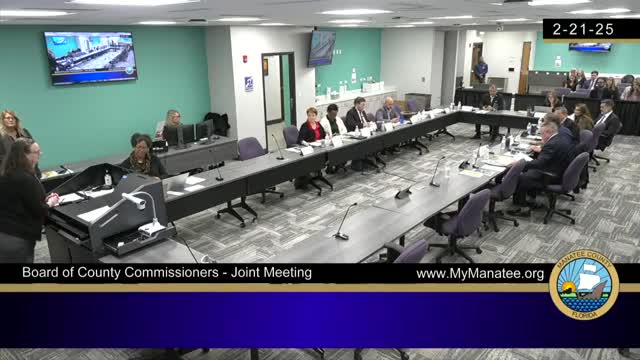
Summary
City and county officials described a pipeline of roughly 600–800 workforce and senior housing units and discussed restoring county gap financing, prioritizing lower‑AMI units for county employees and workers who cannot afford market‑rate rents.
City and county officials at a Feb. 21 joint meeting described a pipeline of workforce and senior housing projects in Bradenton and said Manatee County is working to restore a gap‑financing program to help developers close funding shortfalls.
The discussion focused on whether county gap financing should be targeted to lower Area Median Income (AMI) tiers so workers who earn roughly $17–$20 an hour can afford to live near downtown. "I've had a few people that work within the county that have applied for these 2 developments...they simply didn't make even enough money to qualify for these units here, and they work within the county," Commissioner Jason Bearden said.
The city presented a list of projects it said total about 808 units either built or under construction in the Bradenton‑Manatee area, including Riverview 6 (about 80 units), Astoria (senior, 62+), Lincoln Village, Addison, The MET (199 units) and a 920 project noted as coming online. Rob Perry, city administrator for the City of Bradenton, said many of the completed and planned projects use low‑income housing tax credits, state incentives and developer financing to reach reduced rents that target teachers, nurses and firefighters.
Why it matters: County officials said restoring gap financing — previously used to close deals on projects such as Astoria and Riverview — is one tool to steer development toward lower AMI bands. Several commissioners pressed for mechanics that tie gap funding to deeper affordability (for example, requiring some portion of units at 50–60% AMI when backing market‑rate or 80% AMI units).
Details and debate: Tracy Adams, deputy director of Community and Veteran Services, said county staff are working with the county attorney to draft an application and process for gap funding. "We are in the process of developing a process for gap funding," Adams said. Commissioners and council members raised two recurring issues: (1) qualifying rules and underwriting that make it hard for people who rely on Social Security or who have low monthly earnings to meet developer income thresholds; and (2) the balance between increasing supply at 80% AMI (which several said now approximates market rate) and adding deeper subsidies for lower‑income workers.
Councilman Koger and others said that supply increases help affordability broadly, but several county commissioners urged targeted conditions on county gap funding. Commissioner Bearden proposed exploring ratio‑based requirements (for example, allowing market‑oriented units only if a defined fraction of the project is set aside at lower AMI levels).
Other points: Participants also discussed non‑subsidy tools: modifying minimum lot sizes, reducing minimum parking requirements and using CRA and TIF proceeds to make downtown development more financially feasible. City officials noted the CRA is pursuing incentives to attract a downtown grocer once sufficient rooftops exist. Several speakers said transportation and infrastructure capacity must improve to attract more downtown housing and commercial services.
What’s next: County staff will brief commissioners on the proposed gap‑funding application and process after legal review. City and county elected officials said they will continue coordination on density bonuses, impact‑fee credits and other incentives as draft program rules are developed.
Ending: Officials characterized the meeting as part of an ongoing collaboration; multiple speakers urged faster implementation of a formal gap‑funding program while cautioning that underwriting and program rules will determine whether the units produced are affordable to the county’s lowest‑wage workers.