
Robeson County schools outline local appropriation shortfall; board urged to lobby commissioners
Get AI-powered insights, summaries, and transcripts
Sign Up Free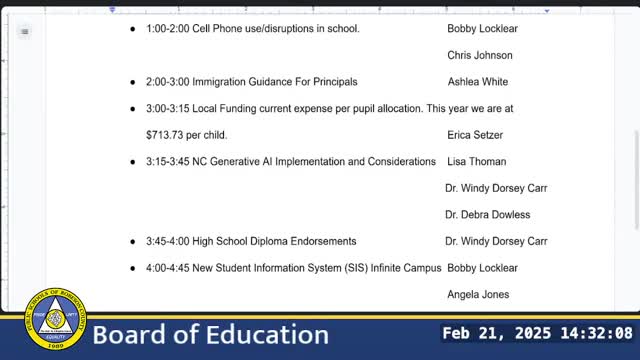
Summary
District finance staff presented local-appropriation history and per‑pupil figures, showing the district received $7.13 in local current‑expense per pupil against a county ability estimate of $25.93; officials asked board members to meet one‑on‑one with county commissioners to press for increased funding.
Public Schools of Robeson County staff on Feb. 21 presented the board with a county appropriations history and independent verification showing the district ranks at or near the bottom in local current‑expense per pupil in North Carolina.
Finance staff provided materials from Public School Forum and a county appropriations history that included the current year (2024–25) increases from the county. The packet showed the district received $653 per child in local funding in 2022–23 in one summary and clarified that the local current‑expense per pupil the district actually receives was $7.13 this year; staff contrasted that with the county’s “ability” figure of $25.93 per pupil.
The presenter, who placed the summary at board members’ seats, said the district ranks 100 of 100 counties on one measure of local appropriations and 90th when low‑wealth state funding is included. She noted low‑wealth is a state allocation that is not local and has different restrictions than county appropriations.
Board discussion focused on how the county’s revenue base affects per‑pupil yields and what the district can show commissioners to support an increase. The district told the board it had requested a $6 million increase over two years (roughly $1,000 per pupil when fully phased in) and that the $1.3 million increase the county provided this year is part of that request. Staff said charter school pass‑throughs are increasing and estimated charter payments could approach $1 million in the coming year because local appropriation increases also flow to charter schools under state law.
Board members asked about areas where the district has pursued efficiencies (site closures, department efficiency efforts) and were told that most of the budget is fixed costs (salaries and benefits account for roughly 82–85% of the total budget) and that rising health‑insurance and retirement costs constrain options. Staff recommended board members pair with county commissioners and hold one‑on‑one meetings to explain the district’s budget pressures.
No formal vote was taken on funding levels. Staff asked board members to partner with commissioners and to provide capital‑outlay requests to central office for planning.