Get Full Government Meeting Transcripts, Videos, & Alerts Forever!
Get email alerts on the Embodied Carbon topic
No spam. Unsubscribe anytime.
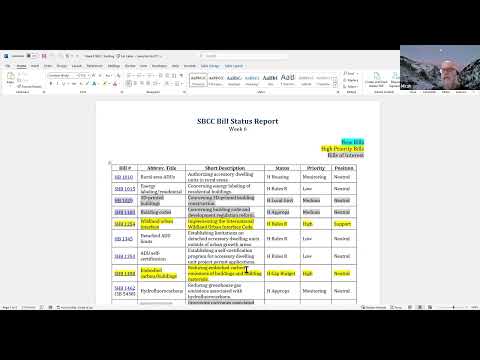
Committee debates technical specifics and emergency-language concerns in embodied carbon bill
Summary
The legislative committee discussed an embodied carbon bill that would direct work on an embodied-carbon appendix for the International Building Code (IBC); members raised concerns that the bill contains technical specifics that could limit flexibility in emergency rulemaking and might be premature relative to ongoing technical work.
On Feb. 20, 2025 the State Building Code Council Legislative Committee examined a bill directing embodied-carbon work for the building code, focusing on whether the proposed statutory language ties the council and its technical groups to detailed, enforceable standards.
Dustin, a staff presenter, summarized the bill changes and said section 7 of the substitute removes a bespoke membership list and instead points to an existing technical work group established in RCW 39.116.050 and to the International Building Code (IBC) tag. "This change here though, identifies an existing technical work group, established in RCW 39.116.050," he said. Dustin also noted potential costs to the Department of Commerce if SBCC work is assigned to that agency’s work group.
Committee members voiced a mix of technical concerns. Several members warned the bill includes specific product and process references — such as limiting acceptable approaches to certain Environmental Product Declarations (EPDs) or materials-based approaches — that could limit rulemaking flexibility and create problems in emergency situations (for example, supply-chain disruption). One member said the legislation "ties our hands" because it names specific standards and products rather than setting high-level policy goals and leaving technical details to code development.
Members asked whether an emergency clause should be included in statute to provide an explicit off-ramp for unanticipated shortages or supply constraints. Dustin and others said the existing administrative procedure and rulemaking framework provides emergency pathways and they were not convinced an emergency clause should be hard-coded in statute. "We do have the emergency pathway," Dustin said, adding the committee currently lacks a reason to expect a statutory emergency clause for this bill.
Some members said the embodied-carbon effort might be premature to codify in statute because the IBC tag and related work groups are still completing technical work. One council member described the bill as "maybe one code cycle premature" and urged caution: finish the technical appendix work, evaluate results, and then consider legislative direction if needed.
Committee members suggested a constructive approach: clarify the bill’s policy goals, reduce prescriptive technical details in statute, and rely on technical groups and the IBC tag to develop implementable code language. Dustin said staff will reach out to sponsors and to the IBC tag to confirm intent and to offer drafting language that points to the tag doing the technical work.
No formal council action or vote occurred at the meeting.