Get Full Government Meeting Transcripts, Videos, & Alerts Forever!
Get email alerts on the Water Supply topic
No spam. Unsubscribe anytime.
Yukon hires Garver for city water-supply evaluation; council approves initial funding and work order
Summary
Council heard a presentation from Garver LLC on a multi-step water-supply evaluation for Yukon, approved a $65,000 budget amendment for this year and a $158,390 work order to start the study, and voted to add the Yukon Municipal Authority to Garver’s master agreement.
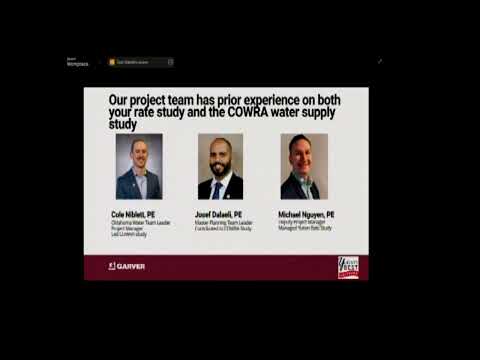
Cole Niblett, project manager for Garver LLC, told the Yukon City Council on a February night in 2025 that Garver will produce a 20- and 50-year water-supply plan for the city and laid out a four‑task process: baseline development, existing system assessment, alternatives evaluation and final plan development.
The council approved an initial budget amendment of $65,000 to begin the project and authorized work order No. 2 for Garver for a total engagement amount of $158,390, with the remainder of the contract to be budgeted in next year’s budget. Council members also approved an amendment to Garver’s master agreement to include the Yukon Municipal Authority so the municipal utility can participate in the study.
Niblett said the study will update Yukon’s demand projections and compare them to existing infrastructure and water rights to create a “gap analysis,” then develop and screen a long list of supply alternatives. “We’ll look at expanding your well field, other groundwater sources, surface water options and even potable or nonpotable reuse where feasible,” he said. He proposed major staff workshops after each phase and a schedule that would deliver a draft water supply plan about 60 days after the alternatives workshop, with a final report and presentation to council to follow.
Councilmember Shelly Selby raised the Cowra (CALRA) study of the region and asked whether the same limits — few viable alternatives and high costs for options like arsenic treatment — still applied. “I talked to them last week, and it was not cost efficient,” Selby said, referring to Mustang’s arsenic treatment. Niblett said the Cowra study’s multijurisdictional coordination challenges will be less acute for a Yukon‑only plan and noted newer treatment technologies have reduced unit costs for arsenic removal.
City Manager Mike Castro confirmed Garver’s proposed schedule and described the intended funding path: the $65,000 approved this year will come from increased water fees the city has planned; the remainder of the Garver contract would be budgeted in the next fiscal year. Castro told the council the city expects to phase work so capital outlays align with demand triggers in the study.
Votes at the meeting: the council approved the $65,000 budget amendment (Selby voted No; Wooten, Pilmore, Shriver and Zimmerman voted Yes), approved the Garver master‑agreement amendment adding the Yukon Municipal Authority (unanimous among members voting), and approved work order No. 2 for Garver for $158,390 (unanimous among members voting). The council record did not name who made or seconded the motions in the minutes.
Niblett said Garver will request key data from city staff and deliver the first workshop about 90 days after the city provides requested materials. The study will produce capital‑outlay schedules and phased implementation and aims to tailor costs and projects so the city can time investments to when demand triggers are reached.
The council directed staff to proceed with the Garver engagement. The study’s final recommendations and any capital funding requests will return to council for separate approval.