
Site & Finance committee: five‑year forecast shows strong fund balance but administrators to advance K–12 technology fee recommendation and approve device and R
Get AI-powered insights, summaries, and transcripts
Subscribe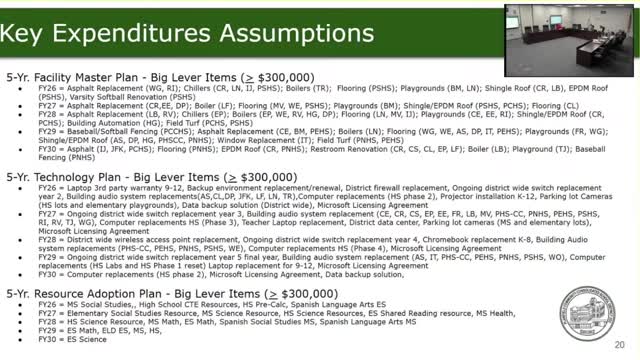
Summary
At a Feb. 19 Site & Finance committee meeting, Plainfield SD 202 reviewed a five‑year forecast showing overall fund balances above policy targets when unaudited totals are viewed raw, but within policy once board‑designated restrictions are removed; the committee approved large device purchase and deployment agreements and agreed to forward a K–12 technology fee recommendation to the full board.
At a Feb. 19 Site & Finance meeting, Plainfield SD 202 financial and operations staff presented a five‑year budget forecast, described the district’s fund‑balance strategy and secured committee approval for vendor agreements tied to a major Chromebook replacement and related deployment services.
Forecast and fund balance Finance staff presented a multi‑year projection that showed the district’s unaudited FY‑24 ending fund balance above the upper policy target (50% of expenditures) but explained that, after subtracting board‑designated restrictions (tier funding set‑asides, restricted medical self‑insurance reserves, lease certificates and other restricted balances), the operating fund balance falls within the district’s policy range (30%–50%). The CFO explained the board’s two‑phase fund‑balance strategy adopted in October: Phase 1 (fiscal discipline and scenario building) and Phase 2 (levy abatement/strategy) and noted no immediate corrective action was required because restricted items account for the excess.
Revenue and expenditure drivers Staff said the largest revenue drivers are property tax growth and the CPI factor used for the levy; a 1‑point CPI change equates to about $2 million in levy revenue. Transportation reimbursements and evidence‑based (tier) funding also affected the FY‑25 adjusted revenue estimate. On the expenditure side, salaries and benefits dominate the forecast; a 1% salary increase across the board raises costs by roughly $2.1 million, and a 1% increase in insurance costs raises expenses by about $400,000. Technology and facilities multi‑year plans — including a technology refresh and textbook/curriculum adoptions — account for large capital and operating needs in the projection.
Device procurement and deployment The committee approved vendor agreements for a major Chromebook refresh and associated deployment services from Dell and related partners. District technology staff explained the year’s purchase will replace tens of thousands of devices across grade bands and that a shift to Chrome OS devices reduced per‑unit cost compared with Windows alternatives. The committee discussed a separate deployment and multi‑pack/warehouse service with Dell to handle storage, multi‑packing and staging; staff said the logistical cost is driven by volume, onsite storage capacity limits and manpower for device prep. The district estimated that multi‑year device cycles and the summer influx of equipment require external staging and packaging services to meet deployment timelines.
School technology fee debate Committee members revisited a previously proposed $50 technology fee. Administration’s recommendation (to be advanced to the full board) was to adopt a K–12 technology fee (i.e., extend the current K–8 fee to high schools), but committee members debated alternatives including keeping only the K–8 fee, adopting K–12 fees, or eliminating the fee entirely. Administration presented revenue estimates: roughly $882,900 in potential revenue from K–8 and about $313,000 from adding high school fees (estimates factored in a portion of fee waivers for low‑income families). Committee members also raised broader concerns about transparency and asked that all school‑level fees (athletics, music, extracurriculars) be posted centrally so families can see potential charges in advance. Committee members agreed to forward the technology‑fee recommendation (administration’s K–12 proposal) to the full board for a vote and asked administration to provide a clearer public listing of ancillary fees districtwide.
Other items The committee approved standard monthly financial reports, payment of bills, donations and disposal of assets. Staff reminded the committee that the district will host a budget workshop and will present an updated enrollment projection in March.
Ending: Finance staff said they will bring the FY‑26 proposed budget and the technology‑fee recommendation to the full board for action next month and will continue to refine device deployment plans and the capital forecast.